What should you check?
Set the finished-drink volume first, then compare preparation directions and labels for products that could make that batch.
| Priority | What to check | Your needs |
|---|
| Batch yield |
Check servings per pack and liquid per serving; multiply them to estimate finished volume at the stated recipe. Sainsbury’s lists Cadbury Instant 300 g as 14 servings made with 200 ml water each, or 2.8 litres. |
I’m making six UK pints of finished drink, about 3.41 litres, so one Cadbury Instant 300 g jar would not cover the batch at its stated serving size. |
| Preparation |
Check whether the exact powder is prepared with water or hot milk, and how much liquid its directions specify. |
If I already have milk for the drinks, a milk-mixed powder may suit the plan. Otherwise, I’d check a water-prepared option. |
| Milk allergens |
Read the current ingredients and precautionary allergen statement. Cadbury Instant lists milk-derived ingredients; Cadbury Original Drinking Hot Chocolate states that it may contain milk. |
Someone drinking the batch has a milk allergy, so I need to check the exact pack rather than judge it by whether the recipe uses water. |
| Nutrition basis |
Compare sugars or energy only with the serving size and preparation method alongside them. Sainsbury’s lists 17 g sugars per Cadbury Instant serving prepared with 200 ml water; Marks & Spencer states 38 kcal per serving for its Low Calorie Instant Hot Chocolate, without a directly comparable serving volume. |
I’m comparing labels and want to know what each figure represents before treating two servings as equivalent. |
Relevant brand references
These product-line examples help distinguish pack formats and preparation methods; a brand name alone does not establish batch yield or allergy suitability.
Cadbury
Sainsbury’s lists a 300 g Instant Hot Chocolate jar prepared with water and a 500 g Original Drinking Hot Chocolate pack mixed with hot milk.
- The instant jar states 14 servings made with 200 ml water each.
- That stated yield is 2.8 litres, below six UK pints; the drinking-chocolate directions do not establish a finished-volume yield.
Sainsbury’s
Its own-label Instant Fairtrade Hot Chocolate appears in a 350 g pack on the Sainsbury’s listing.
- The pack offers an own-label instant format to consider for a large batch.
- Check that exact pack’s preparation directions, yield and ingredients before deciding how many you need.
Galaxy
Sainsbury’s lists Galaxy Instant Hot Chocolate in a 370 g jar.
- Its instant format provides another pack to compare by the directions on its label.
- Confirm the serving volume and ingredients for the exact Galaxy variant rather than transferring details from another instant powder.
Options
Sainsbury’s lists Options Instant Belgian Hot Chocolate Drink in a 220 g pack.
- The smaller listed format may be relevant if you are buying for a different number of drinks.
- Use the exact pack’s serving directions to see how it fits a six-pint batch.
M&S
Marks & Spencer lists a 300 g Drinking Chocolate made with hot milk and a 200 g Low Calorie Instant Hot Chocolate.
- Marks & Spencer states 41% cocoa powder for its Drinking Chocolate and 38 kcal per serving for its Low Calorie Instant product; those figures describe different products and measures.
- The Drinking Chocolate is labelled unsuitable for someone with a milk allergy, and the Low Calorie Instant product contains milk-derived ingredients.
Hot chocolate options on Joybuy
These options include one instant hot chocolate and two 500 g drinking-chocolate powders. For a six-pint batch, check each pack’s directions and yield rather than assuming the same powder weight makes the same volume.
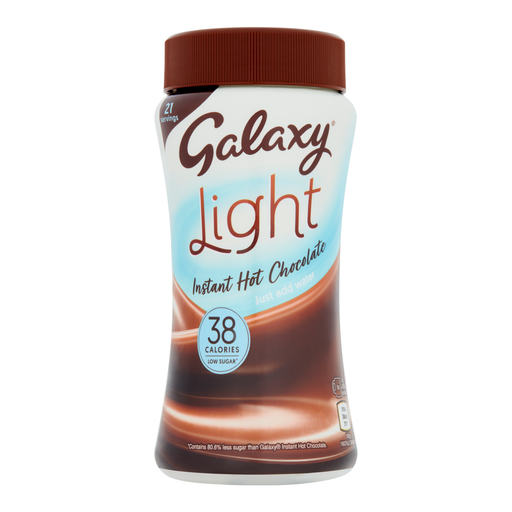 Image unavailable
Galaxy Light Instant Hot Chocolate 210 g
If you plan to prepare a large batch with water, check this instant powder’s pack directions and calculate how many 210 g packs the required number of servings would take. Check the current label for milk, soya and barley allergen information.
View on Joybuy
 Image unavailable
Cadbury Drinking Chocolate 500 g
If you plan to make the batch with hot milk, check this 500 g pack’s powder and liquid directions before working out its finished volume. The pack weight alone cannot confirm six UK pints; read the current milk allergen statement too.
View on Joybuy
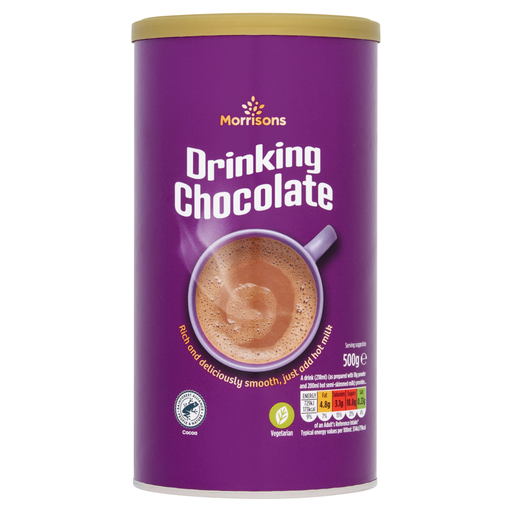 Image unavailable
Morrisons Drinking Chocolate 500 g
For a six-pint batch, check the dose and liquid quantity on this 500 g pack before deciding how many packs to use. Confirm its preparation instructions and current allergen label on the pack.
View on Joybuy
Frequently asked questions
Will one 300 g Cadbury Instant jar make six UK pints?
No, not at the stated recipe. Sainsbury’s lists 14 servings made with 200 ml water each, giving 2.8 litres; six UK pints are about 3.41 litres. If that is your required finished volume, you would need two jars at the stated serving size.
Is a 500 g drinking-chocolate tub enough for six pints?
Pack weight alone cannot answer that. Sainsbury’s gives directions to mix Cadbury Original Drinking Hot Chocolate with hot milk, but those directions do not establish how much finished drink the 500 g pack makes. Check the pack’s dose and liquid quantity for the batch you intend to prepare.
Should I choose instant powder if I do not plan to use milk?
Choose a product whose directions explicitly use water, such as the Cadbury Instant 300 g jar listed by Sainsbury’s. Cadbury Original Drinking Hot Chocolate is directed to be mixed with hot milk. Check the serving yield separately, and do not assume a water recipe means the powder is free from milk ingredients.
Does “instant” or “low calorie” mean milk-free?
No. Sainsbury’s lists milk-derived ingredients in Cadbury Instant, and Marks & Spencer lists whey permeate and dried skimmed milk in its Low Calorie Instant Hot Chocolate. For a milk allergy, check the current physical pack’s ingredients and precautionary allergen statement.


