Home bakers following a recipe
Choose the cocoa powder or drinking-chocolate format the recipe names. Sweetened drinking chocolate and instant powder need not behave like recipe cocoa in a bake.


For home baking, start with the cocoa powder or drinking chocolate specified by the recipe; an instant mix prepared for mugs is not a direct substitute. If you need six pints of prepared drink, use the chosen product’s powder-to-liquid directions to work out the quantity rather than assuming that a powder pack represents a six-pint bottle or a standard yield.
Choose the cocoa powder or drinking-chocolate format the recipe names. Sweetened drinking chocolate and instant powder need not behave like recipe cocoa in a bake.
Check the pack weight and the amount of powder used per mug before deciding how much to buy. Different instant mixes can call for different amounts of powder with the same volume of water.
Read the current pack when allergens or other ingredients matter. Tesco lists milk and soya for Galaxy Instant Hot Chocolate, while Options Belgian Choc listings declare milk and a source of phenylalanine.
Decide whether the purchase is primarily for a bake or for prepared drinks, then check the exact product’s ingredients and preparation directions.
| Priority | What to check | Your needs |
|---|---|---|
| Recipe format | Check whether the recipe specifies cocoa powder or drinking chocolate. Read the ingredients before substituting a sweetened or instant mix. | I want the chocolate ingredient to match my recipe, rather than changing the sweetness or texture without testing it. |
| Required quantity | Clarify whether six pints means finished drink or a liquid container. Compare the pack weight with its stated powder-to-liquid directions; Tesco specifies 25 g of Galaxy powder per 200 ml hot water, while Twinings specifies 11 g of Options per 200 ml water. | For several mugs, I need to know how much powder the chosen instructions use before deciding how many packs to buy. |
| Ingredients | Read the current ingredient and allergen statements. Tesco lists milk and soya for Galaxy; Options Belgian Choc listings declare milk and a source of phenylalanine. | Someone in my household may need to avoid a particular ingredient, so the label on the pack I buy matters. |
| Preparation | Check whether the product is intended for a mug made with water or for the use specified by your baking recipe. Keep the product’s stated serving amount alongside any pack-size comparison. | I may need a quick drink on one occasion and an ingredient for baking on another; those uses call for different checks. |
UK listings from Tesco and Sainsbury’s identify these powders by weight, while preparation amounts vary between products. Pack weight alone does not state the finished drink volume.
Decide whether you mean six pints of prepared drink or a liquid container, then use the exact product’s directions to plan the quantity.
Drinking chocolate can contain sugar, and instant mixes can contain other ingredients intended for mug preparation. A direct swap can change a bake.
Use the format named in the recipe where possible. If you substitute, account for the other ingredients and test a small batch.
Tesco gives 25 g of Galaxy powder with 200 ml hot water; Twinings gives 11 g of Options with 200 ml water. The same liquid volume therefore does not imply the same amount of powder per mug.
Use each product’s own serving instructions when estimating how far a pack will go.
Ingredients and allergen statements can differ between products and can change over time. Galaxy listings declare milk and soya; Options Belgian Choc listings declare milk.
Check the current physical pack’s ingredients, allergens and advisory statements before use.
These ranges illustrate formats to compare; a familiar brand name does not tell you whether a particular product suits a baking recipe.
Sainsbury’s lists Cadbury Original Drinking Chocolate in a 500 g pack.
Tesco lists a 370 g instant hot chocolate with directions for a water-based mug.
Twinings lists Options Belgian Choc as a 220 g instant-powder jar.
Tesco’s hot-chocolate listings include own-label instant powder alongside branded products.
Sainsbury’s lists cocoa powder, instant hot chocolate and drinking chocolate as distinct products.
Marks & Spencer lists cocoa powder separately from its hot-chocolate blends and describes its dark blends as options for adding richness to bakes.
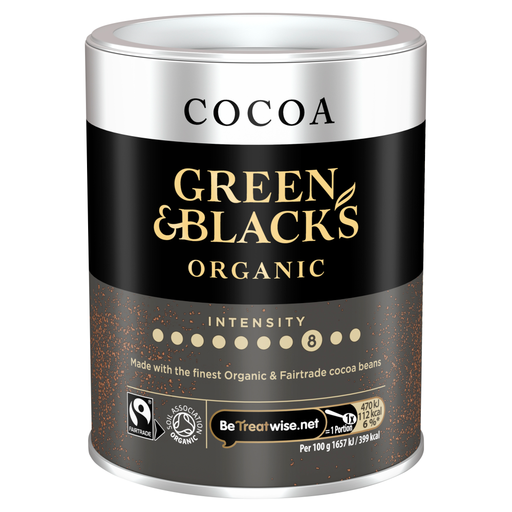
This cocoa-powder option is relevant when a baking recipe calls for cocoa powder. Its 125 g pack weight does not, by itself, establish how much prepared drink it would make.
 No image available
A cocoa-powder option for a recipe that calls for cocoa powder. Measure the 125 g pack against the recipe quantity rather than assuming a six-pint prepared-drink yield; check the current pack’s milk advisory wording if milk avoidance matters.
Do not assume that a gram-weighted powder pack represents a six-pint bottle. Tesco and Sainsbury’s list hot-chocolate products by pack weight; if you need six pints of prepared drink, check the chosen product’s directions, or check a specific liquid product’s stated volume.
Use the format specified by the recipe where possible. Cadbury drinking chocolate contains sugar as well as cocoa, while Galaxy and Options instant products have directions for water-based drinks; do not swap them for recipe cocoa without accounting for their other ingredients and testing the result.
Read the current physical pack’s ingredient, allergen and advisory statements before use. Tesco lists milk and soya for Galaxy Instant Hot Chocolate, while Options Belgian Choc listings declare milk and a source of phenylalanine; an older online listing is not a substitute for the pack you buy.
Follow the directions on the individual pack. ASDA’s listing for Options Belgian Choc says to store it in a cool, dry place; check the pack for any further storage and best-before instructions.