First-time grocery shoppers
If hot chocolate is going into your first food-shop basket, compare the fat, sugars and calories for the drink you will make. A low-calorie name does not, by itself, settle which product has less fat.


Compare the drink as prepared, rather than choosing by a “light” or “low calorie” name. Sainsbury’s lists 0.8g fat for an Options Belgian Hot Chocolate serving made with 11g powder and 200ml water; Tesco lists 1.0g fat, but fewer sugars and calories, for a prepared 211g serving of Cadbury Highlights Milk Chocolate Drink 180g. The serving bases differ, so check the current packs—and weigh ingredients and flavour alongside the figures—before deciding which suits your first shop.
If hot chocolate is going into your first food-shop basket, compare the fat, sugars and calories for the drink you will make. A low-calorie name does not, by itself, settle which product has less fat.
The cited Options serving has less declared fat than the cited Cadbury Highlights 180g serving, while the Cadbury serving has fewer declared sugars and calories. Check the different serving bases before making either figure your deciding factor.
If milk ingredients or sweeteners matter to you, read the current pack rather than relying on “light” or “low calorie” wording. The cited Options and Cadbury Highlights products list milk-derived ingredients and sweeteners.
Start with the preparation instructions, then compare the nutrition and ingredients for the serving you would actually make.
| Priority | What to check | Your needs |
|---|---|---|
| Fat per mug | Check fat and saturates for each stated prepared serving, including its powder quantity and liquid. Sainsbury’s lists 0.8g fat for Options made with 11g powder and 200ml water; Tesco lists 1.0g for a prepared 211g serving of Cadbury Highlights 180g. Those serving bases are not identical. | I want to compare the drink I will make, not a dry-powder figure with a prepared-mug figure. Where traffic-light labelling appears, I can use it as a starting point and still check the serving basis. In the Food Standards Agency and Ipsos Northern Ireland’s 2024 survey, 49% of 611 adults interviewed in Northern Ireland between September and November said they actively used traffic-light labelling when shopping for food; that figure is not specific to hot chocolate. |
| Sugars and calories | Read both lines for the stated preparation. Tesco lists 2.7g sugars and 38 kcal for the prepared Cadbury Highlights 180g serving; Sainsbury’s lists 5.7g sugars and 40 kcal for the stated water-made Options serving. | If sugars or calories matter alongside fat, I want to see all three figures before choosing. The product with the lower declared fat figure here does not also have the lower declared sugars or calories. |
| Preparation | Check how much powder and which liquid the nutrition figures cover. If you use milk or a milk alternative instead of the stated water preparation, the finished drink will differ from the listed water-made serving. | Will I make it as the label describes? That determines whether the printed prepared-serving figures describe my mug. |
| Ingredients | Read the current ingredients and allergen statement, particularly for milk-derived ingredients and sweeteners. Do not infer either from “light” or “low calorie” on the front of a pack. | I need to know what is in the product, not just its nutrition figures. If I must avoid an ingredient, the current pack is the check that matters. |
A smaller fat number is not a fair comparison if one label describes powder and the other describes a finished mug. Even the cited prepared servings differ: Options specifies 11g powder with 200ml water, while the Cadbury Highlights 180g figure is for a prepared 211g serving.
Compare each product’s preparation instructions and the basis of its nutrition panel before deciding what the numbers mean for your mug.
Sainsbury’s lists less fat for the stated Options serving than Tesco lists for Cadbury Highlights 180g, but the cited Options serving has more sugars and calories.
Decide whether fat, sugars, calories or a combination matters to you, then read those lines together on the prepared-serving label.
The cited Options and Cadbury Highlights products list milk-derived ingredients and sweeteners. Front-of-pack positioning is not an ingredient or allergen statement.
Check the current ingredients and allergen declaration whenever you buy, especially if you need to avoid milk.
Recipes and product information can change, so an earlier online nutrition panel may not describe the pack you receive.
Use a listing to narrow your choices, then check the current pack’s serving instructions, nutrition, ingredients and allergens.
These are branded and supermarket-own-label reference points for the label comparison, not a ranking of whole brands.
Cadbury Highlights Milk Chocolate Drink 180g is an instant option with prepared-serving figures listed by Tesco Groceries.
Options Instant Belgian Hot Chocolate Drink 220g has a specified water-made serving on the Sainsbury’s listing.
M&S Low Calorie Instant Hot Chocolate is another instant option to assess by its current pack.
Tesco Groceries lists Tesco Lighter Hot Chocolate alongside branded products in its reduced-sugar and low-calorie hot-chocolate category.
Sainsbury’s lists a Low Calorie Instant Fairtrade Hot Chocolate 250g among its own-label options.
Tesco Groceries lists Galaxy Light Instant Hot Chocolate 210g in its reduced-sugar and low-calorie category.
These instant hot chocolates are options for a first food shop. Check each current pack’s prepared-serving figures before choosing one for a lower-fat mug.
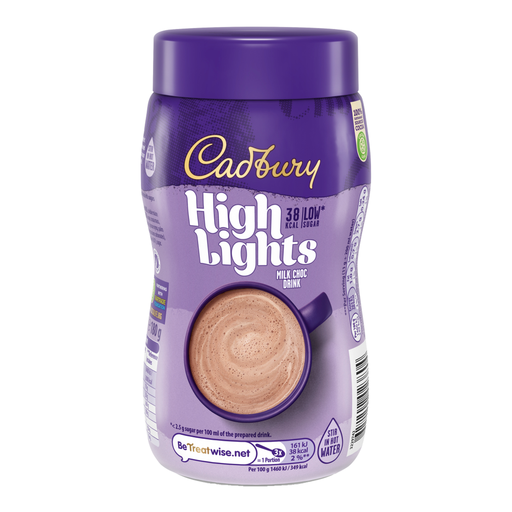 No image available
For a first-shop drink where sugars and calories matter alongside fat, Tesco Groceries lists 1.0g fat, 2.7g sugars and 38 kcal for a prepared 211g serving of this 180g product. Check the current pack’s preparation, nutrition and ingredients, including milk and sweeteners.
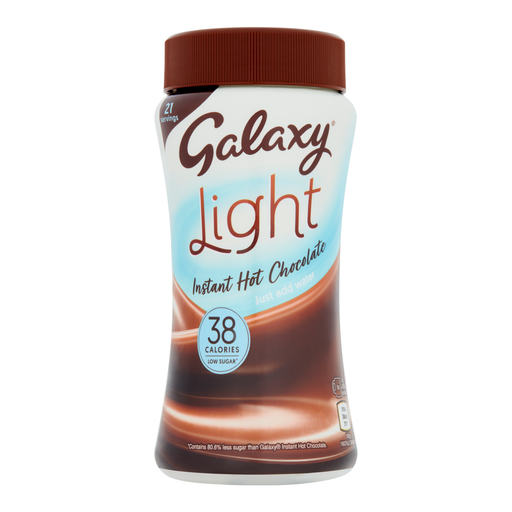 No image available
This instant option belongs in a first-shop comparison, but its “Light” name is not a fat-per-mug figure. Check the current pack for nutrition per prepared serving and for milk, barley gluten, soya and sucralose if those ingredients matter to you.
No. Sainsbury’s lists 0.8g fat and 40 kcal for an Options Belgian Hot Chocolate serving made with 11g powder and 200ml water; Tesco lists 1.0g fat and 38 kcal for a prepared 211g serving of Cadbury Highlights Milk Chocolate Drink 180g. The serving bases differ, so check preparation as well as fat, sugars and calories.
The stated nutrition applies to the stated preparation. The cited Options figures use 200ml water, while the cited Cadbury Highlights 180g figures describe a prepared 211g serving. Making a product with milk or a milk alternative instead of its stated water preparation changes the finished drink, so the printed water-made figures no longer describe it exactly.
Check fat, saturates, sugars and calories on the same preparation basis. GOV.UK explains that, where traffic-light labelling appears, green means low, amber medium and red high for the labelled nutrient. Still read the serving size and mixing instructions before comparing two products.
Do not assume so: the cited Cadbury Highlights and Options products include milk-derived ingredients, and Marks & Spencer lists milk in its Low Calorie Instant Hot Chocolate ingredients. If you need to avoid milk, read the current pack’s allergen statement for the exact product before buying.