Students organising shared drinks
If several mugs will be made in a shared kitchen or society room, pack size and the available preparation facilities matter.


A 400–500g pack is a useful starting point when several people will have hot chocolate at a university lecture lunch. Check the preparation instructions against the facilities available: some drinking chocolates call for hot milk. A smaller lower-calorie product may suit a specific preference, but check its pack size and the exact pack’s allergen information before serving a group.
If several mugs will be made in a shared kitchen or society room, pack size and the available preparation facilities matter.
A smaller jar or sachet may meet a particular product preference. Check its serving information and pack size separately.
Check the ingredients and allergen statements on the exact pack before preparing drinks for others.
For a lecture lunch, settle the preparation and allergen questions before deciding which pack format to bring.
| Priority | What to check | Your needs |
|---|---|---|
| Shared-pack size | Check the net weight and the preparation quantity per mug. Tesco Groceries lists shared-format examples at 400g and 500g, as well as smaller options. | I’m making several mugs and want to choose a pack size that fits the group. |
| Preparation | Read the directions for the exact product and check whether hot milk is needed. Tesco’s Cadbury Drinking Chocolate 2kg listing and Marks & Spencer’s Drinking Chocolate 300g page both specify hot milk. | We may have a kettle and mugs, but I need to know whether hot milk will also be available. |
| Serving information | Compare the stated serving size, nutrition information and ingredients on the products you are considering. Marks & Spencer states 38 kcal per serving for its Low Calorie Instant Hot Chocolate 200g; that figure applies to that product’s stated serving. | If a lower-calorie product is the priority, I still want to know how its pack size fits our plans. |
| Allergens | Read the current pack’s ingredients and precautionary statements before preparation. The Food Standards Agency identifies milk and soya among allergens covered by UK food-information requirements. | I’m serving other people and need to check the specific product before offering it to anyone with a food allergy. |
A large tub does not tell you how many mugs it will make at the preparation quantity you intend to use.
Check the serving directions and decide how many drinks you plan to prepare before choosing a format.
Some drinking chocolates specify hot milk. That changes the preparation plan for a lecture lunch with only a kettle.
Read the directions for the exact pack and confirm that you can prepare it at the venue.
Lower-calorie products address a different preference from buying one pack for several people. Tesco Groceries lists Options jars and sachets in smaller formats than its 400g instant hot chocolate.
Compare the pack weight and stated serving information as well as the product label.
Allergen statements differ by product. Tesco’s Cadbury Drinking Chocolate 2kg listing says it may contain milk, while Marks & Spencer states that its Drinking Chocolate 300g is not suitable for people with a milk allergy.
Read the exact pack immediately before preparation; do not serve it to an allergy-affected person if its suitability is uncertain.
These ranges illustrate different pack formats and preparation requirements; a brand name alone does not establish which product suits the group.
Tesco Groceries lists a 500g Hot Chocolate Cocoa Powder and a separate 2kg Drinking Chocolate.
Tesco Groceries lists Galaxy Instant Hot Chocolate Drink 370g and Galaxy Light Instant Hot Chocolate 210g.
Tesco Groceries lists Options 220g jars and 11g sachets in its reduced-sugar and low-calorie hot-chocolate category.
Marks & Spencer lists Low Calorie Instant Hot Chocolate 200g and Drinking Chocolate 300g as distinct products.
Tesco Groceries lists its own-label Instant Hot Chocolate 400g and Lighter Hot Chocolate 270g.
These two 500g drinking chocolates fit a plan to prepare several mugs where hot milk is available. Check each pack’s directions and allergen information before serving.
 No image available
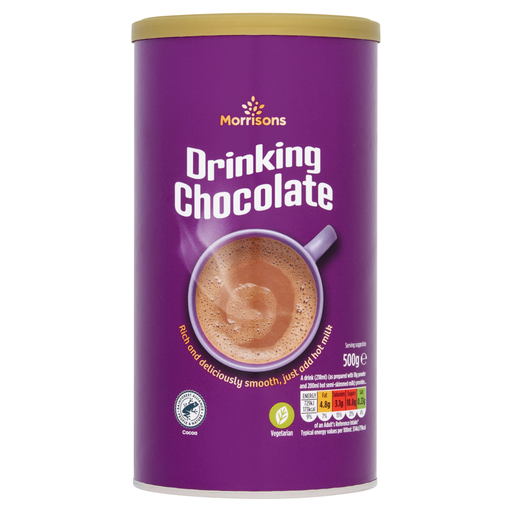
The 500g pack is a format to consider when preparing drinks for a group. This option calls for hot milk; check the exact pack’s preparation directions and milk-allergen statements before serving.
 No image available
The 500g pack is a format to consider for shared drinks when hot milk is available. Check the pack for the quantity needed per mug and its current allergen information before preparing it for others.
It is a starting point for making several mugs, rather than a guaranteed number of servings. Check the product’s quantity per mug, the number of people attending and the facilities available for preparation.
No preparation method should be assumed for every product. Tesco’s Cadbury Drinking Chocolate 2kg listing and Marks & Spencer’s Drinking Chocolate 300g page both specify hot milk, so read the directions for the pack you plan to bring to a kettle-only venue.
Not by itself: check its pack size and serving information separately. Marks & Spencer states 38 kcal per serving for its Low Calorie Instant Hot Chocolate 200g; that serving figure does not describe other products or determine how many drinks your group needs.
Read the exact pack’s ingredients and allergen statements immediately before serving, and do not serve a product if its suitability is uncertain. Allergen warnings are product-specific: Tesco’s Cadbury Drinking Chocolate 2kg listing says it may contain milk, while Marks & Spencer labels its Drinking Chocolate 300g unsuitable for people with a milk allergy.
Follow the instructions on that pack. The Marks & Spencer Drinking Chocolate 300g and Low Calorie Instant Hot Chocolate 200g pages specify a cool, dry place and use within four weeks of opening; instructions for another product may differ.