Households with a Tassimo or Dolce Gusto machine
Check the machine before choosing a pack. Tassimo T DISCs and Dolce Gusto-compatible capsules are different formats, and a Dolce Gusto drink may use either one or two capsules per mug.


Choose a hot-chocolate pod that fits the machine you already own: Cadbury uses a Tassimo T DISC, while Galaxy and Chococino are for Dolce Gusto machines. Galaxy uses one pod per drink, but Chococino uses two per mug; compare finished servings, preparation instructions and current ingredient labels, particularly when milk or soya must be avoided.
Check the machine before choosing a pack. Tassimo T DISCs and Dolce Gusto-compatible capsules are different formats, and a Dolce Gusto drink may use either one or two capsules per mug.
Look at the number of finished drinks and the prepared serving size. A capsule count alone does not tell you how many mugs a pack makes.
Read the current ingredients and allergen information before serving. The Cadbury, Galaxy and Chococino products discussed here contain milk ingredients; Galaxy and Chococino also list soya lecithin.
Start with machine compatibility, then compare how each pack makes a finished drink and what its current label says.
| Priority | What to check | Your needs |
|---|---|---|
| Machine format | Match Tassimo T DISCs to a Tassimo machine or Dolce Gusto-compatible capsules to a Dolce Gusto machine. Check the compatibility wording on the pack. | I want pods that fit the machine already in the kitchen, rather than choosing by flavour alone. |
| Finished drinks | Check pods per mug and declared servings. Tassimo lists 10 cups for its Cadbury pack; Sainsbury’s lists eight one-pod Galaxy drinks; NESCAFÉ Dolce Gusto says Chococino’s 16 capsules make eight mugs using a chocolate and a milk pod for each. | If I am planning several after-school drinks, I need the finished-drink count, not just the number of capsules. |
| Prepared serving | Compare each drink as prepared, including its stated volume. Tassimo declares 7.4 g sugars per 225 ml Cadbury serving; Sainsbury’s declares 10 g per 150 ml Galaxy drink; NESCAFÉ Dolce Gusto declares 14.8 g per Chococino mug. These are different serving bases. | I want to know what is in the drink I will actually prepare, rather than comparing figures without their serving sizes. |
| Ingredients | Read the current label for milk and soya. The stated Cadbury ingredients include skimmed milk powder; Galaxy lists milk-derived ingredients and soya lecithin; Chococino’s milk pod lists whole milk powder and soya lecithin. | Milk or soya may rule out a product for my household, so I need to check the particular pack before serving it. |
| No compatible machine | Consider a non-pod format instead. Twinings lists Options hot chocolate in jars and sachets; check the chosen product’s preparation directions and ingredients. | Without a compatible pod machine, I would rather choose a format I can prepare with the equipment at home. |
A Chococino pack contains 16 capsules, but NESCAFÉ Dolce Gusto specifies one chocolate pod and one milk pod per mug, making eight mugs.
Compare the declared number of servings and the preparation method before choosing a pack.
Cadbury Tassimo T DISCs and Galaxy Dolce Gusto-compatible capsules use different machine formats.
Match the compatibility wording on the pod pack to the machine you own.
The declared sugars for Cadbury, Galaxy and Chococino refer to differently prepared drinks, including stated servings of 225 ml for Cadbury and 150 ml for Galaxy.
Read each prepared-drink declaration alongside its volume and recipe before drawing a comparison.
A drink chosen for home use has not thereby been assessed against requirements for food and drink provided through a school.
For an organised school snack, ask the provider to check the applicable school-food requirements, its allergy policy and the current product specification.
Check the particular product and format: a brand name alone does not establish machine compatibility or ingredients.
The Cadbury hot chocolate listed by Tassimo is a T DISC product for Tassimo machines.
The Galaxy hot chocolate listed by Sainsbury’s is compatible with Nescafé Dolce Gusto machines.
Twinings lists Options hot chocolate in jars and sachets, rather than as a machine-pod option in this range.
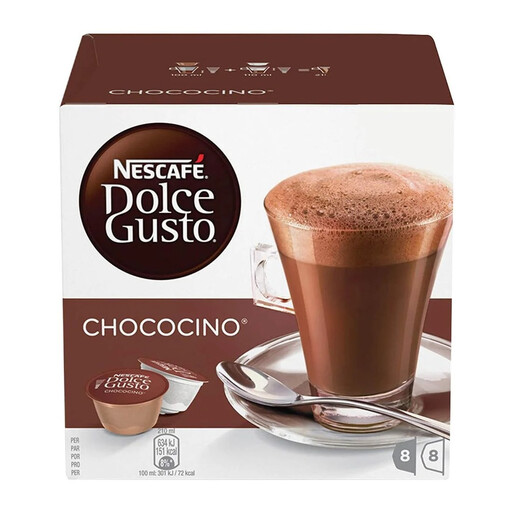
This Dolce Gusto Chococino option is for households considering a two-pod hot chocolate for an after-school drink at home.
 No image available
For a household with a Dolce Gusto machine, Chococino uses a chocolate pod and a milk pod for each mug.
The 16 pods make eight mugs. NESCAFÉ Dolce Gusto declares 14.8 g sugars per mug; the product contains milk and soya, so check the current pack if either ingredient must be avoided.
Do not treat the formats as interchangeable. The Cadbury product discussed here is a Tassimo T DISC, while the Galaxy product is labelled compatible with Nescafé Dolce Gusto machines; choose pods labelled for your machine.
No. NESCAFÉ Dolce Gusto says the pack contains eight chocolate pods and eight milk pods, making eight mugs with two pods per mug.
Check the current pack for milk and soya. Cadbury Tassimo lists milk ingredients; Galaxy lists milk-derived ingredients and soya lecithin; Chococino’s milk pod lists whole milk powder and soya lecithin, while its chocolate pod may contain milk.
No. For food or drink provided through a school, the provider needs to check the applicable school-food requirements, its own allergy policy and the current product specification. A household’s choice for an after-school drink at home does not establish suitability for school provision.