Households with a TASSIMO machine
Look for T DISCs rather than Dolce Gusto or Nespresso capsules. TASSIMO identifies Cadbury Hot Chocolate as a T DISC drink and lists 10 servings per pack.


Start with the format your machine accepts: Cadbury T DISCs are for TASSIMO, while Galaxy, Nesquik and Chococino offer Dolce Gusto options. Nespresso Original-line owners need capsules explicitly labelled for that system. For an afternoon drink, compare nutrition per prepared serving and the number of capsules used, then check the current pack for ingredients and allergens.
The machine you already own narrows the pod choices before flavour or serving size comes into it.
Look for T DISCs rather than Dolce Gusto or Nespresso capsules. TASSIMO identifies Cadbury Hot Chocolate as a T DISC drink and lists 10 servings per pack.
Galaxy and Nesquik use one pod per drink, while Chococino pairs a chocolate capsule with a milk capsule. Compare the stated prepared servings, not just the number of pods in a pack.
Choose a hot-chocolate capsule that explicitly names Nespresso Original-line compatibility. Real Coffee describes its hot-chocolate capsule range as compatible with that system; check the exact product’s preparation and ingredient label before buying.
Confirm the machine format first, then compare what goes into one prepared drink.
| Priority | What to check | Your needs |
|---|---|---|
| Machine format | TASSIMO identifies Cadbury T DISCs for its machines. Tesco labels Galaxy for Dolce Gusto, and Real Coffee specifies Nespresso Original-line compatibility for its capsules. Check the exact format printed on the pack. | I want pods that fit the machine I already have, rather than choosing by chocolate brand alone. |
| Prepared drink | Check sugars and energy per prepared serving, its stated volume, and whether one drink uses one or two capsules. Tesco lists Cadbury at 7.4 g sugars and 66 kcal per 225 ml, and Galaxy at 10 g and 64 kcal when prepared with 150 ml water. NESCAFÉ Dolce Gusto lists Nesquik at 7.8 g and 65 kcal per mug, and Chococino at 14.8 g and 123 kcal per mug. | For my afternoon drink, I want to compare what is in the cup I will make. These figures describe different recipes and serving sizes, so they are not a like-for-like measure of the drinks. |
| Ingredients | Read the current pack’s ingredient and allergen declaration. The listed Cadbury and Nesquik recipes contain milk; Galaxy and Chococino list milk and soya. Do not use an older listing as the final allergen check. | If milk or soya matters in my household, I need to check the particular pack before serving it. |
A Cadbury T DISC and a Dolce Gusto chocolate pod are sold for different machines. A shared drink category does not establish cross-compatibility.
Match the machine family named on the pack to the machine at home before choosing a multipack.
Galaxy’s stated preparation uses 150 ml water, Cadbury’s listed serving is 225 ml, and Chococino uses two capsules per mug. Figures for those servings answer a different question from figures per 100 g of dry product.
Use the prepared-serving figures and note the drink volume and capsule count alongside them.
The listed recipes contain milk, and some also contain soya. Tesco warns that food products can be reformulated, which matters when checking a particular pack for allergens.
Read the ingredient and allergen declaration on the pack being used, especially when preparing a drink for someone with an allergy or intolerance.
Department of Health and Social Care guidance on HFSS promotions and placement applies to businesses operating in and selling to England. School food is a separate subject: the Department for Education sets legally required School Food Standards for state-funded schools in England.
For school catering, check the applicable nation’s school-food requirements and the exact product rather than assuming every hot-chocolate pod has the same classification or permitted use.
These brand examples describe particular pod ranges, not compatibility across everything each brand sells.
TASSIMO offers Cadbury Hot Chocolate as a T DISC drink; its product page lists 10 servings per pack.
Tesco lists an eight-pack of Galaxy instant hot-chocolate pods compatible with NESCAFÉ Dolce Gusto machines.
Its chocolate-drink range includes the two-capsule Chococino recipe and a one-pod Nesquik drink for Dolce Gusto machines.
Real Coffee describes a hot-chocolate capsule range for Nespresso Original-line machines.
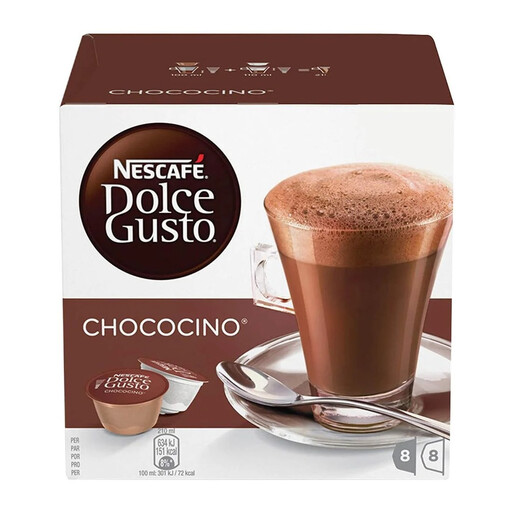
This Chococino option is for an afternoon hot chocolate made in a Dolce Gusto machine. It does not represent the TASSIMO or Nespresso Original-line formats discussed above.
 No image available
For a Dolce Gusto owner wanting a chocolate drink made with separate chocolate and milk capsules, Chococino uses two capsules per mug. The pack contains 16 pods, 256 g; NESCAFÉ Dolce Gusto lists 14.8 g sugars and 123 kcal per prepared mug. Its ingredients list milk and soya, so check the current pack before serving it to someone with an allergy or intolerance.
Do not assume they fit. TASSIMO identifies its Cadbury product as a T DISC, while the Galaxy, Chococino and Nesquik products discussed here are labelled for Dolce Gusto machines. Choose the format named for your machine.
Of these products with stated prepared-serving figures, Tesco lists Cadbury TASSIMO at 7.4 g sugars per 225 ml; NESCAFÉ Dolce Gusto lists Nesquik at 7.8 g per mug. Tesco lists Galaxy at 10 g for its preparation with 150 ml water, and NESCAFÉ Dolce Gusto lists Chococino at 14.8 g per mug. Serving sizes and recipes differ, so these figures are not an overall judgement about the drinks.
The listed Cadbury, Galaxy, Chococino and Nesquik recipes contain milk; Galaxy and Chococino also list soya. Ingredients can change, so use the current pack’s allergen declaration when choosing for someone with an allergy or intolerance.
No. Department of Health and Social Care guidance addresses HFSS promotions and placement for businesses operating in and selling to England; the Department for Education’s School Food Standards set separate requirements for state-funded schools in England. For a school-food decision, check the applicable nation’s rules and the specific product rather than treating the retail rule as a school-meal rule.