Who these options suit
The useful distinction is between how you will prepare the drink and whether you want a stated cocoa specification, rather than relying on words such as “strong” on the front of a pack.
Budget-conscious regular drinkers
If you make hot chocolate often, compare pack sizes and the stated quantity used per mug. A drinking chocolate made with hot milk may suit your routine; include that preparation requirement when deciding between formats.
Drinkers without reliable access to milk
Look for instructions that explicitly allow hot water. Sainsbury’s lists Galaxy Frothy as suitable for preparation with hot water or hot milk, whereas the stated method for Cadbury Drinking Chocolate uses hot milk.
Shoppers seeking an explicitly dark option
M&S Collection Belgian Dark Hot Chocolate Flakes declare at least 70% cocoa solids in the dark chocolate. Check the exact pack and its allergy statement before choosing it; the declaration does not describe the taste of a prepared mug.
What to check before choosing
Decide how you will make the drink, then compare the exact packs’ cocoa declarations, serving instructions and ingredients.
| Priority | What to check | Your needs |
|---|
| Cocoa character |
Look for a cocoa-solids declaration on the exact product, and read the ingredients. M&S declares at least 70% cocoa solids in its Collection Belgian Dark Hot Chocolate Flakes; a descriptive name alone is not an equivalent measure. |
I want an explicitly dark chocolate ingredient, rather than assuming that “frothy” or “smooth” means a stronger cocoa taste. |
| Preparation |
Check whether the instructions call for hot milk or allow water, and note the stated quantity of powder per mug. Cadbury specifies three teaspoons with hot milk; Sainsbury’s lists four heaped teaspoons for Galaxy Frothy, made with water or milk. |
If I cannot reliably heat milk, a product with hot-water instructions fits how I will actually make the drink. |
| Pack and servings |
Compare pack weights alongside the preparation instructions. A larger pack does not by itself tell you how many mugs it will make. |
I make hot chocolate regularly and want to compare packs using the amount I would put in each mug. |
| Ingredients and allergies |
Read the current ingredients and allergy statement for the exact pack. Cadbury Drinking Chocolate states “MAY CONTAIN MILK”; M&S says its dark flakes are unsuitable for people with milk, nut or peanut allergy. |
For an allergy, I need to check the product I will use, not assume that another powder or flake product has the same ingredients. |
Brand and product-line references
These examples illustrate different preparation and ingredient choices; a brand name alone does not establish cocoa strength across its range.
Cadbury
Cadbury Drinking Chocolate has a stated method of mixing three teaspoons with hot milk.
- The milk-based instructions make its preparation requirements clear.
- The listed ingredients begin with sugar and cocoa powder; the 500g product lists 73g sugars per 100g of powder and states “MAY CONTAIN MILK”.
Galaxy
Galaxy Frothy Instant Hot Chocolate 275g is listed by Sainsbury’s with instructions for hot water or hot milk.
- Its stated method gives a choice of preparation liquid.
- The listing specifies 9% fat-reduced cocoa powder; “frothy” is not a declaration of dark cocoa content.
Options
Options includes flavoured hot-chocolate jars and sachets, including Belgian Chocolate, mint and salted caramel varieties.
- The range offers distinct named flavours for shoppers choosing by flavour.
- Check the cocoa declaration and ingredients of the particular variety rather than treating its flavour name as a strength specification.
Tesco
Tesco’s own-label range includes an instant hot-chocolate powder alongside other hot-chocolate formats.
- The instant powder provides another format to compare by pack weight and preparation instructions.
- Check the exact product for a cocoa declaration rather than assuming that “instant” describes the finished drink’s strength.
M&S
M&S has distinct instant hot chocolate and Collection Belgian Dark Hot Chocolate Flakes products.
- The Collection dark flakes declare at least 70% cocoa solids in the dark chocolate; the standard instant product separately lists 20% cocoa powder.
- M&S states that the Collection dark flakes are unsuitable for people with milk, nut or peanut allergy. Check local availability for the exact product.
Joybuy hot-chocolate options
These Joybuy options include powders associated with hot-milk and hot-water preparation. Compare each pack’s instructions and ingredients for your preferred type of mug; the products below are not a ranking of cocoa strength.
 No image available
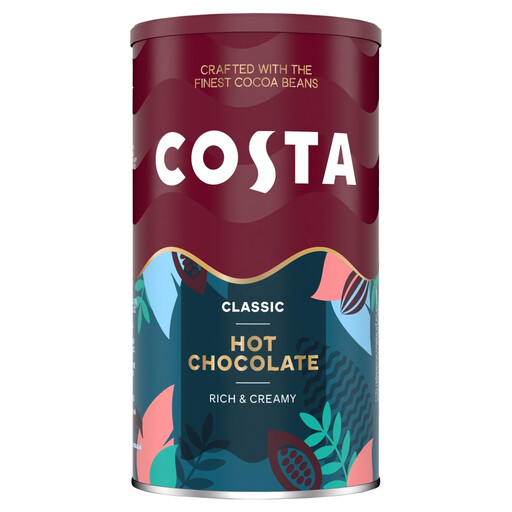
Costa Hot Chocolate 300g
Consider this 300g powder if you plan to make hot chocolate with milk or a plant-based alternative. Check the pack’s preparation and ingredient details for the mug you want to make; the product name does not establish an extra-bold taste.
 No image available
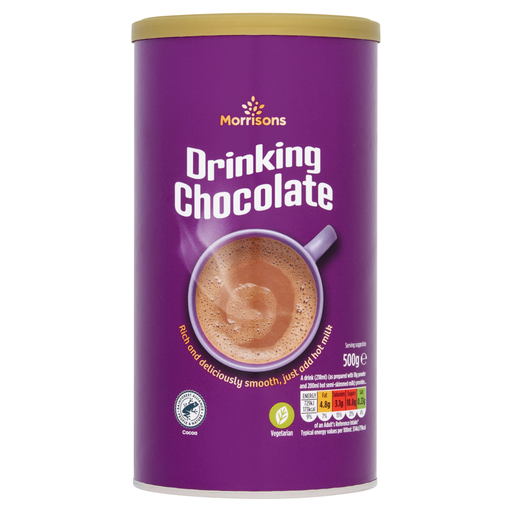
Morrisons Drinking Chocolate 500g
This 500g drinking chocolate fits a hot-milk preparation routine. Check its stated quantity per mug and the current ingredients on the exact pack rather than assuming that the format guarantees a dark taste.
 No image available
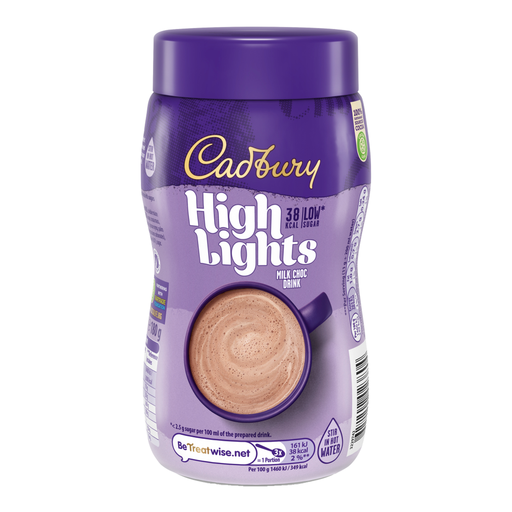
Cadbury Highlights Milk Chocolate Drink 180g
This 180g drink powder is an option when hot-water preparation matters. Check the current pack’s milk allergy information before use; its milk-chocolate name does not establish the strength of the prepared drink.
 No image available
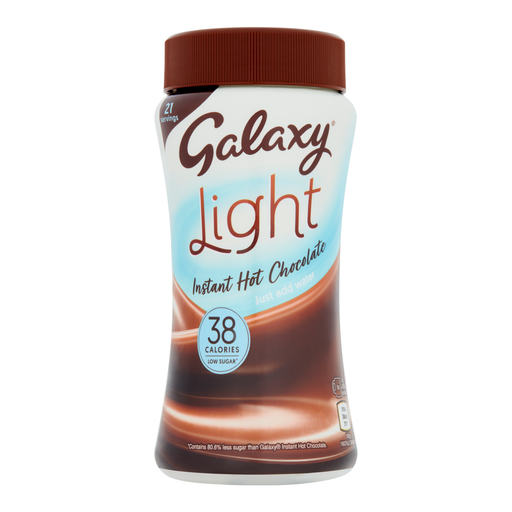
Galaxy Light Instant Hot Chocolate 210g
This 210g instant powder has a hot-water preparation route. Its instructions specify hot, not boiling, water; check the current pack if milk, soya or barley ingredients are relevant to you. “Light” is part of the product name, not a basis for assuming a particular cocoa taste.
 No image available
Cadbury Drinking Chocolate 500g
This 500g drinking chocolate specifies three teaspoons mixed with hot milk. Its listed ingredients begin with sugar and cocoa powder, and the pack states “MAY CONTAIN MILK”; check its current label if either point affects your choice.
Frequently asked questions
Does a higher cocoa percentage mean a less sweet hot chocolate?
No. Cocoa and sugar are separate parts of a recipe. M&S declares at least 70% cocoa solids in its Collection dark flakes, while Cadbury Drinking Chocolate lists sugar first and 73g sugars per 100g of powder. Compare the exact products’ ingredients and nutrition panels rather than their packaging descriptions.
Should I choose drinking chocolate or an instant powder for a stronger mug?
Choose by the preparation you can use, not by an assumed strength advantage. Cadbury Drinking Chocolate specifies three teaspoons with hot milk; Sainsbury’s lists Galaxy Frothy as suitable for hot water or hot milk. Neither format alone proves that the finished drink will taste darker.
How can I compare packs I would use regularly?
Check pack weight alongside the stated amount used per mug and the required liquid. For example, Cadbury Drinking Chocolate specifies three teaspoons with hot milk, while the Galaxy Frothy listing specifies four heaped teaspoons and allows water or milk. Pack weight alone does not describe the prepared serving.
What should I check if I have a food allergy?
Read the current ingredients and allergy statement on the exact pack before consuming it. Cadbury Drinking Chocolate states “MAY CONTAIN MILK”, and M&S says its Collection dark flakes are unsuitable for people with milk, nut or peanut allergy. Do not assume that another hot-chocolate product has the same declaration.
Is an online product description enough to choose by ingredients?
Use it to narrow your options, then check the current pack before use. This matters particularly when an ingredient or allergy statement determines whether the exact product is suitable for you.


