Shoppers comparing lunch-time drinks
If sugars or calories matter to your choice, compare the stated serving and how the drink is prepared, including any milk you add. A product name alone cannot tell you what the finished drink contains.


For a lunch-time hot chocolate, compare sugars, calories and saturated fat on a consistent serving basis rather than assuming that instant powder, chocolate flakes or a ‘light’ label determines the finished drink’s nutritional profile. If ‘pre-grated’ means chocolate flakes, check the amount used and what you mix them with; choose a lower-calorie instant product only after checking its ingredients and preparation instructions.
If sugars or calories matter to your choice, compare the stated serving and how the drink is prepared, including any milk you add. A product name alone cannot tell you what the finished drink contains.
Instant powder and ready-to-melt chocolate flakes call for different preparation checks. Choose the format that fits how you will make the drink, then compare nutrition on a like-for-like basis.
Read the current pack when milk, soya, nuts or non-sugar sweeteners affect your choice. Do not infer a particular product’s suitability from its flavour, format or ‘low calorie’ wording.
Start with the drink you would prepare, then check its label, ingredients and instructions before choosing a format.
| Priority | What to check | Your needs |
|---|---|---|
| Serving nutrition | Compare sugars, calories and saturated fat using the same serving basis. Account for the amount of powder or flakes and any milk or other additions. | I want to know what the drink contributes alongside lunch, not just what the dry mix contains. |
| Pack labels | Use traffic-light information, where provided, to compare fat, saturates, sugars and salt. GOV.UK explains that the colours indicate whether amounts are high, medium or low. | A quick label comparison helps me narrow down products before reading the serving details. |
| Ingredients | Read the exact pack for milk, soya and other relevant allergens, as well as sweeteners. Check the ingredients of anything added during preparation. | If an ingredient or allergen matters to me, ‘light’ or ‘dark chocolate’ is not enough to establish suitability. |
| Flakes or powder | Check the suggested amount and preparation method. Marks & Spencer lists 8.5 g sugars per 100 g for its Belgian dark flakes and 11.3 g per 100 g for its Belgian milk flakes; these are dry-product figures, not finished-drink values. | I may prefer ready-to-melt flakes, but I still need to compare the portion I would use with an instant drink’s serving. |
| Preparation | Check whether the pack calls for water, milk or another ingredient, and which preparation the nutrition figure describes. | At lunch, I need a method that fits what I have available and a serving figure that reflects how I will make it. |
A lower-calorie instant drink can still contain milk ingredients or sweeteners. Marks & Spencer’s Low Calorie Instant Hot Chocolate, for example, lists milk-derived ingredients and sucralose.
Check the current ingredient and allergen information, then compare the serving prepared as you intend to drink it.
Chocolate flakes have their own sugar and saturated-fat values. The amount used and the liquid added also affect the finished drink.
Choose flakes for the format you prefer, but compare equivalent prepared servings before drawing a nutritional conclusion.
Ingredients and suitability information can change, so a previous purchase or retailer image may not describe the pack in hand.
Read the current physical pack before use when an allergen or other ingredient affects your choice.
Cadbury groups hot chocolate and cocoa powder in its UK product range.
Tesco’s hot-chocolate listings include Galaxy instant products, including a Galaxy Light option.
Tesco lists Options Belgian Choc in its reduced-sugar and low-calorie hot-chocolate category.
Tesco’s hot-chocolate categories include instant products, flakes and cocoa powder.
Marks & Spencer lists instant hot chocolate and Belgian dark and milk hot-chocolate flakes.
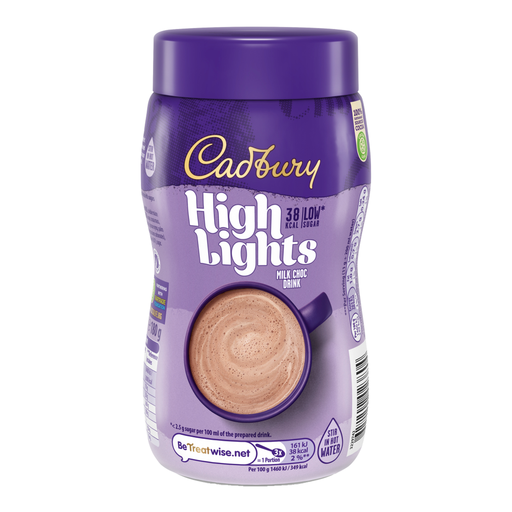
This instant chocolate drink is an option to consider if you are comparing a lunch-time serving rather than choosing ready-to-melt flakes.
 No image available
For a lunch-time comparison, check the pack’s serving nutrition against the drink you intend to prepare. This 180g chocolate drink powder lists milk ingredients and the sweeteners E950 and sucralose. Confirm the preparation instructions and the basis of its nutrition figures on the current pack.
No single format or label establishes that. Compare sugars, calories and saturated fat for the serving you will make, including additions. GOV.UK says traffic-light labels show whether fat, saturates, sugars and salt are high, medium or low; the NHS also advises limiting free sugars.
No. Marks & Spencer’s Low Calorie Instant Hot Chocolate lists milk-derived ingredients and sucralose. Check the ingredients and allergen information on the exact current pack.
Read the current pack’s ingredients, allergen information and suitability statements before use; do not infer suitability from ‘dark’, ‘instant’ or ‘low calorie’. GOV.UK states that food businesses must provide allergen information for prepacked and non-prepacked food and drink.
Follow the instructions on your pack. Marks & Spencer says to keep its Instant Hot Chocolate in a cool, dry place and consume it within four weeks of opening; instructions for another product may differ.