Revision snack planners comparing prepared mugs
If you want an instant chocolate drink made with water, compare the labelled serving rather than relying on “low fat” or “low calorie” alone. The amount of powder matters when you make the drink.


For a quick revision mug, compare fat, sugars and salt for the serving you will actually make; a lower-fat label does not settle every trade-off. ASDA lists Cadbury Highlights at 38 kcal, 1.0g fat and 2.7g sugars per serving, while its Options Belgian Chocolate listing gives 40 kcal, 0.8g fat and 5.7g sugars for 11g powder made with 200ml water. Check each pack’s preparation directions before applying those figures to a mug made with a different amount of powder or with milk.
The useful comparison depends on whether your priority is the prepared drink, a quick single portion or food supplied at school.
If you want an instant chocolate drink made with water, compare the labelled serving rather than relying on “low fat” or “low calorie” alone. The amount of powder matters when you make the drink.
A measured sachet avoids scooping powder from a jar. A jar also works for a short study break, provided you follow its portion and preparation directions.
The Department for Education says school-food standards apply to food and drink provided to pupils on the premises of state-funded schools in England. A low-fat description does not establish that an exact hot-chocolate product or recipe meets those standards.
Start with the powder quantity and preparation method, then compare nutrition, ingredients and format for the mug you intend to make.
| Priority | What to check | Your needs |
|---|---|---|
| Prepared serving | Check grams of powder, liquid quantity and whether the figures describe powder or a prepared drink. ASDA gives Galaxy Light values for 10g powder with 200ml hot water; Tesco gives its Low Fat Hot Chocolate values for 11g with 200ml water. | I want to compare the mug I will make, not two differently sized portions. If I add milk or toppings, the finished drink will differ from the water-made serving. |
| Fat, sugars and salt | Read these alongside energy per serving. ASDA lists Options Belgian Chocolate at 0.8g fat, 5.7g sugars and 0.29g salt for 11g powder made with water, and marks that serving’s sugars medium and salt high on its traffic-light display. | Lower fat is my priority, but I also want to see the sugars and salt that come with that choice. |
| Ingredients and allergens | Read the current pack’s ingredient and allergen declarations. ASDA lists milk, soya and barley for Galaxy Light; the compared Cadbury Highlights and Options Belgian Chocolate listings declare milk. | If an ingredient matters in my household, I need to check the exact pack before making a revision drink. |
| Portion and format | Decide whether an 11g single-serve sachet or a jar suits your routine, and check the preparation instructions and current stock before buying. | For one study break, I may prefer an already measured sachet; for repeated mugs, I am comfortable measuring powder from a jar. |
Similar energy figures can sit alongside different amounts of fat, sugars and salt. For example, ASDA’s Options Belgian Chocolate listing gives 40 kcal, 0.8g fat, 5.7g sugars and 0.29g salt for its water-made serving.
Compare the nutrients that matter to your choice on the same prepared-serving basis, as well as reading any traffic-light information shown for that product.
Adding milk or toppings changes the ingredients and nutrition of the finished mug. Different powder quantities also prevent a straightforward serving-to-serving comparison.
Follow the pack directions when comparing labelled servings. If you make the drink differently, account for the ingredients and amounts you add.
A sachet gives you a measured portion, while a jar requires you to measure the powder. A product shown in a listing may not be in stock when you need it.
Check the pack format, directions and current availability before planning it as a revision-break drink.
Food supplied to pupils in state-funded schools in England falls under school-food standards, according to the Department for Education. The Requirements for School Food Regulations 2014 exclude hot chocolate from their definition of confectionery, but that exception alone does not establish whether a particular drink or recipe meets all applicable standards.
For a school setting in England, check the current standards against the exact product and preparation before serving it. For a drink made at home, use the nutrition, ingredient and allergen information to make the buying decision.
These references describe the named products and labelled servings, not every hot chocolate made by each brand.
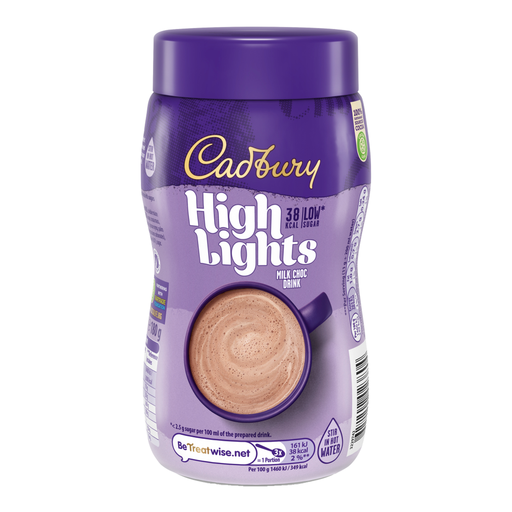
An instant milk-chocolate-flavour drink. ASDA lists 38 kcal, 1.0g fat and 2.7g sugars per serving for its 180g product.
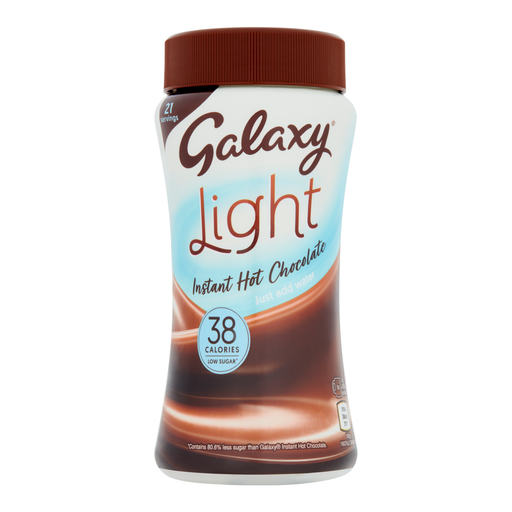
ASDA lists 38 kcal, 1.3g fat and 3.1g sugars for a 10g portion made with 200ml hot water.
ASDA lists 40 kcal, 0.8g fat, 5.7g sugars and 0.29g salt for 11g powder made with 200ml hot water. Tesco also lists an 11g sachet.
Tesco lists a 300g jar and gives 40 kcal, 1.0g fat and 3.9g sugars for an 11g serving prepared with 200ml water.
These instant hot chocolates are options for a quick, hot-water revision drink. Their pack directions matter: the Galaxy Light product below specifies a different powder portion from the 10g serving in ASDA’s listing.
 No image available
This instant drink is mixed with hot water for a quick mug. ASDA lists the matching 180g product at 38 kcal, 1.0g fat and 2.7g sugars per serving; check this pack’s powder quantity and directions before comparing prepared mugs. Contains milk and sweeteners.
 No image available
The product directions specify approximately 20g powder with 200ml hot water. ASDA’s 38 kcal and 3.1g sugars figures describe a 10g portion, so do not use them as the figures for a mug made to these directions; check the pack’s prepared-serving values. Contains milk, soya and barley.
No. ASDA lists 0.8g fat and 5.7g sugars for an Options Belgian Chocolate serving made with water, compared with 1.0g fat and 2.7g sugars per serving for Cadbury Highlights. Check each pack’s serving size and preparation directions before comparing them.
No. Milk changes the ingredients and nutrition of the finished drink. Use the labelled water-made figures to compare those recipes, then account separately for the milk and any toppings you add.
Check the current pack’s allergen declaration before buying or preparing the drink. The compared listings for Cadbury Highlights, Galaxy Light and Options Belgian Chocolate all declare milk; Galaxy Light also declares soya and barley.
No. The Department for Education says school-food standards apply to food and drink provided to pupils in state-funded schools in England. Although the Requirements for School Food Regulations 2014 exclude hot chocolate from the definition of confectionery, that does not establish whether an exact product and recipe meet every applicable school-food requirement.
No. The Department of Health and Social Care’s explanation of the England HFSS promotion regulations concerns specified promotions and locations at medium and large businesses selling food or drink. School-food standards separately govern food and drink provided to pupils in state-funded schools in England; neither set of rules classifies every hot chocolate simply by its name.