Families planning several half-term mugs
If hot chocolate will be a regular snack, compare the total sugars in the drink as prepared, not just the powder. The liquid and amount of powder specified for a serving can differ between products.


For a half-term mug, choose the preparation you want first: an instant mix made with water or a drinking chocolate made with milk. Then compare sugar on the stated prepared-serving basis, check sweeteners and allergens, and use chocolate style as a flavour clue rather than assuming that a product described as mild has a measured level of sweetness.
If hot chocolate will be a regular snack, compare the total sugars in the drink as prepared, not just the powder. The liquid and amount of powder specified for a serving can differ between products.
A milk-chocolate-style instant drink may be a useful starting point if dark cocoa is not to your taste. Product descriptions can help narrow the style, but they cannot establish which finished drink will taste mildest to your family.
Check the exact variant and current pack. Sainsbury’s lists Options Vegan as suitable for vegans but says it may contain traces of milk; Tesco Groceries lists milk, barley and soya in Galaxy Light.
Decide whether you will make the drink with water or milk before comparing prepared servings; then check flavour style and ingredients for the people who will drink it.
| Priority | What to check | Your needs |
|---|---|---|
| Sugar per mug | Read total sugars for the stated amount of powder and liquid. Sainsbury’s lists 2g for an 11g Options Vegan serving made with 200ml water, but 23g for Galaxy Drinking Chocolate made with 18g powder and 200ml semi-skimmed milk; these are different preparations. | I want to know what is in the mug I actually serve, particularly if hot chocolate is on the half-term snack menu more than once. |
| Preparation | Check the powder amount, liquid and serving size on the pack. Tesco Groceries lists Galaxy Light using 10g powder with 200ml water; Sainsbury’s lists standard Galaxy Instant using 25g powder with 200ml water. | A water-made mix suits the way I plan to prepare it, or I would rather make a milk-based drinking chocolate. I need the nutrition figure for that choice, not a different recipe. |
| Chocolate style | Read whether the product is described as a milk-chocolate-style instant drink or another cocoa style. Check its serving directions rather than treating the word ‘mild’ as a sugar or flavour measurement. | Someone at home dislikes an intense chocolate flavour, so the described style matters to me even though it cannot guarantee how the made-up drink will taste. |
| Ingredients | Check allergens, trace statements and sweeteners for the exact variant. Sainsbury’s lists a source of phenylalanine and possible milk traces for Options Vegan; Tesco Groceries lists milk, barley, soya and sweeteners for Galaxy Light. | I need a drink whose current ingredient and allergen information fits my household, rather than relying on ‘vegan’ or ‘light’ alone. |
| School setting | For food or drink provided at school, check the applicable nation’s school-food requirements and the school’s catering arrangements. The Department for Education’s school-food guidance applies to state-funded schools in England. | I am choosing for school provision rather than a snack at home, so I cannot use an HFSS description by itself to decide whether a particular drink may be served. |
A chocolate style does not establish its sugar content. Sainsbury’s lists 16g total sugars for a 25g standard Galaxy Instant serving made with water, while Tesco Groceries lists 3.1g for a smaller, 10g Galaxy Light serving made with water.
Use the flavour description to narrow your options, then check the powder amount, preparation directions and prepared-serving nutrition for each variant.
The listed servings include different liquids. Sainsbury’s 23g sugar figure for Galaxy Drinking Chocolate includes preparation with 200ml semi-skimmed milk; its standard Galaxy Instant figure is for preparation with water.
Compare drinks made in the same way, or account for the milk you actually add to a water-prepared mix.
Sainsbury’s says Options Vegan may contain traces of milk and contains a source of phenylalanine. Tesco Groceries lists milk, barley and soya in Galaxy Light. These details matter independently of the names on the front of the packs.
Read the current ingredients and allergen statement for the exact product before serving it.
School-food standards, advertising restrictions and retail-promotion rules address different settings. The Department for Education’s guidance concerns food and drink provided in state-funded schools in England; UK Government guidance describes separate restrictions on less-healthy-food advertising and, in England, retail promotions.
For school provision, check the rules applicable to that school and its catering requirements rather than drawing a product-specific conclusion from an HFSS description.
A brand can offer drinks with different preparation methods and serving figures, so choose by the exact variant rather than the brand name alone.
UK supermarket listings include water-made Light and standard instant variants, alongside a Drinking Chocolate prepared with hot milk.
Sainsbury’s lists standard and vegan Belgian hot-chocolate variants prepared using 11g powder in 200ml hot water.
Tesco Groceries directs shoppers to make Cadbury Drinking Chocolate with hot milk.
M&S lists regular Instant Hot Chocolate and a separate Low Calorie Instant Hot Chocolate.
These options cover two ways to make a half-term mug: Galaxy Light instant hot chocolate prepared with water and Cadbury Drinking Chocolate prepared with hot milk. Neither product name establishes how mild the finished drink will taste.
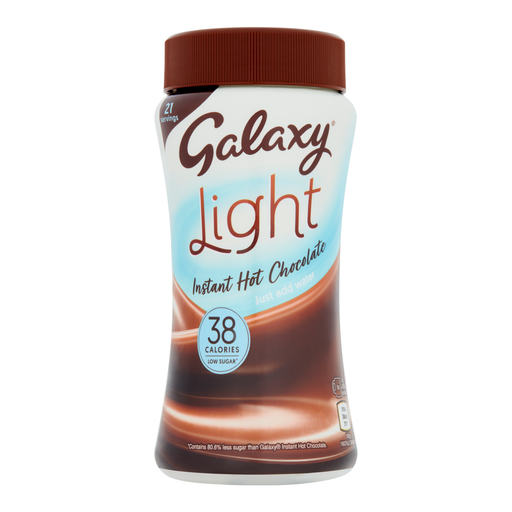 No image available
This is a water-prepared instant option for a family mug. Check the current pack before comparing sugar per prepared serving: Tesco Groceries lists a 10g powder serving, while the Joybuy description directs preparation with approximately 20g. The description lists milk, barley, soya and sucralose.
 No image available
Choose this if you intend to make drinking chocolate with hot milk: the directions call for three teaspoons swirled into the milk. Its stated 224g prepared serving lists 23g total sugars, so compare it with other milk-prepared drinks rather than assuming a water-made serving is equivalent. The product may contain milk.
Start with the described chocolate style, such as a milk-chocolate-style instant mix if you dislike a more intense cocoa profile. That description cannot predict your family’s taste or tell you the drink’s sugar content; check the ingredients and serving directions separately.
For the drink you plan to serve, start with total sugars per prepared serving and check how that serving is made. Tesco Groceries lists Galaxy Light at 3.1g sugars for 10g powder in water, while Sainsbury’s lists Galaxy Drinking Chocolate at 23g for 18g powder with 200ml semi-skimmed milk. Those mugs use different liquids and powder amounts.
No. Sainsbury’s lists Options Vegan as suitable for vegans but says it may contain traces of milk. Read the current allergen statement for the exact pack when milk traces matter to your household.
No product-specific school decision follows from that description alone. The Department for Education’s school-food guidance applies to food and drink provided in state-funded schools in England; UK Government guidance describes separate advertising and retail-promotion restrictions. Check the school-food requirements applicable to the particular school and its catering arrangements.
Follow the instructions on the exact pack. M&S says its regular Instant Hot Chocolate should be kept in a cool, dry place and consumed within four weeks of opening; another product may give different directions.