Households stocking up for several mugs
Check the stated servings and powder needed for each mug alongside the pack weight. A heavier tub does not necessarily make more drinks when serving sizes differ.


For a weekly household shop, choose a pack by how many mugs it makes and how everyone will prepare them: a larger drinking-chocolate tub suits milk-prepared drinks, while an instant jar suits hot-water preparation. If sugars per mug matter, compare the declared prepared servings and their sizes rather than treating a smaller low-calorie jar as equivalent to a standard tub; check the current pack for ingredients and allergens.
Check the stated servings and powder needed for each mug alongside the pack weight. A heavier tub does not necessarily make more drinks when serving sizes differ.
Look for an instant product whose instructions specify hot water. Drinking chocolate prepared with milk is a different choice, including when you compare nutrition per mug.
Read nutrition on the product’s stated prepared-serving basis. For an allergy, check the current pack’s ingredients, allergen declaration and precautionary statements rather than assuming similar-looking jars have the same contents.
Start with the preparation method your household will use, then compare servings and the information on each prepared mug.
| Priority | What to check | Your needs |
|---|---|---|
| Number of mugs | Check the pack weight, declared servings and powder dose per mug. Sainsbury’s lists 12 servings for its 350g standard instant jar and approximately 22 smaller servings for its 250g Low Calorie jar. | I want enough for the week, so the number of drinks matters more to me than tub size alone. |
| Preparation | Read whether the instructions specify hot water or milk. Check which liquid is included in the nutrition declaration. | For quick mugs, I would choose a product prepared with water; if we usually use milk, drinking chocolate may fit our routine. |
| Nutrition per mug | Compare sugars and energy per stated prepared serving, including its powder dose and liquid. A milk-prepared declaration is not directly comparable with a water-prepared one. | I want to compare what goes into the mug we actually make, particularly if sugars are a deciding factor. |
| Ingredients and allergens | Read the current ingredients, highlighted allergens and precautionary statements. Hot-water preparation does not establish that a powder is free from milk or soya. | Someone in my household needs a product-specific label check before I put a jar in the trolley. |
Powder doses differ, so pack weight alone does not tell you how many mugs you can make.
Compare the declared servings and dose. Choose a larger drinking-chocolate tub if its milk-based preparation also fits your household.
Instant products can contain milk ingredients, while soya may appear in ingredients or precautionary statements.
Check the current pack before buying or substituting a different jar for anyone with an allergy.
A serving declared with semi-skimmed milk and one declared with water describe different prepared drinks.
Check the liquid and serving size behind each per-mug figure before comparing sugars or energy.
These ranges illustrate different pack sizes and preparation methods; a brand name alone does not establish which product suits your household.
Cadbury’s 500g Drinking Hot Chocolate is a larger tub for milk-prepared mugs.
Galaxy’s 370g Instant Hot Chocolate Jar is prepared with hot water.
Options includes 220g instant jars in Belgian Chocolate and flavoured variants in the researched Tesco and Sainsbury’s listings.
Sainsbury’s lists both a 350g standard instant jar and a 250g Low Calorie instant jar.
Tesco’s hot-chocolate category includes drinking chocolate, instant jars and other cocoa products.
The Marks & Spencer range includes instant hot chocolate, drinking chocolate, cocoa powder and flavoured options.
These options cover milk-prepared drinking chocolate and hot-water instant chocolate for a weekly household shop. Compare their pack sizes with how many mugs you expect to make, and check the current label where ingredients matter.
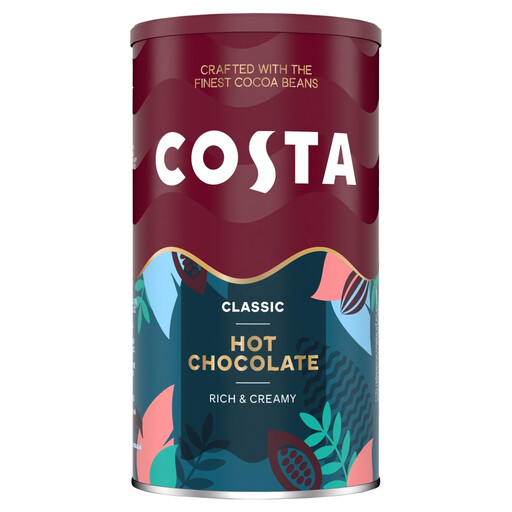 No image available
A 300g option for households making hot chocolate with milk or a preferred plant-based alternative. Check the current ingredients if allergy suitability matters.
 No image available
This 500g tub suits a household planning milk-prepared mugs. Check the pack’s serving instructions to judge how many it will make; it may contain milk.
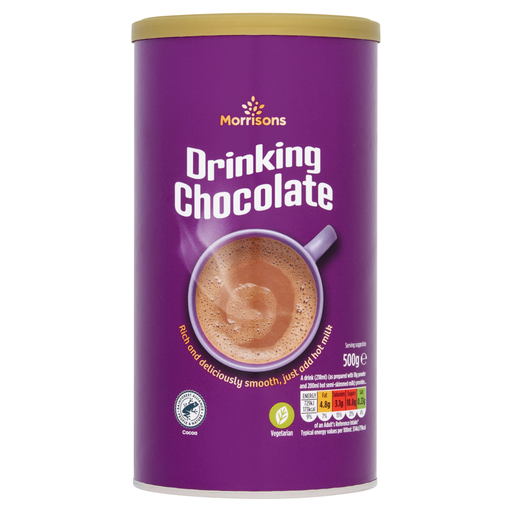 No image available
Another 500g choice for hot-milk preparation. Check the pack’s serving instructions and current allergen statement before choosing it for the household.
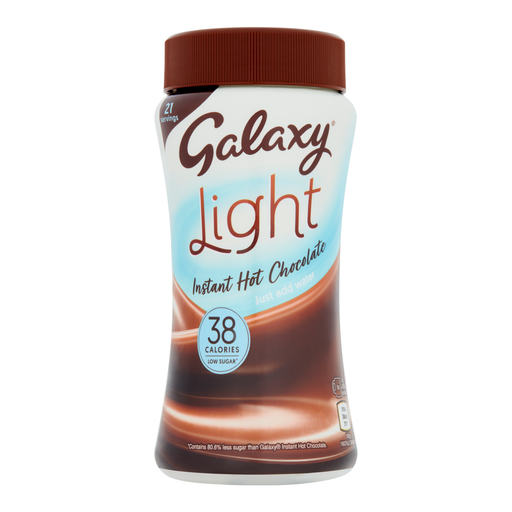 No image available
This 210g instant option is prepared with hot water. Its listed ingredients include milk, soya and barley; check the current pack for allergen information and per-mug nutrition.
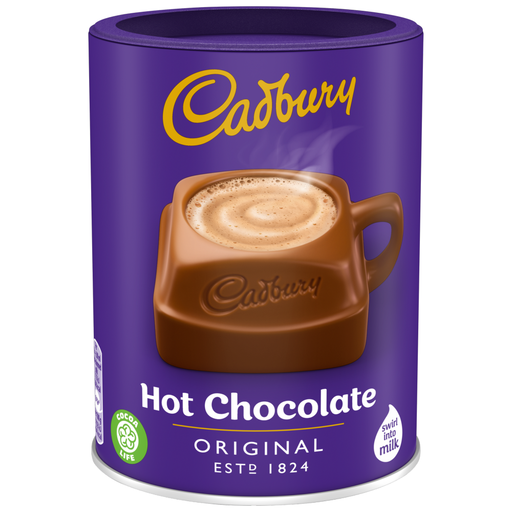 No image available
A smaller pack for households that want milk-prepared drinking chocolate. Check its serving instructions when deciding whether 250 g will cover the week; it may contain milk.
Compare stated servings and the powder dose, not just the jar’s weight. Sainsbury’s lists 12 servings for its 350g standard instant jar and approximately 22 smaller servings for its 250g Low Calorie jar, showing why weight alone cannot answer the question.
Compare them on the same prepared-serving basis, including the stated liquid and portion size. The researched Cadbury Drinking Hot Chocolate declaration includes semi-skimmed milk, whereas the Sainsbury’s instant and Galaxy jar declarations use water, so their per-mug figures are not directly equivalent.
Do not assume it does because it is made with water. The researched Sainsbury’s instant products contain cows’ milk ingredients and carry a soya-allergy manufacturing warning; the researched Galaxy jar lists milk ingredients and soya lecithin. Check the current pack of the exact product before purchase.
Check the current physical pack’s ingredients, highlighted allergens and precautionary statements for the exact product you are buying. Galaxy’s owner, Mars, says it can stand by the allergen information displayed on the back of its packs, rather than an older product listing.