Who is this choice for?
The useful pack size and preparation method depend on how the household will make and share its mid-morning drinks.
Households sharing hot chocolate regularly
A 400g to 500g tub is worth considering when several people will use it and the pack can be finished in line with its storage instructions. Check the preparation method as well as the weight: a larger drinking chocolate and an instant mix need not be made the same way.
Families checking sugars and allergens
For a drink between meals, compare sugars using the serving as prepared. Read the current pack for ingredients and allergen statements; products in this category can contain milk ingredients or carry other allergen warnings.
Drinkers choosing by preparation or flavour
An add-water instant mix may fit a different routine from a drinking chocolate or flakes made with hot milk. Choose the format you will actually prepare, rather than assuming the largest tub meets every preference.
What should you check before choosing?
Start with how often the household will use the pack, then check the directions and label for the drink you intend to make.
| Priority |
What to check |
Your needs |
| Pack size and storage |
Compare the stated weight with how often the household makes hot chocolate. Read any storage and after-opening instructions; M&S gives a four-week after-opening period for its 250g instant product and 300g drinking chocolate. |
Several of us have hot chocolate regularly, so I want a pack we can use in line with its storage directions. |
| Preparation |
Check whether the instructions call for hot milk or water and how much powder or chocolate to use. Tesco’s Cadbury 500g listing specifies hot milk; Joybuy’s Galaxy Light 210g listing says to add water. |
On mornings when I want an add-water drink, I need instructions that match that routine; otherwise, I can choose a hot-milk product. |
| Sugars per drink |
Find the serving size and whether the nutrition figures describe dry powder or a prepared drink. Compare products on the same preparation basis, including the milk used where relevant. |
For a mid-morning drink, I want to understand the sugars in the mug as served, rather than compare unlike figures from two packs. |
| Allergens |
Read the current ingredients and precautionary statements for the exact product. For example, Tesco’s Cadbury listing says it may contain milk, while Joybuy’s Galaxy Light listing identifies barley, milk and soya. |
Milk, barley or soya may matter in my household, so I need the label for the product I am buying, not an assumption based on its name. |
Brand and product-range references
These examples show how pack sizes and preparation styles vary; a brand name alone does not establish the ingredients of a particular product.
Cadbury
Tesco lists a 500g Cadbury hot chocolate powder for preparation with hot milk.
- The listed 500g size fits a regularly shared household routine.
- The Tesco listing says it may contain milk; check the current pack where milk avoidance matters.
Tesco
Tesco’s range includes both a 400g instant hot chocolate and a 400g drinking chocolate.
- The two formats give households a choice of preparation style at the same stated pack weight.
- Do not assume that their ingredients, allergens or prepared-serving figures are interchangeable.
Galaxy
Galaxy appears in different hot chocolate formats, including the 210g Galaxy Light instant product listed by Joybuy.
- The Joybuy listing describes add-water preparation for Galaxy Light 210g.
- That product’s listing identifies barley, milk and soya allergens; ‘light’ does not mean free from those ingredients.
Options
Options Belgian Chocolate is a 220g instant product described by Joybuy as prepared with hot water.
- The smaller jar may suit someone choosing an add-water preparation over a larger tub.
- Joybuy’s product information lists milk and a source of phenylalanine; check the current pack before use.
M&S
M&S lists a 300g drinking chocolate, a 250g instant hot chocolate and 250g Belgian milk chocolate flakes.
- The flakes are described as 45% cocoa solids and are intended to melt into hot milk.
- M&S marks the flakes unsuitable for people with a nut or peanut allergy; check the exact product label.
Joybuy 500g drinking chocolate options
These two 500g drinking chocolates are options for households planning to make shared hot-milk drinks. The choice between a larger tub, an instant mix and chocolate flakes still depends on preparation and label details.
 No image available
Cadbury Drinking Chocolate 500g
The 500g pack suits a household making repeated hot-milk drinks. Its product information says it may contain milk; when comparing sugars, use the stated prepared-serving basis and check the current pack.
View on Joybuy
 No image available
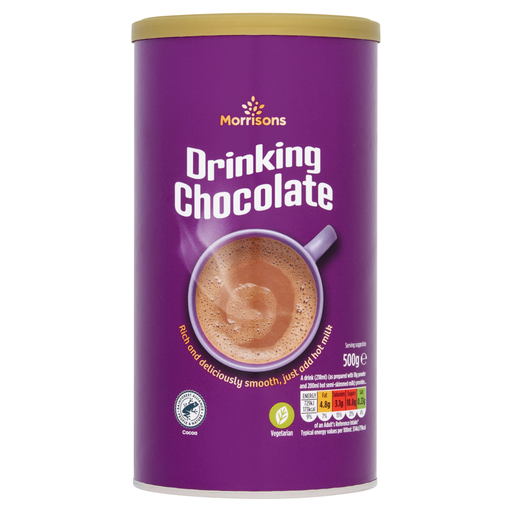
Morrisons Drinking Chocolate 500g
This 500g drinking chocolate is an option for shared hot-milk drinks. Check the current pack’s allergen statement, and establish the serving size and preparation basis before comparing sugars per drink.
View on Joybuy
Frequently asked questions
What size should I consider for a family pack of hot chocolate?
A 400g to 500g pack is a useful shopping range for a household making drinks regularly, not a formal definition of ‘family pack’. Check whether you can use the product in line with its storage and after-opening instructions; a smaller pack may make more sense for occasional drinks.
Should I choose drinking chocolate or an instant mix?
Choose the preparation method that fits your routine. Tesco’s Cadbury 500g listing calls for hot milk, whereas Joybuy’s Galaxy Light 210g listing says to add water. Follow the directions for the exact product rather than assuming every drinking chocolate or instant mix works alike.
How can I compare sugars in hot chocolate?
Compare the sugars for a stated serving made in the way you intend to prepare it. A figure for dry powder is not directly comparable with one for a finished drink made with milk. The NHS advises limiting free sugars, so consider a mid-morning drink alongside other food and drink consumed during the day.
Which label details matter before buying a large tub?
Check the exact pack’s ingredients, allergen statements, weight, date and storage directions. UK food-labelling guidance from the Department for Environment, Food & Rural Affairs and the Food Standards Agency requires ingredients including allergens, net quantity and date information on pre-packed food. Preparation directions also help you judge whether the drink fits your routine.
Is hot chocolate automatically prohibited in English schools?
No blanket conclusion follows from the product category alone. The Requirements for School Food Regulations 2014 exclude hot chocolate from their definition of confectionery, but that does not settle every standard applying to food and drink provided in state-funded schools in England. Check the actual product and preparation against the current requirements with the school or caterer. Department for Education guidance says proposed updated standards for September 2027 remain subject to Parliamentary approval.


