Families making hot chocolate regularly
If several people will use the same pack during the school term, compare how much powder each drink needs and where you will store the opened pack. A larger tub is less useful if it will sit unused.


For regular household use, choose a tub you can store and finish, then compare its serving instructions as well as its pack weight. An instant powder prepared with water may fit a quicker routine, while sachets suit occasional, measured portions; whichever format you choose, check the exact pack’s sugar information and milk or soya allergen labelling.
If several people will use the same pack during the school term, compare how much powder each drink needs and where you will store the opened pack. A larger tub is less useful if it will sit unused.
Serving size and preparation method matter alongside the powder’s nutrition panel. Check the figures for the drink you intend to make rather than judging it by a lighter-sounding product name.
Read the current label of the exact product. The M&S and Sainsbury's instant examples list milk ingredients, while Sainsbury's also warns that its Stamford Street Co. product is unsuitable for customers with a soya allergy due to manufacturing methods.
Start with how often the family will make the drink, then check how it is prepared and what each serving contains. These checks make pack sizes easier to compare without assuming that every powder produces the same number of mugs.
| Priority | What to check | Your needs |
|---|---|---|
| Pack size | Check the pack weight, powder needed per drink and storage directions. Sainsbury's describes its Stamford Street Co. 400 g instant pack as approximately 14 servings. | Several of us will drink it regularly, so I want a pack we are likely to finish. For occasional drinks, a smaller pack or sachets may make more sense. |
| Preparation | Read whether the exact product calls for hot milk or hot water, and how much powder and liquid to use. Tesco’s Cadbury Drinking Chocolate 2 kg listing directs preparation with hot milk; Sainsbury's Stamford Street Co. instant drink uses hot water. | On a busy school day, I want a method that fits the time and ingredients available at home. |
| Sugar | Compare nutrition information for the stated serving and consider any milk or other additions. A reduced-sugar category does not tell you the total sugars in a different, prepared product. | I want to understand what is in the mug my child will actually drink, alongside other food and drinks that day. |
| Allergens | Read the current ingredients and precautionary statements for the exact pack. The Food Standards Agency says the 14 regulated allergens must be emphasised in the ingredients list of pre-packed food and drink. | If milk or soya is relevant to my family, I need the pack’s own labelling rather than an assumption based on the word “cocoa” or an earlier purchase. |
| Taking it to school | Ask the school about its packed-lunch, drinks and allergen policy before sending a hot-chocolate drink or product in. | What we make at home may not fit the arrangements at my child’s school. |
Some drinking chocolate is made with hot milk, while an instant powder may be prepared with water. The liquid and quantity used affect the finished drink.
Check the directions on the pack before choosing a format for quick school-day preparation.
Individual portions avoid measuring powder, but they leave less flexibility when several people want different serving sizes.
Keep sachets in consideration for occasional use; for regular use, compare tub sizes and the stated number of servings.
Examples listed by M&S and Sainsbury's contain milk ingredients, and Tesco’s Cadbury Drinking Chocolate 2 kg listing says it may contain milk. A product name cannot settle an allergen check.
Read the current physical pack, including precautionary statements, before serving a drink to someone with a relevant allergy.
The Requirements for School Food Regulations 2014 concern food and drink provided to pupils in maintained schools and pupil referral units in England. That scope does not itself decide what a parent can pack at every UK school.
Check your school’s current packed-lunch, drinks and allergen policy.
These examples show formats and label details worth comparing; a brand name alone does not establish how a particular pack is prepared or whether it suits an allergy.
Tesco lists Cadbury cocoa powder in a 500 g pack and drinking chocolate in a 2 kg pack.
Tesco lists Galaxy instant hot chocolate and includes Galaxy Light in its reduced-sugar and low-calorie hot-chocolate category.
Tesco lists Options products in its reduced-sugar and low-calorie category and lists an 11 g Belgian Choc sachet.
Tesco lists its own instant hot chocolate in a 400 g pack alongside other cocoa and hot-chocolate formats.
Its Stamford Street Co. Instant Hot Chocolate Drink comes in a 400 g pack described as approximately 14 servings.
M&S lists instant hot chocolate alongside other drinking-chocolate formats.
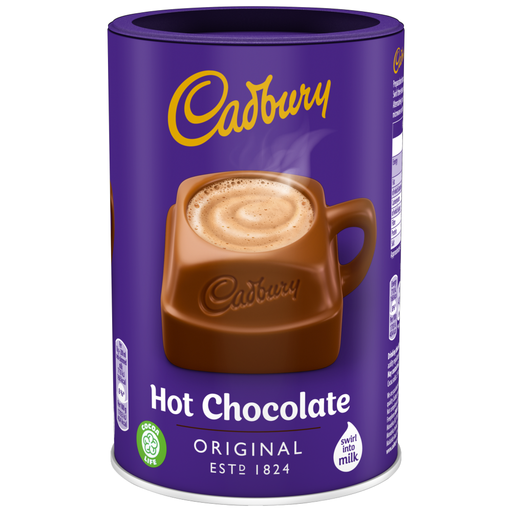
The option below is a 500 g drinking-chocolate pack for households considering a mid-size quantity for home use. Compare its pack directions and servings with your routine before choosing it over an instant powder or sachets.
 No image available
The 500 g pack is a mid-size option to consider for regular hot chocolate at home. Check its preparation directions, servings and current allergen labelling against your family’s needs.
No. Choose a size that fits how often you make it and the pack’s storage directions. Check the powder needed per serving too: a heavier pack does not, by itself, tell you how many mugs it will make.
Not necessarily. The M&S and Sainsbury's instant examples list milk ingredients. Read the exact current pack’s ingredients and allergen statements before serving it to someone with a relevant allergy.
Start with the nutrition information and serving directions for the drink you will prepare, including anything added to the powder. NHS guidance gives recommended daily sugar limits by age, so a single mug should be considered alongside the child’s other food and drinks that day.
The Requirements for School Food Regulations 2014 apply to food and drink provided to pupils in maintained schools and pupil referral units in England; they do not establish a rule for every parent-packed drink across the UK. Ask your child’s school about its packed-lunch, drinks and allergen policy.
Follow the directions on the exact pack. For example, M&S directs buyers of its 250 g instant hot chocolate to keep it in a cool, dry place and consume it within four weeks of opening; directions for another product may differ.