One-mug coffee makers
If you usually make one instant coffee at a time, a single-cup control may matter more than a large tank. Check that your mug fits beneath the nozzle and that you can stop dispensing when needed.


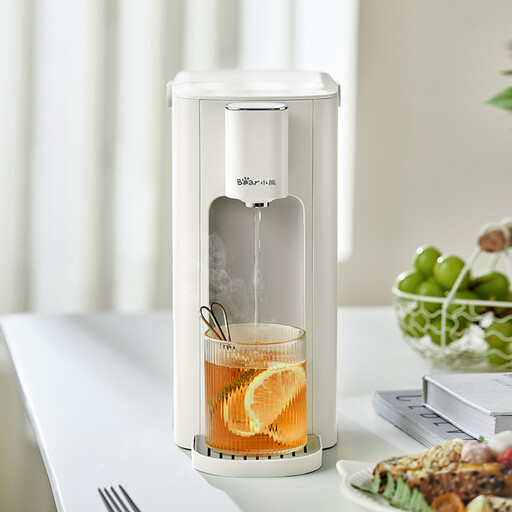
For one or two people making instant coffee, a compact one-cup dispenser is a sensible choice when avoiding the lift and pour of a full kettle matters most. For several guests making drinks in succession, prioritise tank capacity and ease of refilling; choose temperature and portion controls only if the cottage needs them, and check the exact appliance’s dispense temperature, plug and safe-use instructions.
If you usually make one instant coffee at a time, a single-cup control may matter more than a large tank. Check that your mug fits beneath the nozzle and that you can stop dispensing when needed.
When guests are likely to make drinks one after another, tank capacity, a visible water level and straightforward refilling become more useful than the smallest possible appliance.
Selectable temperatures and portions are worth considering if the appliance will serve drinks beyond standard instant coffee. In a shared kitchen, check how any safety lock works on the exact model.
For holiday-cottage instant coffee, decide how many drinks are normally made in succession before paying attention to extra controls. The three routes meet different needs rather than forming a single upgrade path.
Choose it when: One or two people mainly want a mug of boiling water without lifting and pouring from a full kettle.
Trade-off: A smaller tank needs refilling sooner when several guests make drinks.
Choose it when: Several guests regularly make coffee in succession and fewer refills matter more than a compact footprint.
Trade-off: The number of drinks per fill still depends on portion size; a stated cup count does not promise the same number of full mugs.
Choose it when: Guests need measured servings or different temperatures as well as water for instant coffee.
Trade-off: Check the available settings rather than assuming every selectable-temperature model dispenses at 100°C.
| Concern | What to check | Who this matters to |
|---|---|---|
| One-mug convenience | Check the dispense and stop controls, mug clearance and space available on the worktop. | When making just one coffee, I want water in the mug without lifting a full kettle. Around 42% of consumers put one-mug convenience first. |
| Drinks between refills | Compare tank capacity in litres with your usual mug size; check how the tank is filled. | If several guests make coffee in succession, I want to avoid stopping to refill between drinks. For around 33% of consumers, capacity for consecutive servings comes first. |
| Portions, temperature and safeguards | Check the exact temperature and dispense-volume settings, safety lock, cleaning instructions and plug type. | When guests want different servings or drinks, I need controls they can use safely and water at a suitable temperature. Controlled dispensing and shared-use safeguards come first for around 25% of consumers. |
Breville, Swan and Morphy Richards describe capacities using both litres and cups, but the number served depends on the amount dispensed each time.
Compare tank litres with your usual mug size and any selectable dispense volumes before deciding how often guests will need to refill.
A small dispenser still releases hot water and steam at worktop height. Breville’s HotCup manual calls for a stable, dry, level surface and a cup beneath the nozzle before use.
Allow a safe position for the appliance and cord, follow its manual, and give guests clear instructions for dispensing and refilling.
Breville identifies excessive scale as one possible reason a HotCup dispenses less than a full cup. The cited Swan and CASO models also have filters to account for in upkeep.
Check the exact model’s descaling procedure and whether compatible replacement filters are available, particularly where the water is known to be hard.
CASO Design lists the HW 660 with a Schuko plug. A similar product name or photograph does not establish which version a UK retailer supplies.
Confirm the exact model code, plug, voltage, instructions and warranty before choosing it for a UK holiday cottage.
The cited HotCup models offer a straightforward boiling-water route for one-cup use.
The SWD1001 is a higher-capacity option for successive drinks in a shared kitchen.
HydroTouch offers temperature and portion choices for a cottage serving more than standard instant coffee.
The HW 660 is a more finely adjustable option when varied temperatures and measured portions are genuine requirements.
This product choice is for a cottage where a larger tank and selectable temperatures matter alongside instant-coffee making. Check whether its stated temperature range suits the drinks you intend to serve.
 No image available
Consider this model when several guests may make drinks and selectable water temperatures are useful.
The product name states a 3 L capacity, six temperature settings and digital controls. Its stated maximum setting is 90°C, so do not assume it offers a 100°C dispense.
Before choosing it for the cottage, confirm the exact supplied version’s plug and worktop dimensions, as well as the temperature needed for your drinks.
A one-cup dispenser is worth considering if making a mug without lifting and pouring from a full kettle is the priority. If several people will make drinks together, compare tank capacity and serving size before deciding; the one-cup advantage alone does not settle that choice.
Start with the number and size of drinks likely to be made before a refill. The Breville VKT124 is listed at 1.7L and the VKJ318 at 2L, while Swan lists 2.5L for the SWD1001; their stated cup counts should be read alongside the amount dispensed per drink.
Position it according to the exact model’s manual, with room for a suitable cup below the nozzle. Breville’s HotCup instructions specify a stable, secure, dry and level surface and warn users to take care around steam, hot surfaces and filling.
Check the exact version supplied before buying it for UK use. CASO Design lists the HW 660 with a Schuko plug, so confirm the plug, voltage, retailer warranty and instructions rather than relying on the model name or photograph.
For a holiday home in England, treat the safety of an appliance supplied to guests as a host responsibility. Darlington Borough Council Trading Standards explains the safety requirement for goods supplied in rented accommodation, while GOV.UK’s guidance for self-catering holiday homes in England directs hosts to HSE electrical-safety guidance. Check the requirements that apply to your property’s nation and circumstances.