Small-party cottage tea drinkers
If tea is usually made one mug at a time, a compact dispenser with a manageable refill and cleaning routine may suit the kitchen better than equipment intended for group service.


For occasional mugs in a small holiday cottage, choose a compact one-cup dispenser; for repeated tea rounds, prioritise a larger reservoir and consider an urn only when group service justifies its size. Check the water temperature and pour sizes against the teas and mugs you use, then account for cleaning and, in paying-guest accommodation, the property’s fire-risk arrangements.
If tea is usually made one mug at a time, a compact dispenser with a manageable refill and cleaning routine may suit the kitchen better than equipment intended for group service.
When several people make tea during a stay, tank capacity, pour quantities and the number of refills become more important than choosing the smallest appliance.
If the cottage has hard water or different teas call for different preparation temperatures, compare temperature controls, filtration and the maintenance each model requires.
Start with the largest tea round you expect to serve, then check whether the machine’s temperature, pour settings and upkeep suit how the cottage is used.
| Concern | What to check | Who this matters to |
|---|---|---|
| Occasional mugs | Check the tank size, selectable pour sizes and worktop footprint. | If I usually make one mug, I want a measured pour without giving over much worktop space to the machine. Around 30% of consumers put single-cup convenience first. |
| Repeat tea rounds | Compare tank capacity and stated cup yield; check whether continuous dispensing is available. | When several people make tea close together, I want to avoid stopping to refill partway through. For around 30% of consumers, serving the group is the primary concern. |
| Temperature and water quality | Check the maximum temperature, volume settings and any filter or descaling requirements. | If I prepare different teas or want filtered water, I need settings that fit those choices and upkeep I can manage. Around 20% of consumers prioritise temperature or water-quality control. |
| Shared use and upkeep | Check spill handling, relevant safety controls and cleaning instructions; consider how the appliance will be managed if guests pay to stay. | With different visitors using the kitchen, I want an appliance that is straightforward to operate and look after between stays. Ease of shared use and maintenance comes first for around 20% of consumers. |
A countertop dispenser with a larger tank still serves water in portions; it does not necessarily work like an urn during a busy tea round.
Consider the largest group likely to make tea at once. Compare pour options before choosing a dispenser, and consider an urn when frequent group service warrants the larger format.
A machine with a stated maximum of 95°C cannot be treated as equivalent to one specified to dispense at 100°C.
Check the exact model’s maximum temperature if boiling water matters for your tea or preparation method.
Filters and limescale can make an otherwise convenient dispenser less practical when nobody has a clear cleaning routine.
Check the model’s instructions, replacement-filter availability and who will maintain it between cottage stays.
Replacement cartridges or descaling supplies may become part of that routine.
The Health and Safety Executive says there is no universal legal requirement to test portable electrical appliances annually. For small paying-guest accommodation in England, Home Office guidance addresses safety through fire-risk assessment.
If guests pay to stay, consider the dispenser in the property’s fire-risk and appliance-maintenance arrangements, including appropriate visual checks and upkeep.
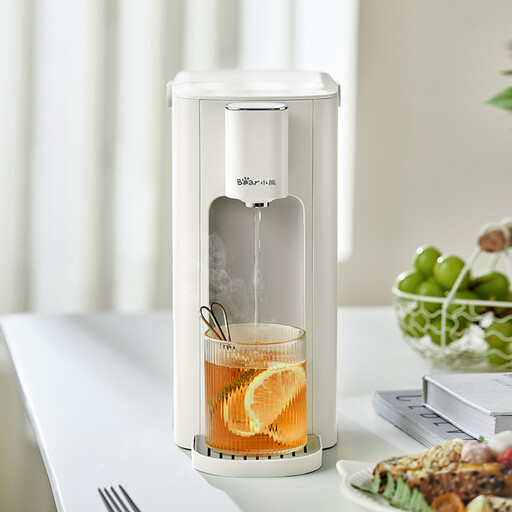
Its HotCup range offers countertop options for making tea a mug at a time.
Its range includes both a countertop dispenser and a larger tea urn.
The Cube is an option for buyers who want filtration alongside selectable temperatures and portions.
The HW 660 offers temperature and volume choices for buyers who want more control over each pour.
These dispenser choices are relevant when you want measured mugs or a reservoir for repeat cottage tea rounds. Compare their stated features with the temperature you need, the space available and the upkeep you can manage.
 No image available
Consider this model if adjustable temperature is important for the teas made at the cottage.
The product name specifies a water filter, room-temperature dispensing, 13 temperature settings and a memory function.
Check filter replacement and cleaning requirements, as well as the plug and exact UK-supplied variant.
 No image available
Consider this model for measured mugs and a reservoir that can serve more than one tea drinker.
The product name specifies six temperature settings and digital controls. Its stated highest setting is 90°C, so check that this suits your tea rather than relying on the fast-boil wording.
Confirm the worktop footprint and the plug on the exact UK-supplied model.
 No image available
The 4 L tank may suit a cottage where several people make tea during a stay.
The product name also specifies a water filter. Check the exact temperature and pour settings against your teas and mugs.
Confirm that the unit fits the available worktop space and check the plug on the exact UK-supplied variant.
Choose a model specified to reach 100°C if boiling water matters for the teas you make. The UK-listed BRITA Cube has a stated maximum of 95°C, whereas Breville UK says its VKJ367 dispenses only once water reaches 100°C; check the exact model rather than treating the two specifications as interchangeable.
Match the tank to the largest likely tea round, not just the number of people staying. The product information lists a 1.5 L Breville HotCup at around five cups, while Swan states that its 2.5 L dispenser makes up to 10 cups and its 8 L urn up to 40; the urn’s larger format makes more sense for frequent group service than occasional mugs.
Yes, plan for the filter and cleaning routine specified for the model you choose. The BRITA Cube has cartridge-exchange reminders, and Breville UK provides HotCup descaling guidance; decide who will handle that upkeep between cottage stays.
Annual portable appliance testing is not a universal legal requirement: the Health and Safety Executive says inspection and testing should reflect the equipment and its environment. For small self-catering accommodation with paying guests in England, Home Office guidance addresses fire safety through risk assessment; assess how the appliance is used and seek advice appropriate to the property if its circumstances or location differ.
Do not assume that a continental listing is ready for use in a UK cottage. CASO Design identifies a Schuko plug for its directly listed HW 660; the product information lists an HW 660 in the UK; confirm the plug, exact supplied variant and warranty before ordering rather than relying on the shared model name.