People filling larger flasks
If you usually prepare a substantial flask before leaving, compare the usable reservoir capacity with the amount you need and check how much the dispenser releases at a time.


Choose a dispenser whose usable water capacity covers what you plan to take and whose dispensing controls let you fill the flask without overfilling it. A compact dispenser can suit an occasional smaller flask, while a larger tank is worth considering if you also prepare drinks before leaving. Neither tank size nor volume settings tell you whether your flask fits beneath the outlet, so check its dimensions before buying.
If you usually prepare a substantial flask before leaving, compare the usable reservoir capacity with the amount you need and check how much the dispenser releases at a time.
If you fill a smaller flask only now and then, a compact dispenser may be enough, provided you are comfortable refilling its tank when making additional drinks.
If the flask is only one part of your routine, selectable temperatures may matter alongside capacity. Check that the temperatures and dispensing amounts suit the drinks you actually make.
Consider it when: You fill a smaller flask occasionally and favour a compact appliance.
Trade-off: A smaller tank may need refilling, and cup-size controls do not establish whether a tall flask fits.
Consider it when: You fill a larger flask or also make drinks, and want to choose the water temperature or dispensing amount.
Trade-off: Even with a larger tank, fixed portions can mean several cycles for one flask; check the exact model's controls.
Consider it when: You need to serve repeated drinks to a group, rather than prepare only one flask before leaving.
Trade-off: Its group-serving purpose is unlikely to justify choosing one solely for an occasional travel flask.
| Concern | What to check | Who this matters to |
|---|---|---|
| Controlled filling | Compare your flask's capacity with the selectable portions; check for a stop button or continuous-flow control and sufficient outlet clearance. | If I cannot fit my flask under the spout, or the machine releases too much at once, filling it becomes awkward. Around 36% of consumers put controlled filling first. |
| Reservoir capacity | Allow for the flask and any drinks made before leaving; distinguish total tank size from usable filtered-water capacity where applicable. | I want enough water ready for my visit without refilling the appliance midway. For roughly 29% of consumers, capacity is the primary concern. |
| Drink temperature | Check whether you need settings below boiling and whether the model pairs them with a dispensing amount you can use. | When I prepare different drinks, I want to select a suitable water temperature rather than always dispense at the same setting. Temperature choice comes first for about 21% of consumers. |
| Safe use and upkeep | Read the exact model's instructions, check relevant safety controls and review its descaling procedure. | I need an appliance I can place securely and clean as instructed, especially if accidental activation is a concern at home. Around 14% of consumers prioritise safe use and upkeep. |
A large reservoir can still feed a dispenser with small fixed portions. Morphy Richards lists 100 ml, 200 ml and 300 ml settings for HydroTouch, so filling a larger flask may take several cycles.
Check the full range of dispensing controls as well as tank capacity. If one uninterrupted fill matters to you, look for a documented continuous or manual-flow setting on the exact model.
Cup-size settings and tank capacity say nothing about the height available beneath the outlet or how a flask's opening lines up with the flow.
Measure your flask and check the model's outlet clearance. Do not force the flask into position; if you plan to dispense into another container, follow the appliance instructions and use a stable, heat-safe container where appropriate.
Descaling and rinsing steps vary by model, so a cleaning method suitable for one dispenser should not automatically be used for another.
Read the exact manual before purchase if low-maintenance use matters to you, and follow its permitted descaling and rinsing method.
Depending on that method, you may need a suitable descaling product and time for clean-water rinses before using the dispenser again.
Safety information and product notices may concern a particular model or batch, rather than every dispenser from a brand.
Keep the model details and purchase record, check that the supplied configuration suits your location, and consult the GOV.UK product-safety alerts and recalls service for the exact product where relevant.
The HotCup range includes compact countertop dispensers with different capacities and controls.
HydroTouch is a countertop option for consumers who want selectable temperatures and measured portions.
The HW 1660 is a larger-tank dispenser with temperature and quantity controls.
The SWD1004 represents a simpler dispenser for smaller quantities.
These countertop choices cover a compact dispensing option and a Bear model with a stated 3 L tank. For either one, check your flask's fit and the amount dispensed per cycle before deciding.
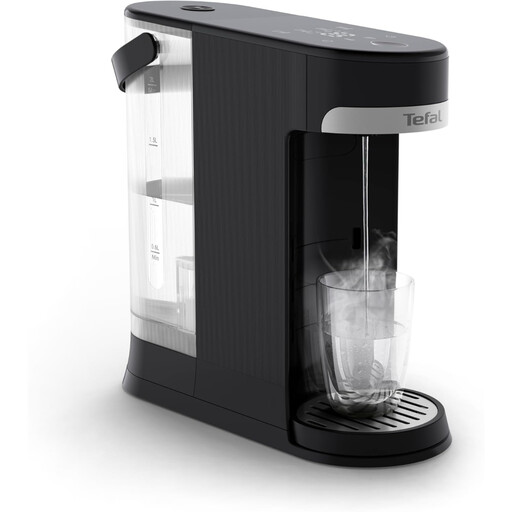 No image available
Consider this compact option if you are happy to fill a flask in controlled stages. Check its dispensing settings, the space beneath the outlet and the supplied plug configuration against your needs.
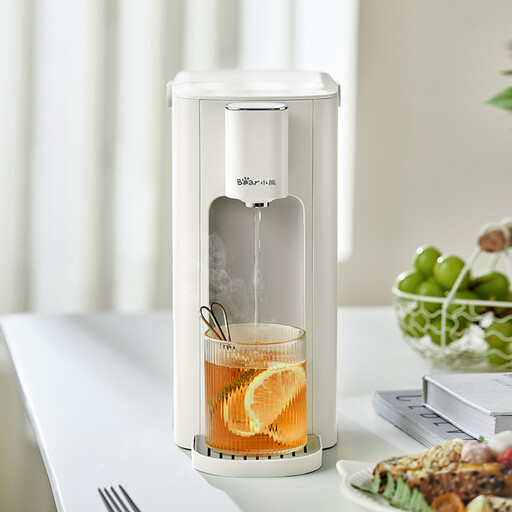 No image available
The stated 3 L tank is worth considering if you fill a flask and prepare additional drinks. Check the dispensing amount, flask clearance, exact appliance dimensions and supplied plug configuration before ordering.
No: tank capacity and dispensing settings do not establish whether your flask fits beneath the outlet. Check its height and opening against the exact dispenser, and follow the appliance instructions if you intend to dispense into a separate heat-safe container.
Not necessarily: a smaller tank may cover an occasional small flask, while a larger one is useful when the flask and any additional drinks would otherwise require a refill. Compare your required amount with usable tank capacity, then check separately how much the dispenser releases per cycle.
Follow the instructions for your exact model, including its rinsing steps. Breville describes vinegar or citric acid as options for its HotCup range, but that does not make either method suitable for every dispenser.
Check the supplied electrical configuration and read the exact model's instructions for placement, operation and cleaning. If you are considering an older or marketplace listing, you can also check the GOV.UK product-safety alerts and recalls service using the model details.