Multi-guest cottage hosts
If several guests make drinks or fill flasks before going out, a visible water level and a removable tank may make refilling easier to manage.


Choose a hot water dispenser only after checking that your flask will fit securely beneath its spout and that you can control the amount dispensed. Then weigh tank size and refilling against the controls guests will use, remembering that a safety lock does not replace careful siting and maintenance.
If several guests make drinks or fill flasks before going out, a visible water level and a removable tank may make refilling easier to manage.
If filling a travel flask is the main task, check spout clearance and how you stop or repeat a pour before focusing on heating speed.
If guests will use the appliance, consider where it will stand, how clearly it operates and how it will be maintained. Devon and Somerset Fire and Rescue Service advises owners of small paying guest accommodation to act on their fire-risk assessments.
| Concern | What to check | Who this matters to |
|---|---|---|
| Tank size and refilling | Compare tank capacity with the flasks likely to be filled between refills; check whether the tank is removable and its water level visible. | When several guests fill flasks before heading out, I want to avoid stopping repeatedly to refill the tank; roughly 36% of consumers put refill frequency first. |
| Flask fit and pour control | Measure your flask and check spout clearance, drip-tray position and whether dispensing can be stopped or continued. | If my flask is tall, I need it to stand securely while I control the pour; around 29% of consumers put flask fit and dispensing control first. |
| Guest operation and safety | Check the lock and stop controls, and choose a dry, stable position where guests can use the appliance as instructed. | With unfamiliar guests using the kitchen, I want clear controls without treating them as protection against every hot-water risk; guest safety comes first for roughly 21% of consumers. |
| Filter and cleaning upkeep | Check the filter type and replacement availability, plus the exact model’s cleaning instructions. | If I expect to clean the dispenser between stays, I want to understand the work involved; for around 14% of consumers, water care and cleaning take priority. |
A large reservoir says nothing about whether your flask fits beneath the spout or how much water the machine dispenses at once.
Measure the flask, then check nozzle clearance, tray position and dispensing controls on the exact model.
A lock does not remove the risks from hot water or steam. Breville’s VKT241 instructions call for a stable, dry, level surface and a suitable container beneath the nozzle during dispensing.
Keep the chosen model’s instructions available to guests and take a damaged or leaking appliance out of use.
For small paying guest accommodation in its area, Devon and Somerset Fire and Rescue Service advises owners to address electrical appliances through the property’s fire-risk assessment. The Health and Safety Executive does not set a universal annual testing interval for portable electrical equipment in low-risk workplaces.
Set inspection and maintenance arrangements for the property using its fire-risk assessment and the requirements that apply locally.
A filter adds a component to maintain; it does not replace cleaning the appliance as its manual directs.
Check the exact filter type, replacement availability and cleaning instructions before choosing a filtered model.
Breville’s VKT241 is relevant if selectable temperature and volume, manual dispensing and a start/stop control matter to you.
The HydroTouch offers preset temperatures of 40°C, 60°C, 80°C and 100°C, with 100ml, 200ml and 300ml dispense options.
Swan’s 2.5L model is worth considering when a removable tank and straightforward one-cup or continuous dispensing suit the cottage kitchen.
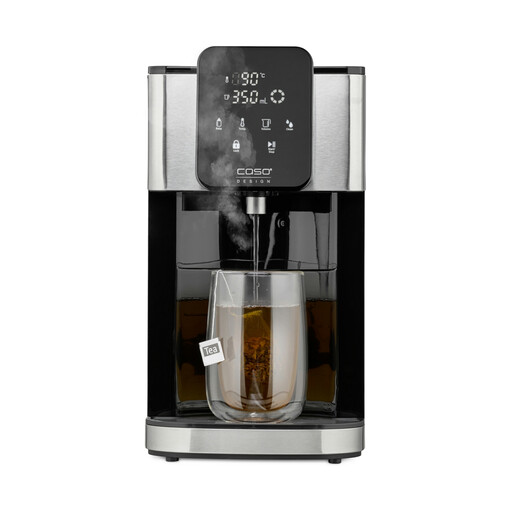
This dispenser has a stated 4L capacity that may appeal where several guests fill flasks, but check its spout clearance and dispensing controls against your flask before choosing it.
 No image available
Consider it for a cottage where several people may use the dispenser between tank refills, provided your flask fits beneath its outlet.
The product name specifies a 4L capacity and a water filter. Check the maximum amount dispensed at once, whether you can stop or continue the pour, and the filter-replacement arrangements if those features matter to you.
Only if the flask fits beneath the spout and the dispensing controls allow the amount you need. Measure the flask and check the model’s clearance and pour options: Morphy Richards lists portions up to 300ml for its HydroTouch, while Swan describes continuous dispensing on its 2.5L model.
Give guests the instructions for the exact model and place it on a stable, dry, level surface. Breville’s VKT241 instructions also require a suitable container beneath the nozzle during dispensing and say not to leave the appliance unattended; a safety lock does not eliminate hot-water and steam risks.
For a property supplied to paying guests, include electrical appliances when considering its fire risks and maintenance arrangements. Devon and Somerset Fire and Rescue Service advises owners of small paying guest accommodation in its area to act on their fire-risk assessments; the Health and Safety Executive’s guidance for low-risk workplaces does not prescribe a universal annual testing interval for portable equipment.