For occasional single mugs in a small office, a compact dispenser makes sense if its serving size suits everyone and refilling is manageable. Choose adjustable portions or filtered water when those features matter more; for repeated group rounds, consider a larger manual-fill boiler or a mains-fed workplace system, allowing for space, electrical suitability and upkeep.
Who is each format for?
Small teams making occasional mugs
A compact, manually refilled dispenser may suit short coffee rounds when counter space is limited. Breville UK describes its 1.5 L HotCup VKJ142 as holding water for five to seven cups and dispensing a fixed 250 ml portion; check that portion against the mugs your team uses.
Shared kitchens with varied drinks
Selectable portions and temperatures matter when colleagues use different cups or make different drinks. Morphy Richards UK lists 100, 200 and 300 ml portions, four temperature presets and a safety lock for its HydroTouch; its 1.8 L filtered capacity still calls for refilling.
Facilities teams serving frequent rounds
When several people need hot water in succession, compare a commercial manual-fill boiler with an installed mains-fed system rather than relying on a small tank. Buffalo Appliances UK lists a 20 L capacity for its CJ549 boiler, while BRITA UK offers mains-fed workplace systems with installation and maintenance options.
What matters when choosing?
Compact fixed-portion dispenser
Choose when: A small team makes occasional mugs and a fixed serving fits its cups.
Allow for: Manual refills and less flexibility when mug sizes vary.
Adjustable or filtered countertop dispenser
Choose when: Portion control, temperature settings or filtration is a deciding need.
Allow for: Refilling and, where a filter is fitted, its replacement and cleaning routine.
Commercial manual-fill boiler
Choose when: Repeated group rounds make a larger reserve more useful than a compact appliance.
Allow for: More space and a planned filling, start-up and cleaning routine.
Mains-fed workplace system
Choose when: Sustained demand warrants a system that does not rely on manual tank refills.
Allow for: Site assessment, installation and agreed maintenance arrangements.
| Concern | What to check | Who this matters to |
|---|
| Peak-round capacity |
Count consecutive coffees at the busiest break; compare usable capacity, refill method and cold-start time. |
When several colleagues make coffee together, I need enough water ready without stopping to refill; around 29% of consumers put uninterrupted group rounds first. |
| Simple single servings |
Check the dispense size against office mugs and whether the tank lasts through a short round. |
If I usually make one cup between tasks, I want a straightforward serving that fits my mug; roughly 29% of consumers prioritise simple single servings. |
| Drink controls and filtration |
Compare available portion and temperature settings; if filtration matters, check the filter and replacement process. |
With different mugs and drink preferences in the kitchen, I want more control over what goes into each cup; around 21% of consumers chiefly value drink controls or filtration. |
| Shared-use upkeep |
Confirm electrical suitability, a safe dispensing position and who will handle cleaning, descaling and refills. |
When everyone uses the same appliance, I need it set up safely and its upkeep assigned; roughly 21% of consumers put shared-use safety and maintenance first. |
What should a shared office avoid?
-
Choosing for an average day instead of the busiest break
Breville UK states that the 1.5 L HotCup holds water for five to seven cups; a short round is different from repeated group service. A larger boiler brings its own space and start-up considerations.
Count the coffees made consecutively at peak times, then compare refill frequency and the time needed to have water ready.
Frequent refilling can take staff time during busy breaks.
-
Assuming a small-office appliance suits commercial demand
BRITA states in its Cube manual that the appliance is for domestic and small-office use, not commercial use.
For sustained high-volume use, confirm the intended setting with the manufacturer or supplier and assess a commercial boiler or workplace system instead.
-
Overlooking the shared electrical setup
A dispenser used by several colleagues needs an appropriate supply and a sensible position for its lead and hot-water outlet. The Health and Safety Executive advises that workplace electrical equipment must be suitable for its supply and method of use.
Ask the responsible workplace person to assess the outlet, cable condition, spill exposure and user instructions before the appliance is put into use.
-
Treating filtration as a replacement for cleaning
A filter does not remove the need to follow the appliance's cleaning and descaling instructions. BRITA's Cube includes a filter-life indicator, which also brings a replacement task.
Check the required filter, cleaning steps and who will carry them out before choosing a filtered model.
Allow staff time for maintenance and for replacing filters where fitted.
Brands to consider
Breville
Breville UK positions its HotCup range around mug-by-mug dispensing; the VKJ142 is a compact, manually refilled example.
- The VKJ142 has a 1.5 L tank, fixed 250 ml dispense, removable drip tray and limescale filter, according to Breville UK.
- Its fixed portion will not suit every mug, and a small tank needs refilling during longer rounds.
Morphy Richards
The HydroTouch offers selectable servings and temperatures for a shared kitchen with varied preferences.
- Morphy Richards UK lists 100, 200 and 300 ml portions, 40, 60, 80 and 100 °C presets, and a safety lock.
- Its stated 1.8 L filtered capacity is lower than its 3 L tank size, so check refill needs against peak use.
BRITA
BRITA offers both the manually refilled Cube for small offices and separate mains-fed workplace systems.
- BRITA lists a 4 L tank and selectable water quantity for the Cube; its workplace systems have installation and maintenance options.
- The Cube manual excludes commercial use. A mains-fed system instead needs a site and maintenance arrangement.
Buffalo
Buffalo Appliances UK lists manual-fill commercial boilers for larger hot-water reserves and tap dispensing.
- The CJ549 has a stated 20 L capacity, 2.6 kW rating and temperature control.
- Plan for the space, filling and cleaning a large boiler needs. Buffalo gives a 45-minute full-tank heat-up time for its separate GL347 model, not the CJ549.
Joybuy product choices
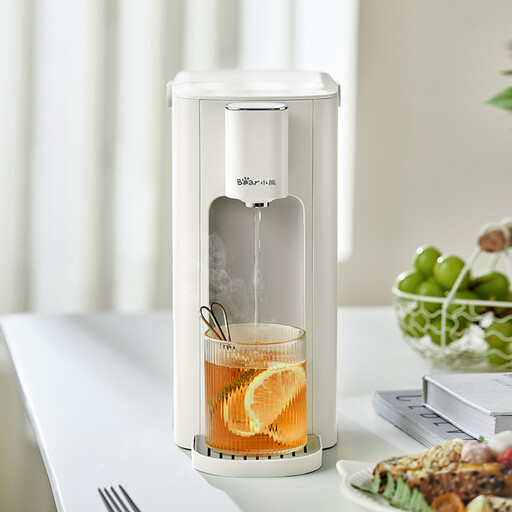
This 3 L dispenser is a choice to assess for mug-by-mug instant coffee. Its product description identifies home use, so confirm that the intended shared-office setting and electrical arrangement are suitable before choosing it.
 No image available
Bear YSJ-E40T2 Digital Hot Water Dispenser, 3 L, 6 Temps
Consider this for a team that wants to choose a serving for different mugs, provided its home-use designation fits the workplace. The product name states a 3 L tank and six temperature settings. Check the available dispense portions, actual footprint, electrical suitability and cleaning instructions before buying.
View on Joybuy
Common questions
Does an office have to install a hot-water dispenser?
No hot-water dispenser is specified by the workplace drinking-water rules cited here. Regulation 22 of the Workplace (Health, Safety and Welfare) Regulations 1992 requires an adequate supply of wholesome drinking water in Great Britain; Northern Ireland has a corresponding drinking-water requirement under its 1993 workplace regulations. A hot-water dispenser is a separate convenience choice.
Can a BRITA Cube be used in a shared office?
BRITA's manual specifies domestic and small-office use for the Cube, so it may suit a small shared office within that scope. The manual says it should not be used commercially; check another format for sustained commercial demand.
Do hot-water dispensers need a water connection?
No, not all of them do. Breville's 1.5 L HotCup is manually filled, whereas BRITA's mains-fed workplace systems require an installation arrangement; decide whether the office can accommodate plumbing before comparing those formats.
What should we check before plugging in an office dispenser?
Check that the appliance and electrical supply suit the intended workplace use. The Health and Safety Executive also advises checking the condition of plugs, leads and equipment; have the responsible workplace person assess the outlet and cable arrangement rather than assuming an extension or shared socket is suitable.


