People filling tall flasks
If a travel mug or flask is used regularly, tap clearance and room to position and remove the vessel matter as much as the dispenser’s hot-water supply.


For a shared office where several people fill tall flasks, start with a high-tap autofill boiler if there is a suitable water connection and worktop. A wall-mounted or standard countertop boiler may work if the flask fits beneath its tap; where plumbing is impractical, a manual-fill boiler avoids the water-line requirement but leaves staff responsible for refilling it. Check clearance with the actual flask and compare busy-period output before choosing a model.
If a travel mug or flask is used regularly, tap clearance and room to position and remove the vessel matter as much as the dispenser’s hot-water supply.
When colleagues fill vessels close together, rapid draw-off and hourly output help assess whether the dispenser can serve the busiest period.
Small, temporary or leased offices may need hot water without adding a mains-water connection. A manual-fill format avoids that connection but requires regular refilling.
For flask filling in a shared office, establish whether the vessel fits and how much hot water is needed during the busiest period. Then choose between a plumbed autofill unit and one that staff refill, taking account of the available space and maintenance work.
| Concern | What to check | Who this matters to |
|---|---|---|
| Flask clearance | Measure the flask as it will be filled and compare its height with the stated tap-to-tray clearance. Instanta specifies 304 mm for the CTSP10H. | I want to set my tall flask beneath the tap without tilting it or crowding the drip tray; roughly 36% of consumers put clearance and controlled filling first. |
| Busy-period supply | Compare rapid draw-off and hourly output, rather than tank capacity alone, against the number and size of flasks filled close together. | When colleagues fill flasks back to back, I need to know whether hot water will remain available; around 29% of consumers make continuity their primary concern. |
| Installation and space | Confirm the water-line requirement, electrical provision and suitable worktop or wall position before choosing an autofill model. | If alterations to our tea point are difficult, I would rather plan around the available connections and space; approximately 21% of consumers prioritise installation flexibility. |
| Upkeep and controls | Check the filter and cleaning requirements, and whether any timer or eco setting suits the hours when hot water is needed. | I need to know who will maintain a frequently used dispenser and whether its controls fit our working day; maintenance and operation come first for roughly 14% of consumers. |
A tank figure does not tell you how much hot water can be drawn during a rush or how quickly the supply recovers.
Compare the manufacturer’s rapid draw-off and hourly output figures with the office’s busiest flask-filling period.
A dispenser may supply enough water yet leave too little room to place or remove a tall flask without tilting it.
Measure the intended flask in its filling position and compare it with the published clearance, including room to handle the vessel.
A plumbed boiler needs a suitable water supply and installation position, with access for servicing.
Before ordering, arrange checks of the water supply, electrical provision, worktop or wall, spill management and maintenance access.
Installation work and filter replacement may also need planning, depending on the model and location.
Manual fill avoids a water connection, but someone must monitor and replenish the vessel. That task can interrupt service when several people need hot water.
Choose it when installation flexibility matters more than continuous replenishment, and agree who will handle refilling.
Its commercial range includes countertop and wall-mounted boilers relevant to shared tea points.
Its countertop automatic-fill boilers offer a plumbed option for shared use.
Its range spans manual-fill boilers and filtered autofill models.
Its office dispenser range is relevant where hot water is wanted alongside other drinking-water options.
These countertop dispensers offer refillable-tank choices for an office considering flask filling without a plumbed autofill boiler. Check the clearance and dispensing pattern of the exact model against the flasks and frequency of use.
 No image available
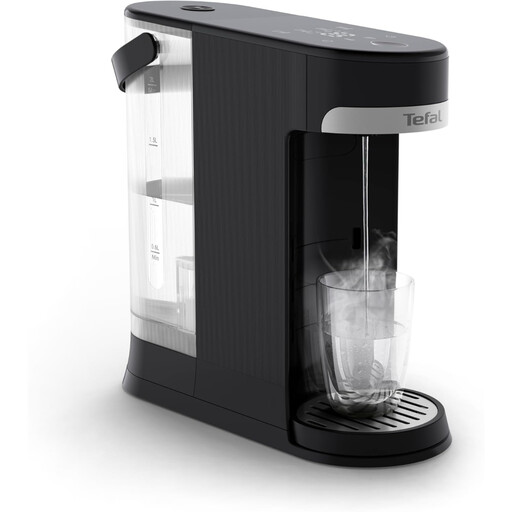
Consider this refillable-tank dispenser if the intended flask fits beneath its outlet; confirm clearance and whether its dispensing rate suits repeated fills.
The product title specifies a 2.7 L capacity, 13 temperature settings, a memory function and room-temperature dispensing. Check the applicable filter and servicing requirements.
 No image available
Consider this model for smaller flasks or staged filling. Check the actual outlet clearance and dispensing options; a larger flask may require several dispensing cycles.
 No image available
Consider its stated 4 L capacity where a larger refillable reservoir is useful. Check flask clearance and the available dispensing volumes before relying on it for busy periods.
Confirm the exact configuration’s filter provision before purchase.
Check the requirement for the exact model: Lincat specifies a water line for its EB3FX automatic-fill boiler. If a connection is impractical, Burco presents its MFCT10ST manual-fill boiler as an option without mains plumbing, though staff must refill it.
Measure the flask as it will stand during filling and compare it with the stated tap clearance, allowing room to place and remove it. Instanta specifies 304 mm from tap to drip tray for the CTSP10H; a photograph alone cannot establish fit.
Have the responsible person assess the appliance’s connected load, connection arrangement, circuit suitability and position relative to possible spills before installation. The Health and Safety Executive advises assessing electrical hazards and putting appropriate controls in place.
Yes—ask the installer which requirements apply to the proposed fittings and installation, and request documentation for the exact components being used. An approval associated with one model or component should not be assumed to cover an entire product range.