Office managers replacing a domestic kettle setup
You need an appliance whose instructions permit shared workplace use, with a suitable position and an agreed approach to electrical safety and upkeep.


For regular shared use, choose a commercial model whose instructions permit workplace use: a refillable countertop boiler suits a small office that can manage refills, while a plumbed-in automatic-fill boiler suits repeated demand where installation is feasible. Check the porridge packet’s required water temperature and quantity before choosing a dispenser; a household-only model, such as the Breville VKJ142, is unsuitable for this shared-office task.
You need an appliance whose instructions permit shared workplace use, with a suitable position and an agreed approach to electrical safety and upkeep.
A commercial countertop appliance avoids a fixed-water installation, provided someone can take responsibility for refilling and cleaning it.
When several people need hot water close together, sustained output and fewer refill interruptions matter more than reservoir size alone.
Start with the manufacturer’s intended-use instructions, then assess demand at the busiest break and the work involved in refilling or installation. Let the porridge packet determine the water-temperature and portion checks.
| Concern | What to check | Who this matters to |
|---|---|---|
| Workplace suitability and safety | Confirm that the exact model permits workplace use and check its electrical connection, placement instructions and provisions for managing spills. | If I am responsible for a shared appliance, I need one that can be used as instructed and maintained safely; around 36% of consumers put workplace suitability first. |
| Peak-time output and refilling | Compare hourly output or recovery information with the busiest period, as well as tank capacity and refill method. | When several colleagues prepare food at once, I want to avoid repeated waits or refills. Around 29% of consumers prioritise peak-time demand. |
| Porridge portions | Check the packet’s water quantity and temperature, the dispense controls and whether the actual pot fits beneath the outlet. | For an individual pot, I need to reach its fill line without awkward handling or overfilling; around 21% of consumers put portion control first. |
| Cleaning and upkeep | Check access to the tank and drip tray, the model’s descaling instructions and filter arrangements where applicable. | If I will look after the appliance, I need cleaning tasks that someone can reliably own. Around 14% of consumers prioritise upkeep. |
Capacity does not establish whether an appliance is intended for a shared office. Breville’s instructions for the 1.5 L VKJ142 say that model is for household use only.
Read the intended-use instructions for the exact model before comparing its tank or dispense settings.
Stored water and the rate at which an appliance can supply more hot water are different measures. A full tank may not cover a concentrated office break.
Consider the busiest likely period, then compare stated hourly output and recovery information alongside capacity and refill method.
Quaker’s Oat So Simple Original Pot calls for boiling water up to its 170 ml line. A fixed dispense setting may not match that line or leave enough room to position the pot safely.
Use the packet for the porridge you buy, and check the dispenser’s controls and clearance with the intended container.
An overfilled pot also creates spill clean-up work in a shared kitchen.
Descaling, cleaning and checks for damage can be overlooked when many people use the same appliance. The Health and Safety Executive advises keeping electrical equipment that could cause injury in a safe condition.
Assign responsibility, keep the model’s instructions accessible and take damaged or leaking equipment out of use pending assessment.
Descaling supplies, filters where fitted and time out of service all need planning.
These product lines illustrate different equipment types; check the specifications and intended use of the particular model before choosing.
Commercial boilers for settings including staff rooms where repeated demand may call for more than a small reservoir.
Automatic-fill commercial boilers for workplaces considering a permanent installation.
Professional hot-water equipment with compact options for locations with low demand.
Consumer HotCup dispensers offer a reference point for cup-oriented dispensing, but intended use varies by model.
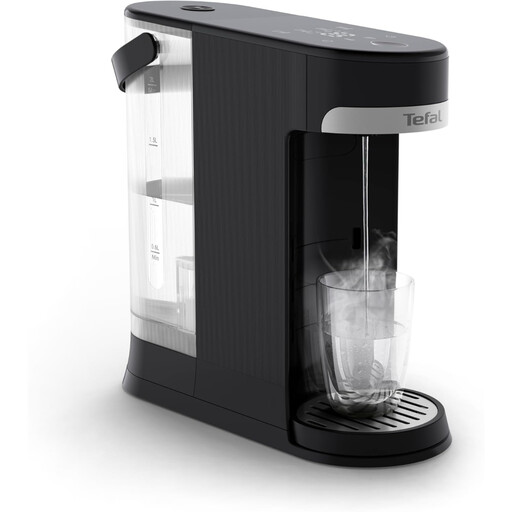
This countertop dispenser is relevant to portion-by-portion preparation, but check workplace suitability and the porridge packet’s temperature requirement before choosing it for a shared office.
 No image available
For individual porridge pots, check whether its dispense controls can reach the packet’s fill line and whether the pot fits safely beneath the outlet.
Its stated 95°C maximum does not meet the boiling-water instruction for Quaker Oat So Simple Original Pot. Confirm that its intended use covers a shared workplace and that its output suits the busiest break before choosing it.
Follow the particular packet rather than a generic cup setting. Quaker says to add boiling water to the 170 ml line in its Oat So Simple Original Pot, stir, replace the lid and let it stand for one minute before stirring again; other products may give different instructions.
An annual test is not an automatic requirement. The Health and Safety Executive says electrical equipment that could cause injury must be kept in a safe condition, while the appropriate inspection and testing arrangements depend on the equipment and its environment. Include user checks in the maintenance approach.
Check that the exact appliance is intended for the setting, can be connected to the available supply and has a stable, dry position where users can fill a pot without unsafe handling. The Health and Safety Executive advises assessing electrical hazards and controls; agree how colleagues will report damage or leaks.
Use the instructions for the exact model and assign someone to carry them out. Breville’s HotCup guidance, for example, includes repeated rinsing with clean water after descaling; do not assume another appliance uses the same procedure.