Families making several servings together
You prepare multiple bowls of instant soup or hot drinks in a short breakfast period and want portions you can repeat without frequent refilling.


For several instant-soup servings at breakfast, choose a dispenser whose usable water capacity and portion settings match the packets and the number of bowls you prepare; a larger tank can mean fewer refills. A simpler one-cup dispenser suits households serving boiling water one person at a time, while adjustable temperatures are worth considering if the appliance will also make other drinks or foods. Check safety controls and worktop space alongside capacity.
You prepare multiple bowls of instant soup or hot drinks in a short breakfast period and want portions you can repeat without frequent refilling.
You mainly want boiling water for individual servings and value straightforward controls more than a large tank or several temperature choices.
You need to consider access to the dispensing controls and safe placement as well as the time it takes to prepare breakfast.
For family-breakfast soup, work out the water needed for consecutive bowls before comparing tank sizes. Then check whether the dispense controls suit each packet’s instructions and whether the appliance fits safely into your kitchen routine.
| Concern | What to check | Who this matters to |
|---|---|---|
| Consecutive servings | Compare usable water capacity with the total quantity required by your soup packets; check how the tank is refilled. | If I make several bowls in one breakfast sitting, I want to finish them without interrupting the meal to refill the tank. Around 42% of consumers would put consecutive servings first. |
| Portions and temperature | Check dispense volumes against your bowls and packets. If a packet specifies boiling water, confirm the dispenser has a suitable setting. | When I prepare soup in different-sized bowls, I want a repeatable amount of water without overfilling one; around 33% of consumers would make portion control and temperature flexibility their primary concern. |
| Safety and upkeep | Look for a lock where children may reach the controls, and check shut-off features and the model’s descaling instructions. | In a busy shared kitchen, I want to limit accidental dispensing and keep the appliance working as instructed. Around 25% of consumers would prioritise safety and upkeep. |
Tank and usable filtered-water capacities can differ. Morphy Richards states a 3L removable tank but a 1.8L filtered-water capacity for the HydroTouch, so the headline tank figure alone may not describe the water available for consecutive bowls.
Add up the quantities on the soup packets you use and compare that total with the model’s usable-water information.
Preset volumes vary: Morphy Richards specifies 100ml, 200ml and 300ml for the HydroTouch, while the CASO Design HW 1660 Turbo has seven settings from 100ml to 400ml.
Check your usual bowl and packet instructions against the available settings, or look for a documented way to stop dispensing manually.
Hot-water controls and the dispensing area need careful placement when children are nearby. Electrical Safety First also advises checking automatic shut-off and boil-dry protection and cautions against overloading extension leads.
Choose a stable position out of children’s reach, consider a lock, and check the plug and electrical-safety features of the model you intend to buy.
Breville says excessive scale can be a reason its HotCup does not dispense a full cup, disrupting portions you expect to repeat.
Follow your model’s manual for descaling and cleaning rather than assuming every dispenser uses the same method.
The VKJ318 HotCup is a one-cup-at-a-time route for households mainly using boiling water.
The HydroTouch combines measured portions, selectable temperatures and a safety lock.
The HW 1660 Turbo is a larger-tank option with adjustable dispense volumes and temperatures.
These dispensers offer different capacities and temperature choices for preparing consecutive breakfast servings. Compare their stated controls with your soup packets before choosing.
 No image available
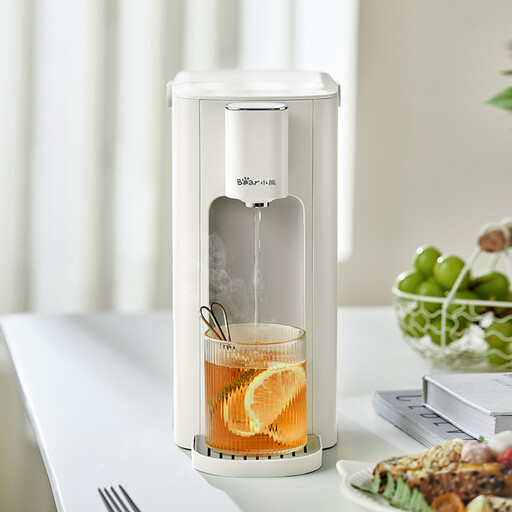
Consider this model if you want hot and room-temperature dispensing for several breakfast servings. The product title states a 2.7L capacity, 13 temperature settings and a memory function. Check that its available portion settings match your soup packets and confirm the plug and safety features needed for your kitchen.
 No image available
Consider the 3 L tank if you prepare several servings together. The product title states six temperature settings; before using one for soup, confirm it reaches the temperature required by the packet. Also check the dispense volumes, worktop footprint, plug and safety controls for your kitchen.
Start with the number of bowls you make consecutively and the water quantity each packet requires. Breville UK specifies a 2L tank for its VKJ318, Morphy Richards describes a 3L removable tank but 1.8L filtered-water capacity for the HydroTouch, and the CASO Design HW 1660 Turbo has a 4L tank. Check usable capacity rather than converting a manufacturer’s cup count directly into soup servings.
Choose a setting that meets your soup packet’s preparation instructions; if it calls for boiling water, check that the dispenser offers it. Adjustable temperatures may also be useful for other drinks and foods: Morphy Richards specifies four settings including 100°C for the HydroTouch, while the CASO Design HW 1660 Turbo has 40°C to 100°C control.
Consider a dispensing lock and place the appliance where children cannot reach the hot-water outlet. Electrical Safety First also advises checking automatic shut-off and boil-dry protection, using the appropriate UK 3-pin fused plug, and avoiding overloaded extension leads.
Check the descaling instructions for the exact model and follow them as part of routine maintenance. Breville says excessive scale can cause its HotCup to dispense less than a full cup, which matters when you rely on repeatable amounts for soup.