Breakfast managers using bean-to-cup machines or grinders
Whole beans let the team work to a set drink recipe. Check the machine’s dose, expected breakfast volume and how quickly an opened pack will be used.


Choose whole beans for a breakfast station with suitable grinding or brewing equipment, and order by weight using its actual dose per drink. For kettle-only service, individually wrapped coffee bags are a different option: Taylors Out of Home lists 80-bag cartons, so three cartons provide 240 bags. If the target is 240 prepared drinks instead, Waitrose & Partners’ stated recipes work out to 3.6 kg for 250 ml filter or cafetière cups, or 3.84–4.08 kg for 50 ml double espressos; the hotel’s recipe may differ.
Whole beans let the team work to a set drink recipe. Check the machine’s dose, expected breakfast volume and how quickly an opened pack will be used.
Individually wrapped coffee bags can be prepared with a kettle, without a grinder. They contain roast-and-ground coffee, not whole beans.
Decide whether decaf needs to work in the main coffee equipment or at a kettle station, then choose the corresponding bean or coffee-bag format.
Settle whether 240 means wrapped bags or prepared drinks, then match the format and quantity to the breakfast station.
| Priority | What to check | Your needs |
|---|---|---|
| Preparation format | Check whether the station has a suitable bean-to-cup machine or grinder, or only a kettle. Taylors Out of Home says its individually wrapped coffee bags brew with a kettle in two minutes. | For a staffed machine station, I can plan around whole beans. At a kettle-only counter, I need coffee bags rather than beans that guests cannot grind there. |
| The 240-unit target | Specify bags or prepared drinks. Three Taylors Out of Home 80-bag cartons make 240 bags. For beans, multiply the hotel’s dose by 240 and convert grams to kilograms. | I want the order to describe the portions we will actually serve, rather than treating a bag, a bean pack and a finished cup as interchangeable. |
| Bean quantity | Confirm dose and drink size. Waitrose & Partners gives 15 g per 250 ml filter or cafetière cup and 16–17 g per 50 ml double espresso: for 240 drinks, those recipes require 3.6 kg or 3.84–4.08 kg respectively, before any allowance for wastage. | If we use whole beans, I need a quantity based on our programmed drinks, including whether each milk drink uses a single or double espresso. |
| Pack turnover | Compare pack size with daily use and storage. Waitrose & Partners advises using its espresso beans within two weeks of opening for the taste described on its pack. | A large bean pack only works for my station if we expect to use the opened coffee at a suitable pace. |
| Ongoing supply | For repeat service, ask the supplier about the required pack format, equipment fit, delivery arrangements and substitutions. A retail product page alone does not set those terms. | If breakfast coffee is a recurring order, I need to know what the supplier will deliver and how changes to the usual product will be handled. |
Whole beans are ordered by weight, while coffee bags are counted as wrapped portions. An unspecified count can lead to the wrong format or quantity.
Write either “240 individually wrapped coffee bags” or “whole beans for 240 drinks”, with the intended dose and drink size.
Waitrose & Partners specifies 15 g for a 250 ml filter or cafetière cup but 16–17 g for a 50 ml double espresso. Those recipes produce different drink counts from the same weight of beans.
Check the breakfast machine’s programmed dose and cup size before calculating kilograms; plan any contingency separately.
A product listing identifies a pack, but it does not establish a hotel’s repeat-delivery schedule or substitution arrangements.
For regular breakfast service, confirm the required quantity and delivery terms directly with the supplier.
Pack size affects how long beans remain open, and a caffeinated blend does not provide a separate decaf choice. Waitrose & Partners advises using its espresso beans within two weeks of opening for the taste described on its pack.
Match pack size to expected use, record opening dates and specify decaf separately if it is part of the breakfast offer.
Lavazza UK lists 1 kg whole-bean products in its food-service range for hotels, restaurants and cafés.
illy describes a hotel programme with 1.5 kg and 3 kg whole-bean tins.
Taylors Out of Home lists both whole beans and individually wrapped roast-and-ground coffee bags.
Union offers a 1 kg whole-bean decaf blend that the brand describes as suited to espresso or bean-to-cup preparation.
M&S lists whole-bean coffees in 227 g and 454 g retail packs, as well as a separate roast-and-ground coffee-bag product.
Waitrose & Partners lists a 1 kg Espresso Beans product and gives separate dose guidance for double espresso and filter or cafetière coffee.
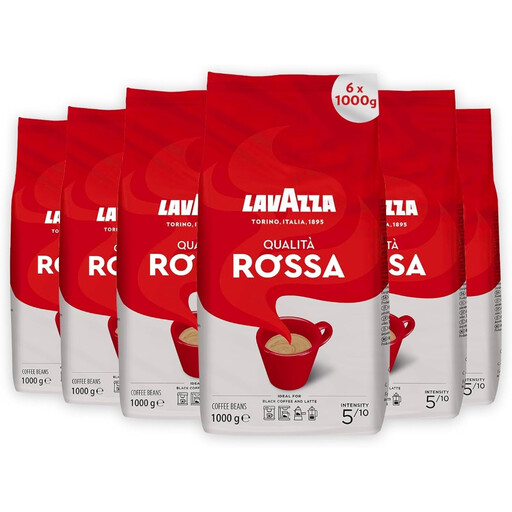
This case is for a hotel preparing breakfast drinks from whole beans; it is not a 240-bag option for kettle service.
 No image available
The 6 kg whole-bean case is relevant when the breakfast station has suitable grinding or brewing equipment and the order is for prepared drinks, not individually wrapped bags.
Joybuy describes the case for bean-to-cup, filter, French press and moka pot preparation. Check the hotel’s equipment, dose, pack turnover and repeat-supply needs before ordering.
No: it does not identify a useful whole-bean quantity. Lavazza UK lists food-service beans by kilogram, while Taylors Out of Home counts individually wrapped coffee bags in 80-bag cartons. Specify either 240 coffee bags or the weight of beans needed for 240 drinks at the hotel’s chosen dose.
It depends on the recipe. At Waitrose & Partners’ stated 15 g per 250 ml filter or cafetière cup, 240 cups use 3.6 kg; at its 16–17 g per 50 ml double espresso, 240 drinks use 3.84–4.08 kg. Check the machine’s actual dose and allow separately for any expected wastage.
Coffee bags can serve a kettle-based station, but they do not supply beans to a bean-to-cup or espresso machine. Taylors Out of Home describes its individually wrapped bags as containing roast-and-ground coffee that brews with a kettle in two minutes.
Choose the preparation format first. Taylors Out of Home lists decaf coffee bags in 80-bag cartons, while Union offers a 1 kg whole-bean decaf blend that it describes for espresso or bean-to-cup use. Specify the decaf quantity separately from the main coffee order.
The Food Standards Agency says UK retail and catering food businesses must provide allergen information for prepacked and non-prepacked food and drink. Keep current product and recipe information available for the coffee service, including additions such as milk, plant drinks and syrups; check each product rather than assuming different items have the same ingredients.