What matters when buying?
Choose a format around the quantity you expect to serve and what staff can prepare and hold safely. The concerns below cover the primary needs that can change that choice for a hotel breakfast buffet.
| Concern | What to check | Who this matters to |
|---|
| Service capacity |
Check pack size, labelled servings and the instructions for storing an opened pack. |
When several guests are likely to take custard, opening fewer packs makes replenishment simpler. About 29% of consumers put group-service capacity first. |
| Hot service and allergens |
Check heating directions, hot-holding arrangements and the allergens on the current pack. |
For a heated self-service station, maintaining the food correctly and communicating allergens matter more than the pack format alone. About 29% of consumers make these service controls their primary concern. |
| Pack use and waste |
Match the quantity opened to expected portions and the product's opened-pack storage period. |
If guest uptake varies, an unfinished large pack may be harder to use within its storage instructions. Avoiding opened-pack waste comes first for about 24% of consumers. |
| Recipe choice |
Read the nutrition panel, the stated basis of any reduction claim and the allergen declaration. |
Where a different sugar-and-fat profile is the menu priority, the exact recipe matters as well as the serving format. About 18% of consumers place recipe choice first. |
For hot holding in England, the Food Safety and Hygiene (England) Regulations 2013 set out requirements involving a 63°C threshold and applicable exceptions. Food Standards Agency caterer guidance says hot food should be held at 63°C or above. This is a service requirement to plan for, not a property of a custard carton.
Brands and product lines to consider
These examples show how pack formats differ; a brand's presence here does not mean every product in its range has the same ingredients, storage instructions or serving size.
Sainsbury's
Its ready-to-eat 1kg custard is a carton labelled as eight servings.
- A stated serving count gives staff a starting point for planning a group service.
- After opening, the researched carton must be refrigerated and consumed within three days.
Ambrosia
Its researched Devon and Light ready-to-serve lines include 1kg cartons for group service.
- The standard Devon 1kg carton is labelled as eight servings. Ambrosia says its Light 1kg recipe has 30% less sugar and fat than Ambrosia Devon Custard.
- The researched products contain milk-derived ingredients; the opened-pack storage instructions still need to be followed.
Tesco
Tesco lists a Reduced Fat Custard 1kg product among its custard range.
- The listed 1kg size is worth checking when planning a larger service.
- Read the current pack for its ingredients, preparation and opened-pack storage instructions before using it on a buffet.
Bird's
Bird's appears in the researched supermarket listings as a custard-powder option, not a like-for-like ready-to-serve carton.
- Powder can fit a kitchen that intends to prepare the quantity it needs.
- Preparation and subsequent service need staff time and food-safety controls.
M&S
Its researched Silky Smooth Custard is a 400g canned option rather than a 1kg group carton.
- The smaller pack may be easier to match to limited demand.
- M&S instructs consumers to eat this product within two days after opening.
Joybuy custard selections
These ready-to-serve custards cover a 1kg carton for planned group service and smaller packs to consider when demand is less certain. Check the quantity and current pack instructions against your own breakfast service.
 Image unavailable
Ambrosia Light Devon Custard 1kg
Consider this ready-to-serve 1kg option when planned demand suits a group carton and the menu calls for its particular recipe. Ambrosia says its Light custard has 30% less sugar and fat than Ambrosia Devon Custard; check the current allergen declaration, as the researched Light product contains milk-derived ingredients. Refrigerate after opening and consume within three days, following the pack instructions.
View on Joybuy
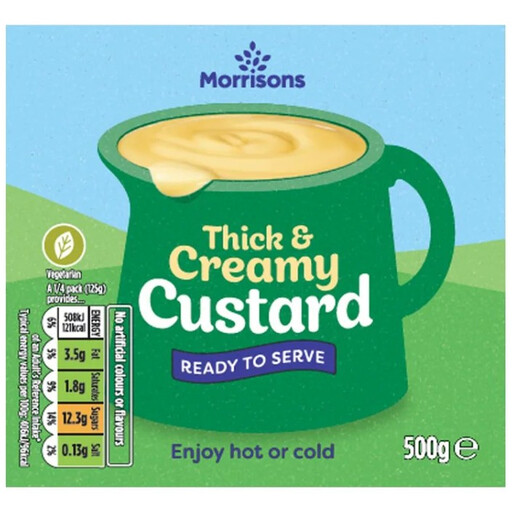 Image unavailable
Morrisons Ready To Serve Custard 500g
This ready-to-serve 500g product is a smaller-quantity option when a 1kg pack would exceed expected demand. Decide how many packs to open from your planned portions, and check the current pack for serving, allergen and opened-pack storage instructions.
View on Joybuy
 Image unavailable
Ambrosia Devon Custard 400g
The 400g size is worth considering when breakfast demand is low or uncertain. Check how much the service is likely to use, and follow the current pack's preparation, allergen and storage instructions for any remainder.
View on Joybuy
Frequently asked questions
How many servings are in a 1kg custard carton?
Sainsbury's Ready To Eat Custard 1kg and Ambrosia Devon Custard 1kg are each labelled as eight servings. Use the stated 125g portions as a planning reference, then allow for how custard is served at your buffet.
Can ready-to-serve custard be offered hot at breakfast?
Yes, the researched 1kg ready-to-serve products provide heating directions, but heating the pack and holding food for buffet service are separate steps. Food Standards Agency caterer guidance says hot food should be held at 63°C or above; in England, the Food Safety and Hygiene (England) Regulations 2013 set out hot-holding requirements and exceptions. Use equipment and procedures appropriate to the service.
What allergen information should accompany buffet custard?
In England, Northern Ireland and Wales, GOV.UK guidance says food businesses must provide allergen information for food and drink they serve. The researched Sainsbury's 1kg custard and Ambrosia standard and Light 1kg products contain milk-derived ingredients. Check each current pack and use its declaration in the hotel's allergen information.
Is Bird's powder a direct substitute for a 1kg ready-to-serve carton?
No. The researched Bird's option is custard powder, which the kitchen must prepare rather than pour from a ready-to-serve carton. Choose it only if the kitchen can accommodate the preparation and service process.
Are the larger sharing packs tins or tubs?
The researched ready-to-serve 1kg Sainsbury's and Ambrosia packs are cartons, not tins or rigid tubs. Check the actual container and pack size when a particular format matters for ordering, storage or serving.


