Single-portion soup makers
If you usually make one mug at a time, a straightforward single-cup dispenser may meet your needs without lifting and pouring from a full kettle. Compare the amount it dispenses with your usual mug and soup packet.


For one mug of instant soup at a time, a simple single-cup dispenser may be enough; choose selectable volumes if matching the water quantity on the soup packet matters. A larger tank is worth considering for several guests, while temperature controls are useful only when the available settings suit the soup instructions and other planned drinks. For a holiday cottage, also check counter space, safe placement and the upkeep the appliance requires.
If you usually make one mug at a time, a straightforward single-cup dispenser may meet your needs without lifting and pouring from a full kettle. Compare the amount it dispenses with your usual mug and soup packet.
If you supply the appliance for guests, consider how easily you can refill, clean and inspect it between stays. Check the responsibilities that apply where the cottage is located.
If several people will make soup, tea or coffee, a larger reservoir may mean fewer refills. Selectable volumes or temperatures are worth considering when those settings match what the group will prepare.
Start with the water quantity and temperature required by the soup packet, then decide how many servings the dispenser needs to handle before refilling.
| Concern | What to check | Who this matters to |
|---|---|---|
| Soup portion size | Compare selectable volumes or the stop control with the soup packet’s instructions and the clearance beneath the nozzle. | For one mug, I want to add the intended amount of water without overflowing it; around 31% of consumers put portion control first. |
| Servings between refills | Compare tank capacity with the number of consecutive servings needed, then check the appliance’s footprint. | When several guests want soup or drinks close together, I would rather not refill after each serving; roughly 31% of consumers prioritise capacity. |
| Guest-facing use | Check the model’s safety features, placement and cord instructions, and how you will inspect and clean it. | If guests will use a dispenser I supply, I need a practical way to keep it safely placed and maintained; around 23% of consumers make guest-facing use their main concern. |
| Other drinks and limescale | Check available temperatures against intended uses and read the model’s filter and descaling instructions. | If the dispenser will also make varied drinks, I care about useful settings and manageable upkeep; approximately 15% of consumers put that flexibility first. |
A larger reservoir changes how often you refill it; it does not establish how much water reaches one mug.
Check the actual volume choices or stop control, and make sure your usual mug fits beneath the nozzle.
Safety features do not replace the placement and operating instructions for the model. Breville’s VKT111 booklet specifies a stable, secure, dry and level surface.
Follow the chosen model’s manual, keep the cord clear of heat and damage, and give guests straightforward operating instructions.
A replaceable filter does not remove the need to follow the model’s cleaning instructions. Breville’s HotCup descaling guidance calls for several rinses with clean water afterwards.
Choose a maintenance routine you can carry out between guests and retain the instructions for the appliance you buy.
Depending on the model’s instructions and local water conditions, descaling may require a suitable cleaning product and time for repeated rinsing.
England’s GOV.UK guidance for self-catering holiday homes directs operators to HSE electrical-safety guidance. Electrical Safety First notes that legislation differs across UK nations.
Inspect the appliance and cable before guest use and confirm the requirements that apply in the cottage’s nation and locality.
The HotCup models considered here offer a choice between simpler single-cup use and selectable dispensing volumes.
The SWD1001 is an option to examine when several servings between refills matter.
The HW550 is relevant when a cottage dispenser will serve soup and drinks needing different settings.
The HydroTouch SKU 130002 offers preset temperatures and volumes for uses beyond a single fixed soup portion.
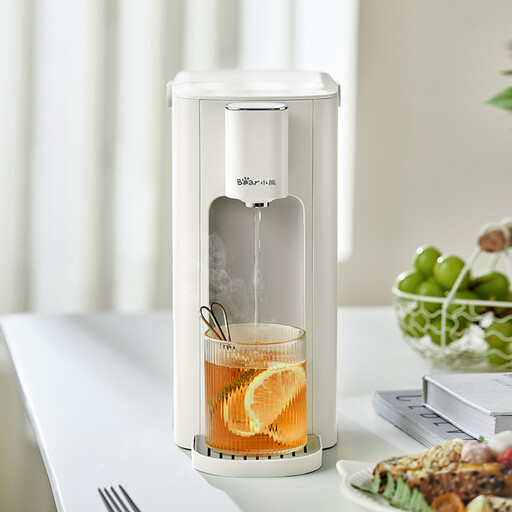
This 3 L dispenser is worth considering when several cottage guests may need hot water. Check its portion and temperature settings against the soup you plan to make.
 No image available
Consider this model if you need a dispenser for several cottage servings and can accommodate its tank. Its product name specifies a 3 L capacity, six temperature settings and digital controls. Before choosing it, check that its settings suit the soup packet, and confirm the counter dimensions, plug type and cleaning instructions.
Choose capacity around the number of servings needed before a refill, not the water quantity for one soup. The Breville VKJ142 is listed at 1.5 litres and up to five cups, the Swan SWD1001 at 2.5 litres and 10 cups, and the Caso HW550 at 2.9 litres and 12 cups; also check the dispense control and your mug size.
No single dispenser setting should be assumed suitable for every instant soup: follow the water instructions on its packet. Morphy Richards lists 40°C, 60°C, 80°C and 100°C presets for the HydroTouch, while the Caso HW550 has variable temperature.
Follow the cleaning and descaling instructions for the exact model and leave time to complete them between guests. Breville’s HotCup descaling guidance says to rinse the dispenser several times with clean water after descaling.
Check the appliance’s condition and the duties applicable where the cottage is located. For self-catering holiday homes in England, GOV.UK directs operators to HSE electrical-safety guidance; Electrical Safety First notes that legislation differs across UK nations.
Do not use a leaking or visibly damaged dispenser; tell the cottage host or manager. Breville’s safety instructions warn against using its appliance if it has been dropped, shows visible damage or is leaking.