
24/7 Customer Support

Free returns

Same-day & Next-day Delivery

Quality Guaranteed

Unlock Your Welcome Offers: FREE Delivery | Up to 80% OFF | Free 30-day JoyPlus trial
Download the APP
A household insect killer spray can be a practical way to deal with insects in a rented flat, family home, student accommodation, small business or landlord-managed property. However, choosing by can size or bold packaging alone can lead to wasted money, poor coverage and unnecessary exposure to insecticide.
As the Joybuy Product Recommendation Officer, I focus on matching the product to the pest, treatment area and practical needs of UK households. These are the common buying pitfalls to avoid before placing an order.
A broad-spectrum aerosol may deal with occasional flies or ants, but it may not be suitable for bed bugs, clothes moths or flea eggs. These pests often hide in fabrics, floor edges, wardrobes or cracks and crevices.
For a targeted problem, look for a product specifically labelled for the pest involved, such as a bed bug killer spray, flea killer spray, clothes moth killer or carpet beetle killer.
Residual protection only applies to the surfaces and areas treated according to the label. It does not necessarily protect every room, untreated textile or new entry point. Claims such as “up to four weeks” or “up to 12 weeks” should be read alongside the application instructions and pest life cycle.
A follow-up treatment, cleaning routine or non-chemical control may still be necessary, particularly where eggs and larvae are present.
Some sprays are suitable for hard surfaces and soft furnishings, while others must not be applied directly to clothes, bedding, pet bedding, animals or food-contact surfaces. A product that works on skirting boards may not be suitable for a mattress or wardrobe interior.
Always check the label, test an inconspicuous area where permitted, remove food and utensils, keep children and pets away, and ventilate treated rooms as instructed.
First identify whether you need control for flying insects, crawling insects or a more specific pest.
A trigger spray offers more controlled application for edges and hiding places. An aerosol may be useful for direct treatment or room-area application. A single-shot bomb can disperse product into cracks and crevices, but it requires careful room preparation and strict re-entry instructions.
Consider the room size, ventilation, furniture density and whether you need targeted application or wider indoor pest control.
UK biocidal products should be used strictly according to their packaging and instructions. Check the active ingredients, approved use, warnings, ventilation requirements and any stated registration details.
Common household insecticide ingredients in this selection include cyphenothrin, prallethrin, permethrin, tetramethrin, cypermethrin and benzalkonium chloride. These are not interchangeable: the correct use depends on the formulation and label. Never mix insecticides or apply more frequently than instructed.
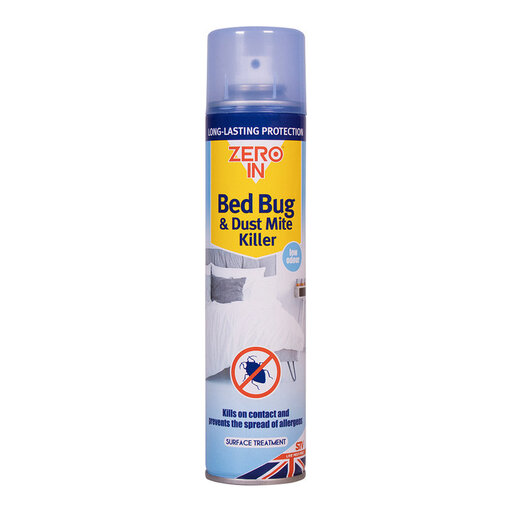
Why This Fits Their Persona: A compact option for renters and households dealing with a defined problem around sleeping areas, bed frames or skirting boards.
Its stated pest coverage is narrower than a general aerosol, helping shoppers avoid paying for an unsuitable all-purpose product.
300ml format; intended for bed bugs and dust mites; suitable for stated hard and soft furnishing applications.
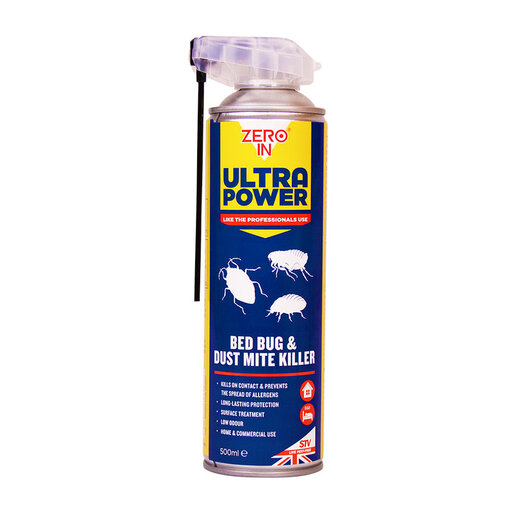
Why This Fits Their Persona: Suitable for larger homes, landlords and users who want one can with both precision and broader spray options.
The dual-action nozzle makes it easier to target cracks and crevices rather than relying only on an indiscriminate room spray.
500ml format; fold-down lance for targeted treatment; broader V-shaped spray pattern for room areas and flying insects.

Why This Fits Their Persona: A larger-capacity choice for landlords, small businesses or households managing several pest types across multiple areas.
Its listed coverage includes fleas, bed bugs, clothes moths and other household pests, reducing the need to buy several narrowly focused cans.
600ml trigger format; targeted crack-and-crevice application; residual action stated for up to 12 weeks against emerging eggs and larvae.
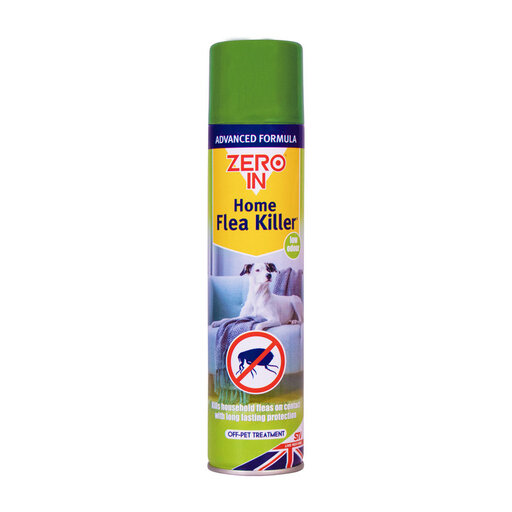
Why This Fits Their Persona: Designed for household areas affected by fleas, including carpets, rugs, cushions, pet bedding and baskets, while keeping the treatment separate from the animal.
The product instructions clearly state not to spray directly onto animals, helping prevent a common and serious misuse.
300ml format; stated use on soft furnishings and carpets; protection of treated areas listed for up to four weeks.
Before using any crawling insect killer or flying insect aerosol:
We have compiled a complete, real-time list of products that fully satisfy these strict selection criteria and UK safety regulations.
The lifespan of the treatment varies by product, pest and treated surface. The products listed above specify protection periods ranging from over two weeks to up to 12 weeks. These are treated-area claims, not a guarantee that an entire property remains pest-free. Follow-up applications must follow the product label.
A spray provides more control for skirting boards, bed frames, wardrobes and cracks. An insect bomb can reach room areas and crevices with a single-shot application, but requires careful preparation, evacuation and ventilation. Choose according to the room size, pest location and label instructions.
Only where the product label permits it, and never directly on an animal unless specifically formulated and authorised for that purpose. Remove pets during treatment, keep them away until the area is fully ventilated and dry, and use separate veterinary products for flea control on animals.