
24/7 Customer Support

Free returns

Same-day & Next-day Delivery

Quality Guaranteed

Unlock Your Welcome Offers: FREE Delivery | Up to 80% OFF | Free 30-day JoyPlus trial
Download the APP
Choosing between hair dryers can be harder than it looks. Product pages often highlight motor speed, ion counts and wattage, while leaving out details that affect everyday use, such as weight, attachment compatibility, heat control and cleaning.
For UK shoppers, three buying traps appear repeatedly:
The right choice depends on your hair type, styling habits and where you plan to use it.
A fast-drying hair dryer needs a useful combination of airflow and heat. Household models commonly range from around 1,500W to 2,300W, while high-speed models may use brushless motors with speeds of 100,000 RPM or more.
However, RPM figures should not be viewed in isolation. Check the stated airflow speed, available fan settings and whether the dryer includes a concentrator nozzle. A high-speed hair dryer with adjustable airflow can be more versatile than a high-wattage model with limited control.
For everyday UK home use, 1,600W to 1,800W can provide a practical balance between drying performance and manageable power consumption. Thick, long or dense hair may benefit from stronger airflow, but the dryer should still offer lower heat settings.
Look for at least two heat levels, two speed settings and a cool-air option. More settings make it easier to adapt the dryer for fine hair, thick hair, children or styling with attachments.
Temperature sensors can help regulate heat, but they should not be treated as a guarantee against damage. Keep the dryer moving, avoid holding hot air close to the scalp and use the lowest effective temperature.
UK users should also check that the product is suitable for 220–240V mains power and has an appropriate UK plug or clearly stated compatibility. Never use a hair dryer near a bath, shower, sink or other water source. Unplug it after use, particularly in a bathroom, and keep air vents clear of hair and lint.
A lightweight hair dryer is useful if you have long or thick hair, style frequently or experience arm fatigue. Models weighing approximately 270g to 480g are easier to hold for longer sessions, although the shape and balance of the handle matter too.
Noise ratings can help if you live with children, flatmates or light sleepers. Some models list operation at around 56–58dB, but the perceived sound may vary depending on the room and airflow setting.
Attachments should match your styling needs:
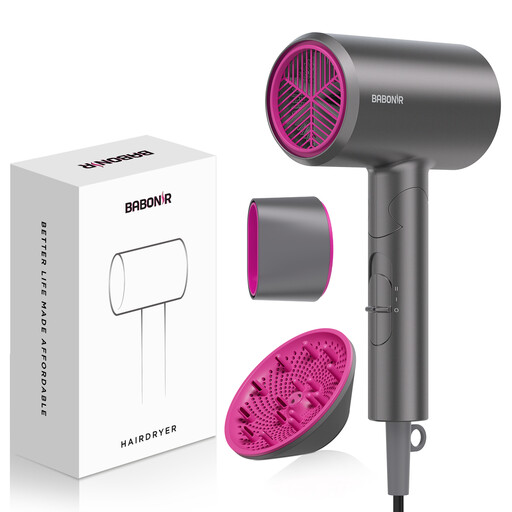
Why This Fits Their Persona: A practical option for everyday home drying and occasional short trips, with a 330g body and foldable handle.
It combines stated airflow and motor figures with three temperature settings and two power settings, rather than relying on wattage alone.
1800W power, 20,000 RPM motor, diffuser and concentrator included; foldable 330g design.
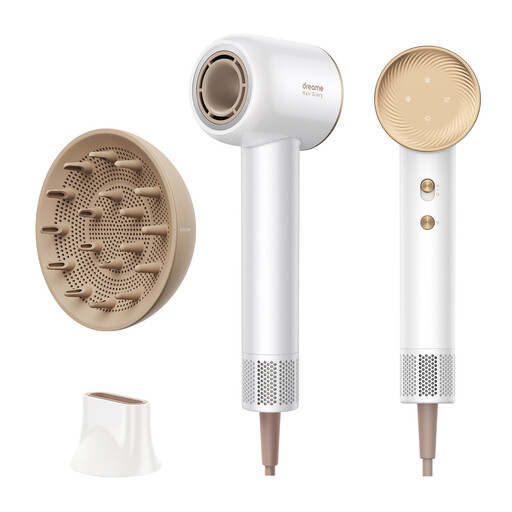
Why This Fits Their Persona: Suitable for shoppers wanting a compact, high-speed dryer with a diffuser for varied home styling.
Its specifications include weight, noise level, temperature control and attachments, making practical comparison easier than judging ion figures alone.
110,000 RPM motor, 70m/s stated airflow, 345g weight, diffuser and smoothing nozzle.
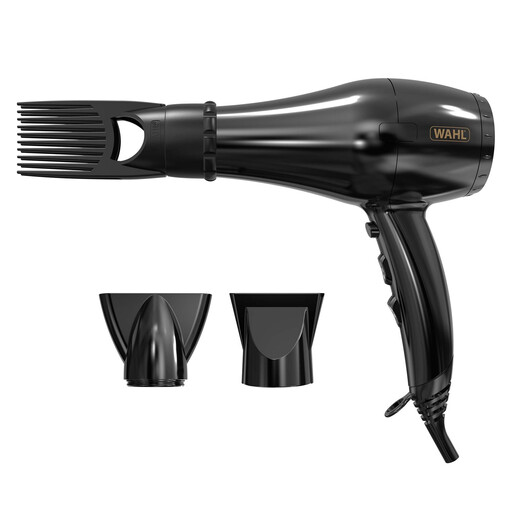
Why This Fits Their Persona: Designed for Afro, curly and textured hair, particularly where root access and controlled airflow are priorities.
The dedicated pik attachment addresses dense roots, while the guidance to avoid maximum heat with attachments helps prevent careless use.
1800W power, ionic conditioning, three heat settings, two speeds, cool shot and 3m cable.
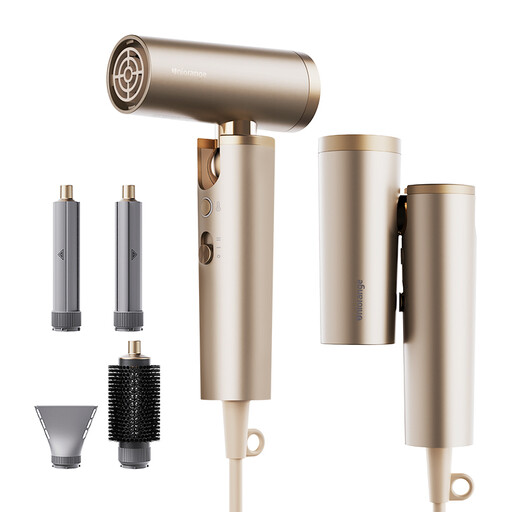
Why This Fits Their Persona: A compact travel hair dryer for users who need foldable storage and international voltage flexibility.
Its dual-voltage specification avoids the common mistake of assuming a UK dryer can be used safely overseas.
Foldable design, 100–240V dual voltage, removable filter with self-cleaning mode and four attachments.
We have compiled a complete, real-time list of products that fully satisfy these strict selection criteria and UK safety regulations.
An ionic hair dryer may help reduce static and leave hair feeling smoother, particularly in dry indoor conditions. It should still be used with sensible heat, regular movement and an appropriate distance from the scalp. Ionic technology is a feature, not a substitute for temperature control.
Running cost depends on the appliance’s wattage, the electricity tariff and drying time. A 1,800W dryer uses 1.8 kilowatt-hours if operated continuously for one hour. Most sessions are much shorter, so reducing drying time and switching the appliance off when finished can limit consumption.
Lifespan depends on build quality, frequency of use, ventilation and maintenance. Clean the filter regularly, avoid blocking the air inlet, allow the appliance to cool before storage and stop using it if the cord, plug or housing becomes damaged. Always follow the supplied manual for cleaning and care.