
24/7 Customer Support

Free returns

Same-day & Next-day Delivery

Quality Guaranteed

Unlock Your Welcome Offers: FREE Delivery | Up to 80% OFF | Free 30-day JoyPlus trial
Download the APP
As a Joybuy Product Recommendation Officer, my role is to help you navigate the crowded market of tech accessories. A reliable power bank is no longer a luxury but a daily necessity for many of us in the UK, whether we're commuting on the train, studying on campus, or travelling abroad. However, the market is filled with confusing specifications and marketing claims that can lead to a disappointing purchase.
Before you spend your money, let's look at the three most common pitfalls that catch out unsuspecting buyers and how you can avoid them.
You buy a 10000mAh power bank, assuming it will charge your 3,500mAh phone almost three times. In reality, you might only get one and a half charges. This isn't a faulty product; it's a misunderstanding of "rated capacity." The advertised mAh refers to the total capacity of the internal battery cells. However, energy is always lost during the voltage conversion process when charging your device. A reputable manufacturer will also list the rated capacity, which is the actual, usable power you can expect. Always look for this figure to get a realistic idea of its performance.
Nearly every portable charger claims to be a fast charging power bank, but the term is often meaningless without context. True fast charging depends on two things: wattage (W) and charging protocols (like Power Delivery (PD) or Quick Charge (QC)). A power bank with a 22.5W output will charge a compatible smartphone quickly, but it won't make a difference for a laptop that requires 65W or more. You need to match the power bank's output wattage and protocol to your device's requirements.
A bulky power bank with the wrong ports is just an expensive paperweight. Many users buy a new USB-C power bank only to realise all their cables are the older USB-A type. Others grow tired of carrying a tangle of wires. Modern designs now offer solutions like integrated cables, ultra-slim profiles for portability and magnetic wireless power bank options (often called MagSafe power bank compatibility) that make charging effortless.
To make an informed choice, focus on these core parameters instead of just the marketing headlines.
Capacity, measured in milliamp-hours (mAh), tells you how much charge the battery holds. Here’s a practical guide:
For air travel, the critical figure is Watt-hours (Wh). UK and international aviation rules generally permit power banks under 100Wh in carry-on luggage. Most consumer power banks, even high-capacity ones, fall well below this limit.
This determines how fast your devices will charge.
Ensure the power bank has the ports you need. A combination of USB-C (for modern devices) and USB-A (for legacy accessories) offers the most versatility.
Based on these practical criteria, we've matched several models to different user needs. These recommendations focus on transparent specifications and practical design.
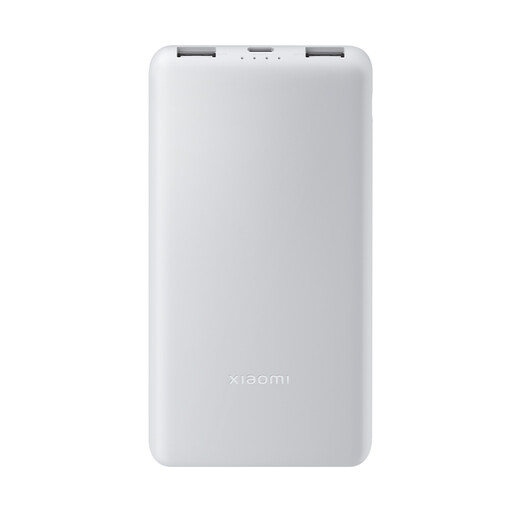
Why This Fits Their Persona: This is a reliable, no-fuss portable battery pack for anyone needing to keep their phone alive through a day of lectures or a commute into the city. Its slim and lightweight design won't weigh down a backpack or handbag.
It avoids the "fast charging" ambiguity by clearly stating its 22.5W maximum output, which is ample for modern smartphones. The 10,000mAh capacity is a practical size for daily use, not an oversized, underutilised brick.
Features both USB-A and USB-C ports for broad compatibility and supports two-way fast charging via the USB-C port, so the power bank itself recharges quickly.
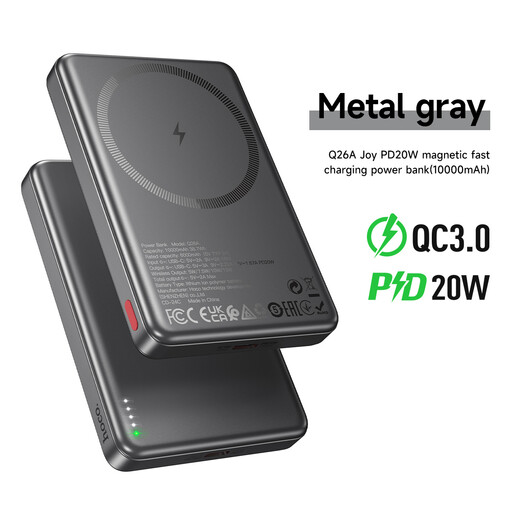
Why This Fits Their Persona: For the user who values convenience and a cable-free setup, this magnetic power bank is a perfect companion for a MagSafe-compatible iPhone. It snaps onto the back of the phone, charging it wirelessly without any fuss.
It solves the design and connectivity pitfall by eliminating the need for a separate charging cable between the phone and the bank. It also provides clear charging speeds: up to 15W wireless and 20W PD wired charging via its USB-C port.
Offers dual-mode charging, allowing you to power one device wirelessly and another via the USB-C port simultaneously. The premium aluminium alloy body aids in heat dissipation.
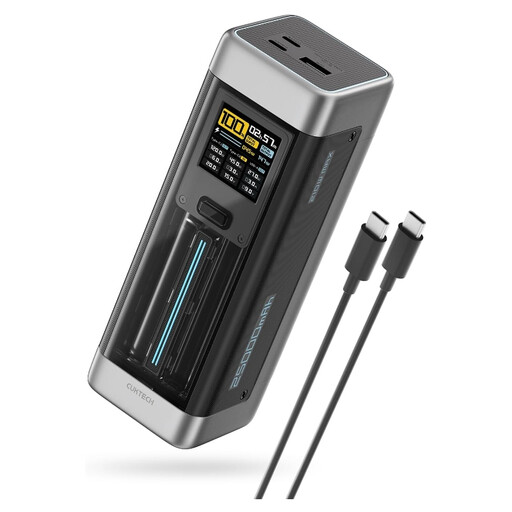
Why This Fits Their Persona: This is a high-performance laptop power bank for professionals and travellers who need to power demanding devices like a MacBook Pro, a tablet and a phone. Its massive capacity and output can sustain a mobile workstation.
It cuts through the "fast charging" jargon with a clearly stated 140W maximum output and support for the advanced PD3.1 protocol. This is a verifiable specification that guarantees high-speed charging for compatible laptops, not just a vague promise.
Its 25,000mAh capacity provides substantial power reserves, while the three-port design (2x USB-C, 1x USB-A) allows for simultaneous charging of multiple gadgets. The colour display provides real-time data on power output for each port.
We have compiled a complete, real-time list of products that fully satisfy these strict selection criteria and UK safety regulations.
As a general rule, you can expect a 10,000mAh power bank to charge a typical modern smartphone (with a battery of 3,500-4,500mAh) around 1.5 to 2 times. This accounts for the energy lost during power conversion. To get a more precise estimate, look for the "rated capacity" (usually around 5,800-6,500mAh for a 10,000mAh model) and divide it by your phone's battery capacity.
Most power banks are allowed in your carry-on luggage, but they are strictly forbidden in checked baggage. The universal limit set by aviation authorities is 100 Watt-hours (Wh) per battery. Nearly all consumer power banks, including 20,000mAh and even some 27,000mAh models, fall under this limit. The Wh value is almost always printed on the device casing.
The lifespan of a portable charger is measured in charge cycles. A quality power bank should last for at least 300-500 full charge/discharge cycles before its capacity begins to noticeably degrade. For an average user, this translates to several years of reliable service. To prolong its life, avoid exposing it to extreme temperatures and try not to leave it fully discharged for long periods.