
24/7 Customer Support

Free returns

Same-day & Next-day Delivery

Quality Guaranteed

Unlock Your Welcome Offers: FREE Delivery | Up to 80% OFF | Free 30-day JoyPlus trial
Download the APP
A flat battery on your phone or laptop is more than an inconvenience; it can disrupt your entire day. A reliable power bank is the solution, but the market is flooded with options that often over-promise and under-deliver. Many portable chargers suffer from inflated capacity claims, ambiguous "fast charging" labels and poor construction that can fail within months.
As a Joybuy Product Recommendation Officer, my role is to help you see past the marketing clutter. This guide will break down the essential features to look for and highlight the common traps to avoid, ensuring you invest in a device that genuinely meets your needs.
Before you add any portable charger to your basket, be aware of these widespread issues that lead to buyer's remorse:
To make a smart purchase, focus on these three non-negotiable specifications.
Instead of just looking at the headline mAh number, try to find the Watt-hour (Wh) rating. This is a more accurate measure of energy content. For air travel, global regulations, including those followed in the UK, restrict batteries in carry-on luggage to 100Wh. Most power banks up to around 27,000mAh fall under this limit, but it's always crucial to check. A 20000mAh power bank is often a good balance of high capacity and flight compliance.
This is the most critical factor for performance. Look for the 'W' (Watts) rating.
A power bank is a travel companion, so its build is important.
Based on these practical criteria, here are some options tailored to different user needs.

Why This Fits Their Persona: This is for the user who values aesthetics as much as function. Its compact, elegant design and soft ambient lighting make it a stylish accessory rather than just a piece of tech. It's perfect for slipping into a handbag for all-day power without the bulk.
It clearly states both the 10,000mAh battery capacity and the 5,500mAh rated capacity, avoiding the capacity illusion. The 22.5W output is also clearly defined, so you know exactly what charging speed to expect.
Unique design with warm LED ambient light. Comes as a complete package with a quality USB-C cable and travel pouch.
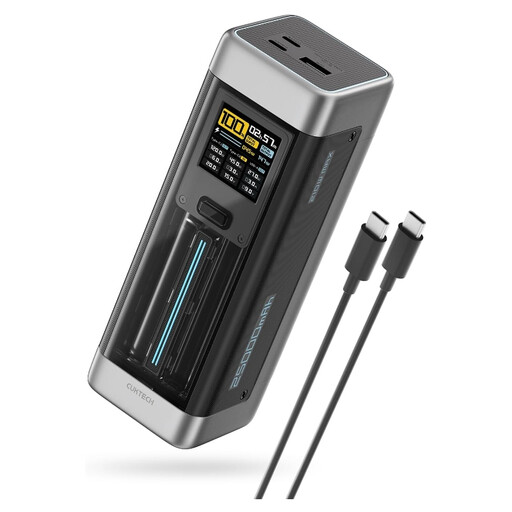
Why This Fits Their Persona: For the professional who relies on a laptop, tablet and phone throughout the day. This is a true laptop power bank, delivering an immense 140W via a single USB-C port, enough to fast-charge even a 16-inch MacBook Pro. The 25,000mAh capacity provides ample power for multiple devices.
It demolishes the "vague fast charging" trap by offering a specific, verifiable 140W PD3.1 output. The detailed safety information and use of high-density 21700 cells show a focus on performance and safety, not just marketing.
Genuine 140W single-port output for high-performance laptops. Features a colour display showing real-time charging stats for each port.
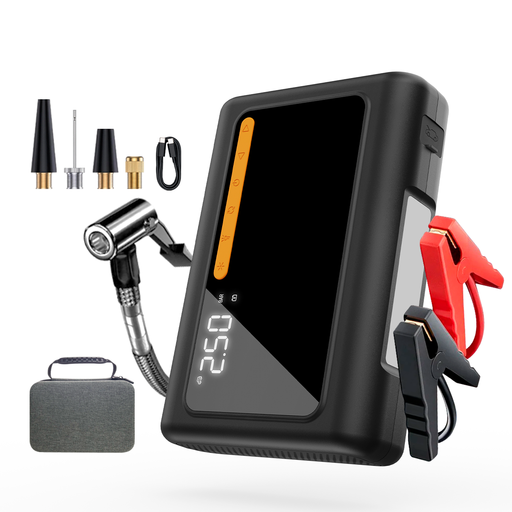
Why This Fits Their Persona: This is the ultimate emergency tool for anyone who drives. It's not just a power bank; it's a car jump starter, tyre inflator and flashlight. Its sodium-ion battery is specifically designed to be safely stored in a car, withstanding extreme temperatures where lithium batteries would fail or become hazardous.
It directly confronts the safety and durability trap. Unlike standard lithium power banks, its sodium-ion chemistry is stable from -40°C to 80°C, making it safe to leave in a car year-round. The 5-year standby claim addresses the issue of battery drain in emergency devices.
4-in-1 functionality is incredibly practical. The sodium-ion battery provides superior safety, a much longer cycle life (6,000 cycles) and an extremely low self-discharge rate.
We have compiled a complete, real-time list of products that fully satisfy these strict selection criteria and UK safety regulations.
As a general rule, expect a 10,000mAh power bank to provide around 6,000-7,000mAh of usable charge. This means it can charge a modern smartphone with a 4,500mAh battery approximately 1.5 times. The exact number depends on the power bank's energy efficiency and your phone's battery size.
Yes, in most cases. Airline regulations typically limit batteries to 100Wh (Watt-hours). A 20,000mAh power bank is usually around 74Wh, which is well within the limit for carry-on luggage. However, you must not pack it in your checked baggage. Always verify the Wh rating on the device itself before travelling.
The key difference is power output, measured in Watts (W). A standard portable charger might offer 10-22.5W, which is fine for phones and small devices. A true laptop power bank must provide a much higher output via a USB-C Power Delivery (PD) port—typically 60W, 100W, or more—to be able to charge a laptop efficiently. Using a low-wattage charger on a laptop will either not work or charge it extremely slowly.