What matters when choosing?
Check the room’s humidity before choosing an output level, then match the unit to the room and to the cleaning routine you can sustain. Dorset Council describes around 40–55% relative humidity as normally comfortable in an occupied home and warns of greater condensation and mould risk when it is regularly above 60%.
| Concern | What to check | Who this matters to |
|---|
| Room capacity |
Compare stated room coverage and moisture output for the intended mode; check the test conditions where given. A larger tank alone does not establish room suitability. |
If I need to add moisture across a larger heated room, I want coverage and output figures relevant to that space. Around 33% of consumers put room capacity first. |
| Cleaning and consumables |
Read the exact model’s tank and base cleaning instructions, and check which water-treatment parts need replacing. |
When regular cleaning would be hard to keep up with, I need a water system and replacement-part routine I can manage. Cleaning and consumables come first for around 27% of consumers. |
| Overnight disruption |
Check noise in the mode you intend to use, whether lights can be turned off, and the stated runtime at that setting. |
In a bedroom, I need to sleep without intrusive sound, light or a refill during the night. Around 20% of consumers prioritise overnight disruption. |
| Excess humidity |
Use a humidistat or independent hygrometer, and reduce or stop output if condensation appears or room humidity stays high. |
If my home is prone to condensation, I need to know when adding moisture is no longer helpful. Avoiding excess humidity is the primary concern for around 20% of consumers. |
Joybuy humidifiers for these rooms
These models offer different tank sizes and controls to consider for a heated bedroom or living room. Check each listing’s room claim against your space, and plan to monitor humidity and follow the model’s cleaning instructions.
 No image available
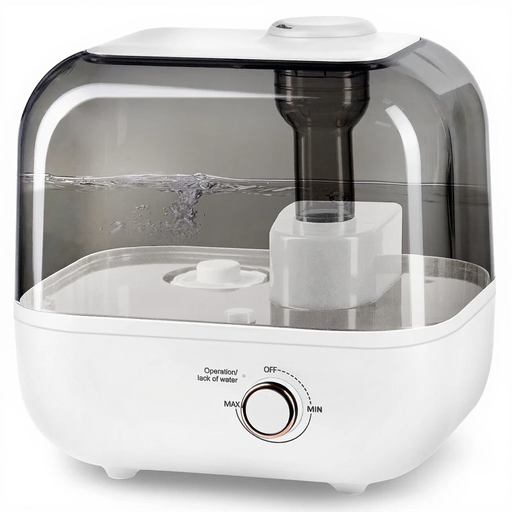
Bear 5 L bedroom humidifier, white
Consider this top-filling model if overnight noise and straightforward refilling matter in a bedroom. Its listing states a 5 L tank, 35-hour runtime, 28 dB noise claim and an aromatherapy tray; check the conditions behind the runtime and noise figures for your intended setting.
Use a hygrometer to judge when the room has enough moisture, and check the model’s cleaning instructions before purchase.
View on Joybuy
 No image available
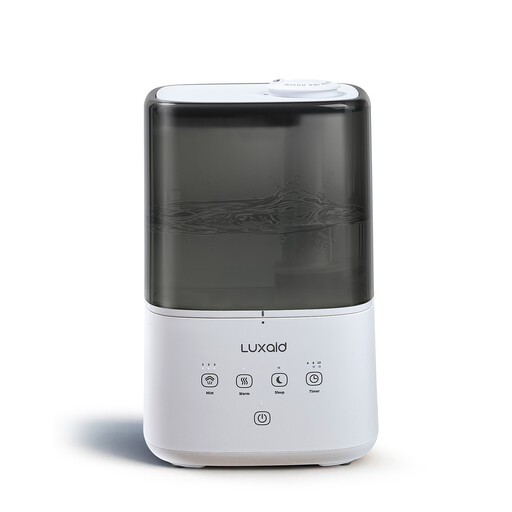
Luxaid 4.5 L cool- and warm-mist humidifier
Consider this model if you want to choose between cool and warm mist. Its listing states coverage up to 505 ft², a 4.5 L top-fill tank, 4-, 8- and 12-hour timer settings, and a 20 dB sleep-mode claim; check whether the coverage and noise claims apply to your intended setting.
Before choosing a mist mode, check its power use and the model’s cleaning and filter instructions. Monitor room humidity rather than using the coverage figure as a humidity target.
View on Joybuy
 No image available
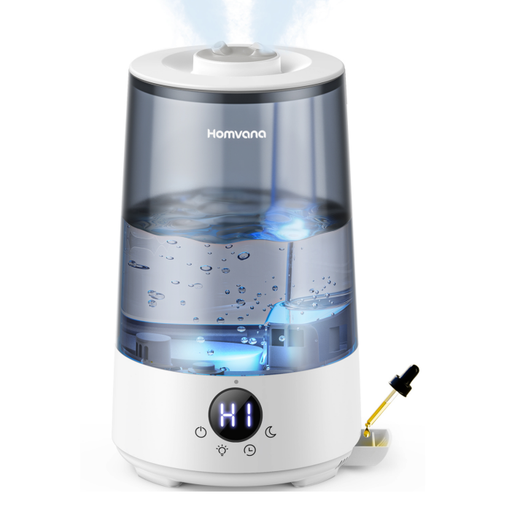
Homvana H101 Grey 3.6 L humidifier
Consider this top-filling cool-mist model for bedroom use if its stated 16 dB noise claim suits the mode you intend to run. The listing also describes a 3.6 L tank, a night light and a separate aroma tray.
Check the applicable overnight runtime before buying: the listing gives conflicting figures of up to 29 and up to 34 hours. Follow the model’s cleaning instructions and put essential oils only in the aroma tray, not the water tank.
View on Joybuy
Frequently asked questions
What humidity should I aim for in a heated room?
Use a hygrometer and aim broadly for the 40–55% relative-humidity range Dorset Council describes as normally comfortable in an occupied home. Reduce or stop humidifying if readings are regularly above 60% or condensation persists, and address any underlying damp problem.
Should I use a humidifier in a room that already has mould or condensation?
Do not add moisture as a remedy for an already damp room. Measure its humidity and investigate ventilation, leaks or other causes first; Dorset Council associates regularly high indoor humidity with a greater risk of condensation and mould.
How often does a humidifier need cleaning?
Follow the cleaning schedule for the exact model you buy. For example, Levoit instructs LV600S owners to clean the tank and base chamber every three days; the Health and Safety Executive identifies humidifiers among water systems that can present a Legionella risk under relevant conditions.
Can I compare room-size ratings across brands directly?
Not without considering output, operating mode and test conditions. Venta states that its LW15 figures use AHAM HU-1-2016 conditions at 21°C and 30% relative humidity; a coverage figure stated on a different basis is not automatically equivalent.
What ongoing requirements should I check before buying?
Check the model’s cleaning steps, replacement parts and electricity use in the mode you expect to run. Levoit specifies replacement intervals for LV600S water-treatment parts that vary with water hardness, while Meaco states 25 W for cool mist and 105 W for warm mist on its Deluxe 202.


