Large-room comfort seekers
If your heated living room feels dry in winter, compare the unit’s stated coverage and output with the room’s size. Water capacity and automatic control also matter if you expect to use it regularly.


Measure the room’s humidity before buying, then choose a humidifier whose stated coverage fits the living room rather than relying on tank size alone. A humidistat or automatic control can help manage moisture, but ventilation, condensation and the cleaning routine still affect which model is practical.
If your heated living room feels dry in winter, compare the unit’s stated coverage and output with the room’s size. Water capacity and automatic control also matter if you expect to use it regularly.
If windows collect condensation or the room has damp indicators, measure humidity before adding moisture. Avoid treating a humidifier as the answer to discomfort that may have another cause.
If frequent refilling or difficult cleaning would put you off using the appliance, look at tank access, the model’s cleaning instructions and any replacement consumables alongside its stated capacity.
For a large living room in winter, check whether the air needs added moisture before comparing room coverage and the upkeep each design requires.
| Concern | What to check | Who this matters to |
|---|---|---|
| Room coverage and output | Compare stated coverage and output with the room’s floor area, taking open doors and ventilation into account. | If I have a large, heated room, I need a unit with a stated range that matches the space rather than simply a large tank. Around 40% of consumers would put coverage and output first. |
| Moisture control | Measure relative humidity and check for a humidistat or automatic target control; watch for condensation. | When my windows already collect moisture, I need to know whether adding more would be appropriate. Avoiding excess humidity would be the main concern for around 30% of consumers. |
| Everyday upkeep | Check tank access, the cleaning schedule, replacement parts and stated noise levels. | If the living room is used throughout the evening, I need refilling and cleaning to fit my routine without overlooking noise. Around 30% of consumers would prioritise manageable upkeep and quiet operation. |
Recurring condensation or visible mould changes the decision: more moisture may compound a problem that needs attention. Epping Forest District Council identifies indoor humidity as a consideration in managing damp and mould.
Measure humidity first. If condensation or mould persists, investigate ventilation and the source of moisture before using a humidifier.
Tank volume affects how often you refill, not whether a unit’s stated output and coverage suit a large or well-ventilated room. Manufacturer coverage figures also depend on their stated conditions.
Compare the claimed room area and output with your space, and consider how often doors are open or ventilation is running.
Maintenance differs by model. Levoit instructs LV600S owners to clean its tank and base chamber every three days; Stadler Form’s Oskar big uses humidifier filters and hygiene tabs, while Venta says the LW45 Comfort Plus needs no humidifying mats or filters.
Read the exact model’s cleaning instructions and check which parts need replacing before deciding whether its routine is manageable.
Levoit lists ultrasonic options for larger rooms, including warm-and-cool-mist models with automatic controls.
Venta’s LW45 Comfort Plus takes a cold-evaporative approach with a digital hygrostat.
Stadler Form’s evaporative Oskar big is specified for large rooms and includes humidity control.
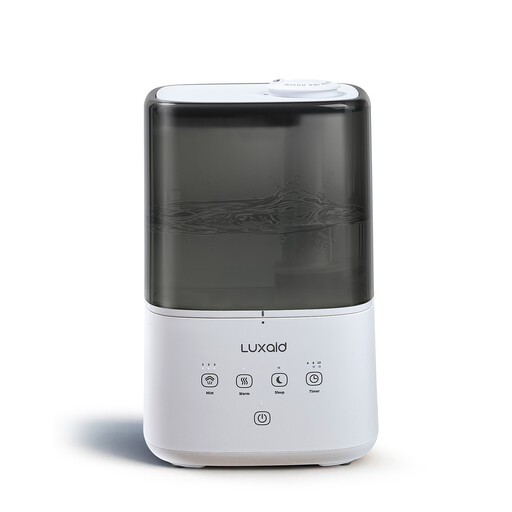
This Joybuy option has a stated coverage area that may be relevant to a living room. Compare that claim with your room’s size and ventilation, and check how you will monitor humidity.
 No image available
Consider this top-fill model if your room fits its stated coverage of up to 505 ft², while allowing for ventilation when assessing suitability.
Its listed features include a 4.5 L tank, touch controls, a 4/8/12-hour timer and an adjustable 360° mist nozzle.
If avoiding excess moisture is important, check whether this exact model offers a humidistat or target-humidity control. Check its cleaning instructions before buying.
Use a hygrometer to judge the room rather than relying on how the air feels. Epping Forest District Council describes 30–60% as a good indoor range during cooler months; condensation and other damp indicators are also reasons to reassess humidifier use.
No. A bigger tank can reduce refill frequency, but stated coverage and moisture output are separate considerations. Check both against the living room’s area and ventilation before choosing.
Follow the instructions for the exact model. For example, Levoit UK specifies cleaning the LV600S tank and base chamber every three days; the routine for another humidifier may differ.
Check that the seller provides the product’s instructions and safety information, and look for relevant product-safety alerts if you have concerns. GOV.UK explains that the Electrical Equipment (Safety) Regulations 2016 set requirements for electrical equipment placed on the Great Britain market.