People working in a compact study
If you spend long periods in one room, check that the air is dry before choosing a unit that fits the available space and will not distract you at its usual operating setting.


Choose a humidifier only if the study is genuinely dry: adding moisture will not resolve condensation, damp or mould. For a small study, look for adjustable output, a tank you can clean easily and noise information for the setting you would use; a built-in humidistat is more useful if you intend to use it to limit humidity.
If you spend long periods in one room, check that the air is dry before choosing a unit that fits the available space and will not distract you at its usual operating setting.
In a small, enclosed flat, you may prefer a humidity reading and adjustable output so you can respond if moisture builds up. A separate hygrometer is another way to monitor a manually controlled unit.
Choose a tank you can empty and wipe comfortably. The US Environmental Protection Agency advises regular water renewal and cleaning for portable humidifiers, making access an important part of the decision.
Check the room for excess moisture before comparing humidifier types. If it is genuinely dry, a basic adjustable unit, a humidistat-equipped model and an evaporative model offer different ways to manage the output.
Consider it when: You want manual mist adjustment for a confirmed-dry study.
Bear in mind: Without a built-in humidity reading, you will need another way to check the room, as well as time to renew water and clean the tank.
Consider it when: You intend to set and monitor a humidity target rather than adjust mist by eye.
Bear in mind: Automatic control does not replace checking for condensation or following the model’s cleaning instructions.
Consider it when: You prefer an evaporative design to an ultrasonic mist unit.
Bear in mind: Check the model’s dimensions, output and replacement-part requirements against your study; Meaco lists its Armin 300 for rooms up to 44 m², but that claim alone does not establish how it will suit your room.
| Concern | What to check | Who this matters to |
|---|---|---|
| Confirming dryness | Check room humidity and look for condensation, damp, mould or leaks before adding moisture. | If moisture is already collecting on the windows, I need to understand the cause rather than add mist. Around 44% of consumers would put confirming dryness first. |
| Quiet, compact use | Compare dimensions, tank access and the operating setting behind any quoted noise figure. | When I work beside the unit, it must fit the room without disrupting concentration or becoming awkward to refill. Roughly 33% of consumers would prioritise quiet, compact daily use. |
| Control and cleaning | Check the output controls or humidistat, plus the tank-opening and cleaning instructions. | I want to limit moisture without choosing a tank I cannot keep clean. About 23% of consumers would make manageable control and cleaning their primary concern. |
A humidifier adds moisture, so it is the wrong response to a study already affected by damp or mould.
Check humidity and investigate condensation, leaks and ventilation before buying. Where a property problem is involved, address its cause rather than trying to cover it with an appliance.
Standing water makes routine care important. The US Environmental Protection Agency advises emptying and drying portable humidifier tanks daily and cleaning them every third day.
Check that you can reach and wipe the tank, then follow the exact model manual for water renewal, cleaning and any filter requirements.
Low-mineral water and replacement filters, where required by the model, also add to routine upkeep.
A manufacturer’s coverage figure does not tell you what humidity a particular enclosed study will reach.
Choose output you can adjust or control with a humidistat, and use a hygrometer to check the room after installation.
Connectivity does not remove the need to choose a setting, watch for condensation and clean the tank.
If you will not use automatic adjustment, consider whether manual output control and a separate hygrometer meet your needs instead.
The Classic 160 is a compact, manually adjustable cool-mist example for a confirmed-dry study.
The Beam Mini² illustrates the ultrasonic route for buyers who intend to use built-in humidity control.
Meaco’s Armin range provides an evaporative option; its dehumidifiers address a different problem, namely excess moisture.
These humidifiers provide options for adding moisture to a confirmed-dry study. Compare their tank sizes and stated operating features with your available space, and plan to monitor room humidity rather than relying on a room-coverage claim.
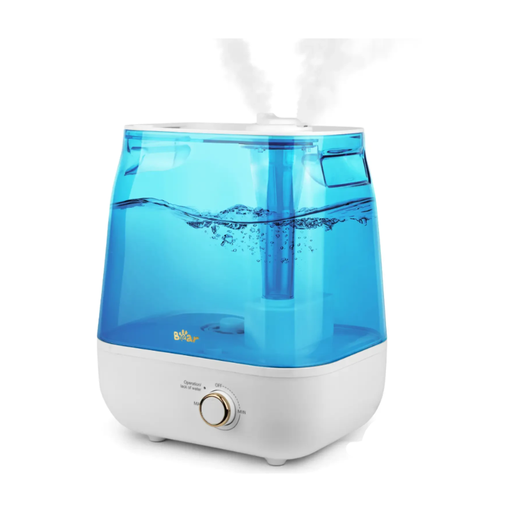 No image available
Consider the larger tank if fewer refills matter, while checking that the unit will fit your study and be easy to clean.
The product title states a 6 L tank, top filling, automatic shut-off and a 28 dB noise figure. Confirm the operating setting behind the noise claim and the runtime you need before buying.
Check its humidity-control features and UK electrical specification; monitor the room separately if the model does not provide the control you need.
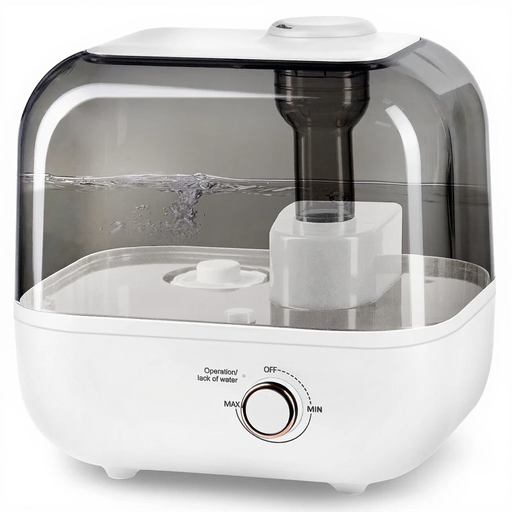 No image available
This top-filling option is worth comparing if tank capacity and straightforward refilling matter more to you than app features.
The product title specifies a 5 L tank, a 28 dB noise claim and a stated 35-hour runtime. Check the settings behind those figures and measure the space available for the unit.
Confirm how its output is adjusted, whether it offers the humidity feedback you want and whether its electrical specification suits your home.
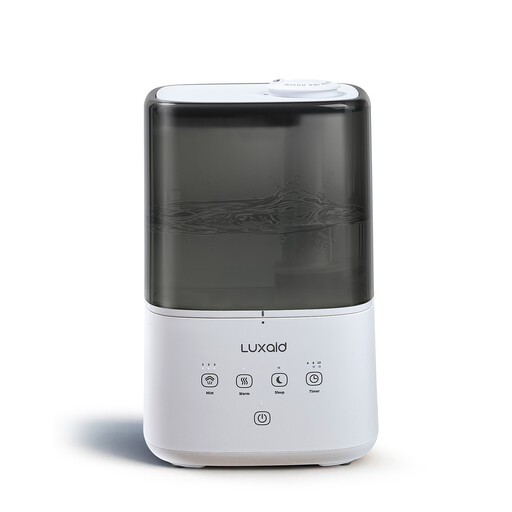 No image available
Consider this model if you specifically want the choice of cool or warm mist, while checking how its controls work in your study.
The product title states a 4.5 L top-fill tank, 4-, 8- and 12-hour timer settings and 20 dB in sleep mode. Its stated coverage of up to 505 ft² is not a humidity target for a small room.
Check physical fit, humidity-control features and UK electrical compatibility. Follow the model’s instructions for cleaning and for using its aromatherapy feature; do not assume oils can go into the water tank.
No—not to address those signs. A humidifier adds moisture, so check the cause of condensation, damp or mould instead. For a rented home in England, GOV.UK guidance explains that landlords have responsibilities concerning relevant damp and mould hazards; housing requirements differ across UK nations.
Follow your model’s manual. As a general care benchmark, the US Environmental Protection Agency recommends emptying and drying a portable humidifier tank daily and cleaning the unit every third day; check whether your model has additional instructions.
Only put oil in the water tank if the exact model’s instructions expressly permit it. An aroma tray or pad does not mean that oils belong in the reservoir; check where the manufacturer says to place them.
Check the manual for its water and filter requirements. Low-mineral water may be useful for an ultrasonic unit, while filters or other replaceable parts depend on the model; make sure you can obtain what your chosen unit requires.