People with a dry bedroom
If a heated bedroom feels dry overnight, look for a room-sized humidifier that fits the available space, has manageable refills and will not disturb sleep.


Measure humidity in the room you use before choosing a humidifier: a compact model with adjustable output can suit a dry bedroom, but adding moisture when the room is already damp increases condensation risk. Choose a larger unit only if its room rating and refill interval suit your space, and consider a purifier-humidifier only if you also want its other functions and can manage the additional upkeep.
If a heated bedroom feels dry overnight, look for a room-sized humidifier that fits the available space, has manageable refills and will not disturb sleep.
In a compact or poorly ventilated flat, measure humidity and control the output before adding moisture. Dorset Council warns that homes regularly above 60% relative humidity face a higher risk of condensation and mould.
If you want filtration or cooling as well as humidification, compare those functions with the space the appliance occupies and the filter and cleaning routines it requires.
Check the humidity of the room you intend to use first, then decide how much cleaning, noise and appliance space you can accommodate.
| Concern | What to check | Who this matters to |
|---|---|---|
| Excess humidity | Use a hygrometer; check for adjustable output or a target-humidity setting. | If cooking or laundry already leaves condensation, I want to avoid adding moisture unnecessarily. Around 36% of consumers put humidity control first. |
| Cleaning and residue | Check access to water-contact surfaces, the cleaning instructions and any filter requirements. | I need to empty and clean the tank regularly without an awkward routine. For around 29% of consumers, manageable upkeep is the primary concern. |
| Overnight use | Compare the stated noise level, dimensions, tank capacity and automatic shut-off. | When the appliance runs near where I sleep, noise and bedside space matter more than extra functions. Around 21% of consumers put quiet, compact use first. |
| Combined functions | Decide whether you also need filtration or cooling; check the associated filter and cleaning routines. | If I want air treatment or cooling alongside moisture, I need to be comfortable maintaining those functions. Combined functions come first for around 14% of consumers. |
Cooking, showers and drying laundry can add moisture even when heating makes the air feel dry. Dorset Council says occupied homes are normally comfortable at around 40–55% relative humidity, while regularly exceeding 60% increases condensation and mould risk.
Check a hygrometer in the room you occupy and reduce or stop humidification if condensation appears on windows, sills or cold walls.
Water-contact surfaces need regular care. The US Environmental Protection Agency advises emptying a portable humidifier’s tank, wiping surfaces dry and refilling it daily, as well as cleaning the unit every third day.
Before choosing a model, check whether you can reach the tank surfaces and follow its specific cleaning instructions.
Regular emptying, drying and cleaning take time; check the exact model’s instructions for any replacement parts or descaling materials.
Filtration and cooling address separate needs; they are not required simply to add moisture to a dry room.
Consider a combined appliance only if you want those functions too, and check its filter and water-system maintenance before deciding.
Levoit offers compact humidifiers such as the Dual 150 and larger smart models such as the OasisMist.
The Series 2000 HU4803/01 is relevant if visible mineral residue or wet spots influence your choice of humidification approach.
Dyson’s PH2 De-NOx combines humidification with filtration and fan cooling for shoppers who want those functions together.
These humidifiers offer adjustable moisture output for a bedroom or another occupied room. Compare their stated capacity and room coverage with that room, and measure humidity rather than relying on appliance size alone.
 No image available
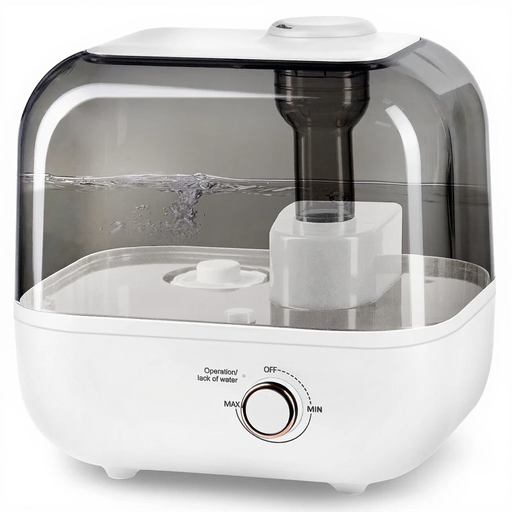
Consider this for a bedroom where you want to adjust moisture output and prefer a top-fill tank. The product title states a 5 L capacity, up to 35 hours of running time and a 28 dB noise figure; these are listing claims, so check how the settings affect use in your room.
Use a hygrometer to decide when to run it, and check the model’s cleaning instructions and whether it has a built-in humidistat.
 No image available
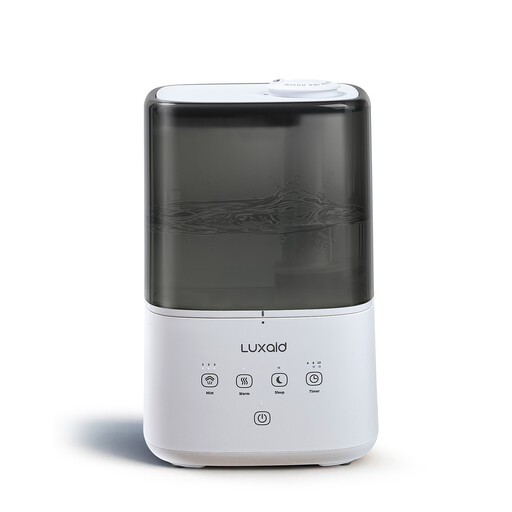
Consider this if you want to select cool or warm mist and adjust output for the room you occupy. Its title states a 4.5 L top-fill tank, an up-to-505 ft² coverage claim, a 4/8/12-hour timer and a 20 dB sleep-mode claim. Compare the coverage with your room rather than the whole flat.
Check the model’s cleaning instructions and whether it has a built-in humidistat; use a hygrometer to avoid adding moisture when the room is not dry.
Use a hygrometer and add moisture only when the occupied room needs it. Dorset Council says a comfortable relative humidity level in an occupied home is normally around 40–55%; homes regularly above 60% face a higher risk of condensation and mould.
Choose for the room where you spend time or sleep rather than assuming one appliance will serve every room. Compare its stated coverage with that room, and keep ventilation working so household moisture does not become trapped.
The US Environmental Protection Agency advises emptying the tank, wiping surfaces dry and refilling daily, then cleaning a portable humidifier every third day. Follow the exact model’s instructions for its removable parts, filters and descaling steps.
Check the seller, product instructions and warnings, appropriate safety marking, and the manufacturer’s name and address. GOV.UK recommends checking marking and manufacturer details on consumer products; use the exact product information to assess the appliance you are considering.