For occasional iced coffees, a compact countertop ice maker makes sense if everyone can refill it and empty the basket as needed. If several people make drinks throughout the day, compare tank capacity and batch output before relying on a stated daily maximum; in either case, agree who will clean the machine and handle the ice.
Who is it for?
Frequent iced-coffee drinkers
If several people make drinks through the day, compare how much water the tank holds and how many cubes each cycle makes. A daily-output figure alone will not tell you how often someone must refill the machine or empty its basket.
People working near the kitchen
Counter space and operating noise matter when the machine sits near desks or calls. Check its dimensions and placement requirements; treat any stated noise figure as a claim for that model, not a like-for-like comparison with another machine.
People responsible for the shared kitchen
A cleaning programme can help with maintenance, but someone still needs to clean the ice-storage area, keep the scoop clean and make sure users know how to handle ice. West Lothian Council's ice-handling guidance stresses hygienic production, storage and handling.
What matters when choosing?
Start with how often the group needs ice and who will refill and empty the machine. Then check whether its position and cleaning routine will work in the shared kitchen.
| Concern |
What to check |
Who this matters to |
| Ice and refills |
Compare tank capacity, cubes per cycle and the stated kg per 24 hours. Check what happens when the basket fills. |
When several people want iced coffee throughout the day, I need enough ice without repeatedly stopping to refill water or clear the basket. Around 40% of consumers put throughput and fewer refills first. |
| Counter fit and noise |
Measure the space, including lid access and required ventilation. Check the model's stated operating noise without assuming different claims were measured alike. |
If the kitchen is beside a work area, I need a machine that fits without getting in the way or disrupting calls. Around 30% of consumers put low-disruption placement first. |
| Cleaning and handling |
Check how to access and clean the tank and basket, and whether there is a self-clean programme. Decide who will maintain the machine and scoop. |
With several people serving themselves, I need a routine that keeps ice handling and cleaning from becoming nobody's responsibility. Around 30% of consumers put hygiene and clear ownership first. |
Buying pitfalls
-
Reading daily output as basket capacity
A stated kg-per-day figure describes production over time, not how much ice is ready at once. The basket may fill, or the tank may need refilling, while other people are waiting.
Compare the tank, batch size and cycle time as well as daily output, and agree when ice will be removed from the basket.
-
Leaving all the cleaning to the self-clean cycle
Ice can be contaminated through the machine or poor handling. A self-clean programme does not establish that the storage area and scoop are clean.
Assign cleaning responsibility, follow the model's instructions and use a clean scoop rather than hands or a drinking glass. West Lothian Council's ice-handling guidance covers hygienic storage and handling as well as production.
-
Choosing by first-batch speed alone
A fast first batch is less useful if the machine obstructs a shared preparation area or cannot be placed with adequate ventilation.
Measure the intended spot, including room to open the lid, and follow the manufacturer's clearance instructions. If noise matters, assess each model's stated figure without treating different listings as a controlled test.
-
Relying on an older model being available
Lakeland marks the GASTROBACK Ice Maker Bartender Pro 41143 discontinued, while GASTROBACK's product page says it is unavailable. Its specifications can still help frame a larger-tank comparison.
Confirm current availability and support before planning around a particular model.
Brands to consider for these product types
EUHOMY
The EUHOMY IM008 listing on Joybuy describes a compact countertop machine with two bullet-ice sizes.
- The listing states nine cubes in 6–12 minutes and approximately 12 kg of output per day, alongside a carry handle.
- Its under-45 dB noise figure is a listing claim, not an independently measured comparison. Check the space and upkeep the shared kitchen can accommodate.
Silonn
The Silonn SLIM09B-UK is a compact bullet-ice model listed through B&Q's marketplace.
- The listing states a 1.2 L capacity, two ice sizes and a 30-minute self-clean programme.
- The stated 35 dB operating level is a listing claim. Check the current seller and product terms before purchasing through the marketplace.
GASTROBACK
The Bartender Pro 41143 provides a larger-tank specification to compare with compact countertop machines.
- GASTROBACK specifies a 2.8 L water tank, nine cubes per cycle and up to 15 kg of output per day.
- GASTROBACK says the model is unavailable, and Lakeland marks its listing discontinued. Do not assume it is a current purchase option.
Joybuy product choices
These compact countertop models suit kitchens considering ice for a few drinks at a time, provided someone can manage refills, ice removal and cleaning. Compare their stated batches with the group's routine rather than treating daily output as ice held ready to serve.
 No image available
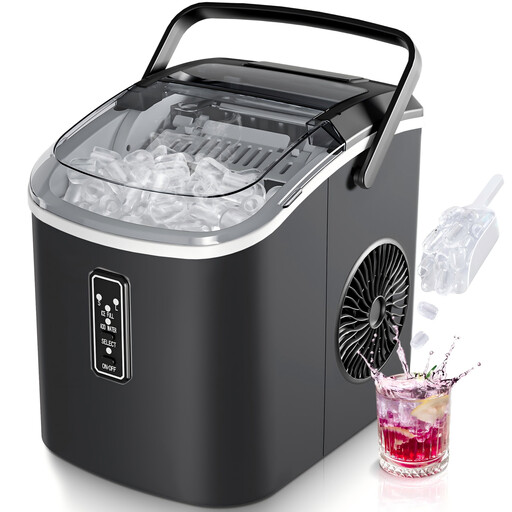
EUHOMY self-cleaning countertop ice maker, 9 cubes per batch
Consider this model if the kitchen makes a few iced coffees at a time and the machine may need moving between uses.
Joybuy lists two ice sizes, nine cubes in 6–12 minutes and approximately 12 kg of daily output. The stated dimensions are 22.2 × 36.6 × 29.39 cm; measure the space needed around the machine as well as its footprint.
The basket still needs managing, and self-cleaning does not replace cleaning the storage area or using a clean scoop.
View on Joybuy
 No image available
Comfee' RCI12WH1UK(E) countertop ice maker
Consider this model if choosing between two bullet-ice sizes matters for the drinks being made and users can keep up with ice removal.
Its product name states eight ice bullets in 6–9 minutes, two sizes and 12 kg of output in 24 hours. It also identifies a self-cleaning function, scoop and basket.
Check the intended counter position and ventilation requirements before buying. Arrange who will empty the basket and clean the ice-storage area; the stated daily output is not basket capacity.
View on Joybuy
Common questions
Does self-cleaning remove the need to wash a shared ice maker?
No. A self-clean cycle can form part of the routine, but the storage area and scoop still need attention. Follow the machine's instructions and assign someone to check that ice is handled and stored hygienically.
Can a countertop ice maker sit close against a wall?
Leave the ventilation clearance required by that model's instructions rather than assuming it can sit against a wall. Also allow room to open the lid and keep it away from heat; West Lothian Council's ice-handling guidance calls for sufficient space and ventilation around an ice machine.
Will a countertop machine keep finished ice frozen?
Do not assume its basket works like a freezer. Plan to use ice promptly or transfer surplus to a freezer, and check the particular model's instructions for ice storage and basket management.
Does every shared kitchen need a documented cleaning schedule?
Sharing a kitchen alone does not establish which food-business requirements apply. If it operates as a food business, check the rules applicable to its location and activities; GOV.UK's food-business cleaning guidance for England and Wales calls for a cleaning schedule and records.


