Regular at-home drink maker
If you make iced chocolate often and would rather not charge an appliance between uses, assess a mains-powered personal blender. Check that the exact model is intended to handle ice.


For regular iced chocolate at home, consider a mains-powered personal blender if you would rather use a socket than manage charging. Choose a cordless cup blender if you want to make one drink away from a socket and can work within its maximum-fill line; consider a compact food processor with a blender attachment only if you will also use its food-prep functions. Whichever format appeals, check that the exact model is intended for ice and that its cup and parts suit your storage and cleaning routine.
If you make iced chocolate often and would rather not charge an appliance between uses, assess a mains-powered personal blender. Check that the exact model is intended to handle ice.
If you make one drink at a time, compare the usable fill line with your serving size, then check where the cup and base will fit and how their drink-contact parts are cleaned.
If you also need chopping or slicing functions, a compact food processor with a personal-blender attachment may earn its storage space. Allow for the additional parts you will need to keep and wash.
Choose it when: you want to blend a single drink away from a socket and carry it in the cup.
Accept: charging between uses and a serving limited by the marked maximum-fill line.
Choose it when: iced chocolate is a regular at-home drink and you do not need cordless use.
Accept: the need for a socket where you prepare the drink.
Choose it when: you will also use its chopping, slicing or other food-prep functions.
Accept: more parts to store and wash than with a dedicated cup blender.
| Concern | What to check | Who this matters to |
|---|---|---|
| Ice suitability | Look for ice or frozen-ingredient guidance for the exact model; follow its ingredient and fill instructions. | If ice is central to my iced chocolate, I want to confirm the blender is intended to process it before choosing a convenient format. Around 46% of consumers put ice suitability first. |
| Storage and cleaning | Compare stated dimensions with your storage space, and check which drink-contact parts separate and can go in a dishwasher. | With little room to store parts, I need a blender I can put away and clean after milk and cocoa; around 36% of consumers place storage and cleaning first. |
| Cordless use | Check charging requirements, the maximum-fill line and which parts you need to carry. | When I make a drink away from a socket, being able to take it with me matters enough to plan around charging. Cordless use comes first for around 18% of consumers. |
A compact blender intended for smoothies is not necessarily intended to process ice cubes.
Check the exact model's ice or frozen-ingredient instructions before choosing it for iced chocolate, and follow its fill and use guidance.
The permitted maximum fill can be lower than the cup capacity, leaving less room for milk, cocoa and ice than the headline figure suggests.
Use the marked maximum-fill line to plan a serving. SharkNinja UK specifies a 530ml cup but a 470ml maximum fill for the Ninja Blast BC151UK; nutribullet UK gives its Portable blender a 350ml maximum line.
A cordless blender lets you work away from a socket, but charging becomes part of the routine when you make drinks frequently.
Choose cordless if you will use that flexibility; otherwise compare a mains-powered model intended for ice.
A compact food processor can handle other kitchen tasks, but those functions add parts that may see little use if you only make iced chocolate.
Consider this format when you will regularly use its chopping, slicing or processing attachments as well as its blender.
Additional attachments also need storage and washing.
The Ninja Blast BC151UK is a cordless, single-serve option to examine if you want to make an iced drink away from a socket.
nutribullet offers both a cordless Portable blender and the mains-powered nutribullet 600, giving shoppers two distinct ways to make an at-home or drink-to-go choice.
Kenwood's MultiPro Go Blend FDP23.380GY is relevant when a small kitchen also needs food-prep functions alongside a personal blender.
These options offer a cordless cup blender for drinks on the move and a mains-powered personal blender for iced chocolate at home. Check the exact model's ice instructions, usable fill and storage fit before choosing either.
 No image available
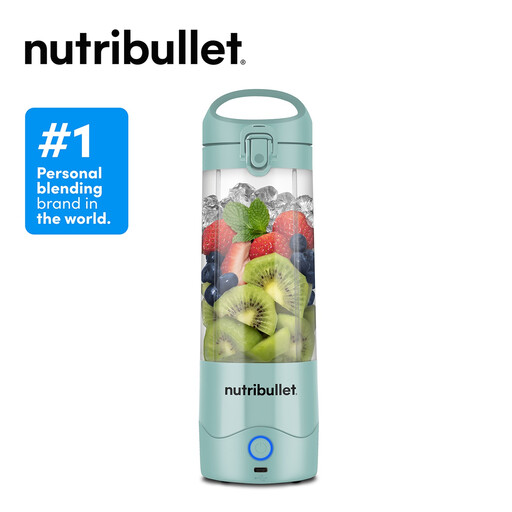
Consider this cordless model if you want to blend a single drink away from a socket and carry it in the supplied to-go cup. Its name specifies USB-C charging and a 475ml cup; use the marked maximum-fill line, rather than cup capacity, to plan your recipe, and check its ice instructions before using cubes.
 No image available
Consider this mains-powered model for iced chocolate made at home without a charging step. Its listing describes ice-crushing use and specifies a 1200W motor and 900ml cup; check the model's use instructions, maximum-fill line and dimensions before planning a serving or storage space.
No: choose a model whose instructions explicitly allow ice or frozen ingredients. SharkNinja UK, nutribullet UK and Kenwood describe ice-related use for particular models, but that does not establish the same capability for every blender bearing those brands.
Plan around the maximum-fill line, with room for all the milk, cocoa and ice in the drink. SharkNinja UK lists the Ninja Blast BC151UK with a 530ml cup and 470ml maximum fill, while nutribullet UK lists a 350ml maximum line for its Portable blender.
Check whether the exact model's drink-contact parts separate and which components its care instructions allow in a dishwasher. nutribullet UK says the Flex blade block detaches and is dishwasher safe; Kenwood identifies dishwasher-safe parts for its MultiPro Go Blend. Those instructions do not apply automatically to every component or model.
Check the manufacturer's stated intended use and care instructions for the cup and lid, especially if you are unsure whether they suit a particular ingredient or cleaning method. Food Standards Agency guidance for Great Britain states that food-contact materials must meet the requirements of assimilated Regulation 1935/2004; that general requirement does not establish what an individual blender cup is intended to handle.