
24/7 Customer Support

Free returns

Same-day & Next-day Delivery

Quality Guaranteed

Unlock Your Welcome Offers: FREE Delivery | Up to 80% OFF | Free 30-day JoyPlus trial
Download the APP
An indoor electric grill can make steaks, paninis, burgers, vegetables and breakfast foods more convenient, particularly when the weather is unsuitable for outdoor barbecuing. However, compact appliances can look similar while offering very different cooking capacity, controls and cleaning arrangements.
Before buying, watch for three common pitfalls:
The right choice depends on how you cook, how much worktop space you have and whether you prefer a plug-in appliance or a hob grill pan.
Cooking areas vary considerably. A mini contact grill may suit a student flat, couple or quick lunch, while a family-size grill needs enough space for several burgers, sandwiches or vegetable portions without overcrowding.
Useful reference points include:
A grill that opens flat can create a larger cooking area, but it also needs more clearance around the appliance. Measure your worktop before ordering and leave sufficient space for ventilation.
An adjustable temperature grill gives you more control over delicate foods, sandwiches and thicker cuts of meat than a simple on/off switch. Higher wattage can support quicker preheating, but heat management remains important.
A contact grill uses upper and lower plates at the same time, which can speed up cooking and reduce the need to turn food. A floating top plate is useful for burgers, steaks and filled sandwiches because it can accommodate different thicknesses without pressing them excessively.
If you prefer cooking several ingredients side by side, a tabletop grill or electric table grill may be more suitable than a hinged contact grill. For shared dining, look for a broad plate, grease collection and a stable base.
A non-stick grill should be used with silicone, nylon or wooden utensils rather than metal tools. Avoid abrasive sponges and overheating an empty plate, as both can damage the surface.
For easier maintenance, check for:
Not every removable plate is dishwasher-safe. For example, some models require hand washing even when the cooking surface releases food easily.

Why This Fits Their Persona: Its compact format suits students, couples and smaller UK kitchens where storage and quick meals matter.
The stated 22.5 × 14cm plates make its capacity clear, avoiding vague family-size wording. It also uses double-sided heating and a food-grade non-stick coating.
800W output; combines a contact grill, sandwich maker and panini press in one compact appliance.
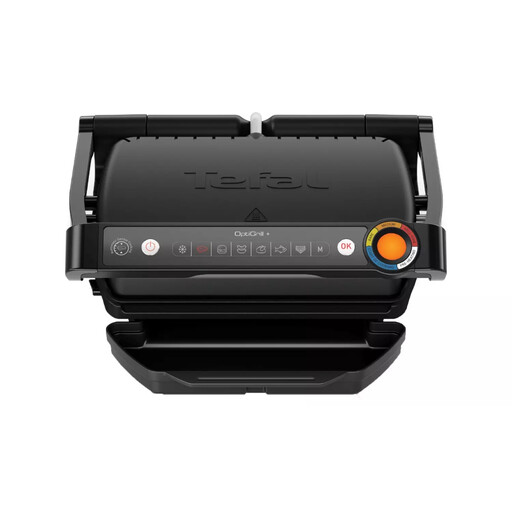
Why This Fits Their Persona: A suitable choice for cooks who want guided programmes and a larger cooking surface for regular household meals.
The specifications identify removable, dishwasher-safe plates, a drip tray and cooking for up to five portions rather than relying only on broad marketing language.
2000W power; six automatic programmes, colour-coded indicators and a sloped grill design.
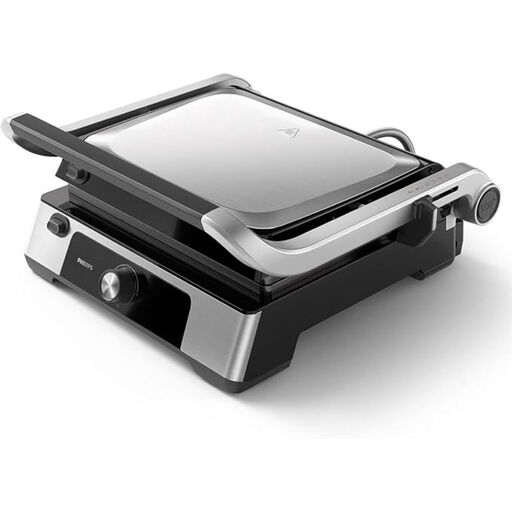
Why This Fits Their Persona: Its broad, flexible format suits families and hosts who want to grill different foods or open the appliance flat.
The adjustable rotary control, 180° opening and floating top plate provide measurable flexibility beyond a fixed-temperature sandwich maker.
Up to 2200W maximum power; removable non-stick plates, adjustable height and integrated drip tray.

Why This Fits Their Persona: Ideal for cooks who prefer a grill pan over a plug-in appliance and want to prepare breakfast items together.
The three sections are clearly specified, while the 4.5mm magnetic stainless-steel base is listed as compatible with induction, gas and electric hobs.
Divided grill pan for cooking separate ingredients; raised ridges and recessed circles for steaks, pancakes and eggs.
Choose an indoor electric grill if you value consistent two-sided heating, quick panini preparation and controls that do not depend on the hob. A contact grill can also reduce the need to turn food manually.
A grill pan may be preferable if you already own suitable cookware, want to use induction or gas, or need a pan that can move between different hobs. A divided grill pan is particularly useful for bacon, eggs, pancakes and sausages, although it usually requires hand washing and manual temperature adjustment.
For pancake-focused cooking, a flat pancake pan or crêpe pan gives a broad, low-sided surface. Check whether the model is oven-safe and confirm the stated temperature limit before using it in an oven.
We have compiled a complete, real-time list of products that fully satisfy these strict selection criteria and UK safety regulations.
Use any indoor electric grill on a stable, heat-resistant surface with space around the appliance. The plates and grease may become very hot, so keep children away, avoid touching cooking surfaces and unplug the unit before cleaning. Follow the supplied instructions, use a suitable UK mains socket and check the product information for voltage, plug and conformity details.
To estimate electricity use, multiply the appliance’s power in kilowatts by its operating time. An 800W grill uses 0.8kWh if it runs continuously for one hour; a 2000W model uses 2kWh in the same period. Actual consumption depends on preheating, thermostat cycling and your electricity tariff.
Yes, provided the cooking plates are large enough and the appliance reaches an appropriate temperature. A floating top plate can accommodate thicker steaks, while an adjustable temperature grill offers more control. Always follow food-safety guidance and check that meat is cooked through where required.
They can make cleaning easier because you can access the cooking surface and remove grease separately. However, check whether the plates are dishwasher-safe; some require hand washing to protect the coating.
Lifespan depends on frequency of use, storage, coating care and electrical condition. Using non-metal utensils, avoiding empty overheating, cleaning according to the manual and storing the appliance dry can help preserve it. Stop using the grill if the cord, plug, plates or housing show signs of damage.