
24/7 Customer Support

Free returns

Same-day & Next-day Delivery

Quality Guaranteed

Unlock Your Welcome Offers: FREE Delivery | Up to 80% OFF | Free 30-day JoyPlus trial
Download the APP
An indoor exercise bike can provide convenient cardio without a gym membership, but choosing the wrong model may leave you with an uncomfortable saddle, excessive vibration or features you never use. UK homes also bring practical concerns: limited floor space, shared walls and changing energy costs.
Before buying, look beyond headline resistance levels and app promises. The following guide explains the specifications that affect everyday use, common marketing traps and which type of equipment may suit different households.
A large flywheel or a stated “resistance weight” does not automatically indicate a smoother workout. The resistance system, belt drive, frame stability and adjustment range all affect how the bike feels.
A magnetic resistance exercise bike uses magnets rather than direct friction against the flywheel. This generally means less contact wear and quieter resistance changes, although the actual noise level still depends on the belt, bearings and floor surface.
Noise descriptions can be subjective. A bike may be quiet mechanically but still transmit vibration through a hard floor. Flat residents should check for:
For example, the MERACH model below lists operation at no more than 30 dB in its product information. This is a stated specification, not a guarantee for every room or flooring type.
An exercise bike with APP connectivity may display useful workout data, but app availability, Bluetooth functions and third-party syncing can vary. Check whether your phone or tablet supports the required app and whether the relevant features are free or subscription-based.
An LCD monitor is still useful if you prefer straightforward tracking of time, speed, distance and calories without connecting another device.
For occasional cycling, a manually adjusted magnetic bike may be sufficient. Regular cyclists or users following structured sessions may prefer electromagnetic resistance, which can provide more defined resistance steps.
Also compare the drive system. A belt drive is commonly selected for home use because it does not require the chain lubrication associated with some traditional designs. It is still important to follow the manufacturer’s assembly and maintenance guidance.
Never treat maximum user weight as a suggestion. Select a model with a suitable margin above the rider’s weight and place it on a flat, stable surface. A heavier steel frame, wide base and levelling feet can help reduce movement during harder sessions.
Product listings may use different measurements, such as 120 kg, 136 kg or 160 kg. Compare the stated capacity directly rather than relying on descriptions such as “heavy-duty”.
An adjustable indoor cycling bike should allow you to set the saddle and handlebars so that your knees and back remain in a comfortable position. Check:
If a traditional upright or spinning bike is unsuitable, a recumbent design may provide a more supported seating position. Browse the recumbent exercise bike range for additional formats.
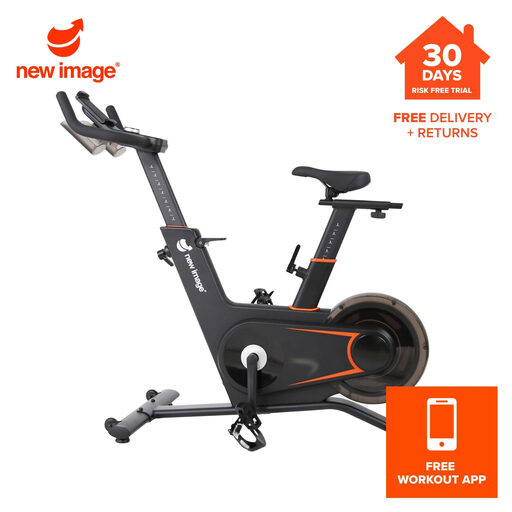
Why This Fits Their Persona: It offers a straightforward home cycling setup with 16 electromagnetic resistance levels, useful for beginners who want room to progress without needing a large collection of equipment.
The listing specifies a belt-driven flywheel and 16 resistance levels rather than relying only on broad performance language.
Electromagnetic resistance; adjustable seat and handlebars; phone or tablet holder.
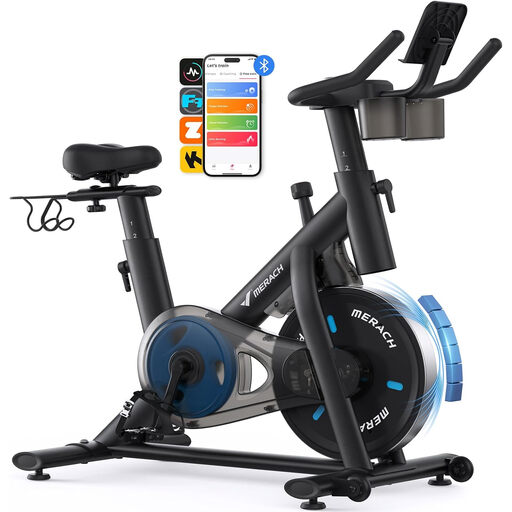
Why This Fits Their Persona: This is suited to households wanting app-supported sessions, a broad adjustment range and a stated maximum capacity of 122 kg.
Its product information identifies the app, LCD display, magnetic resistance and stated noise figure, making the feature set easier to compare.
App data interaction; four-way seat adjustment; 70% pre-assembled according to the listing.
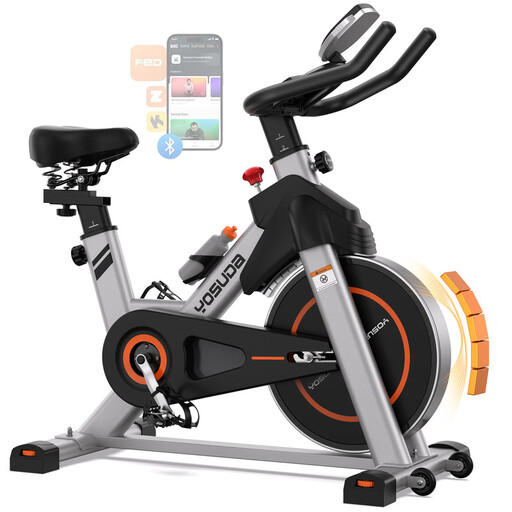
Why This Fits Their Persona: The listed 160 kg maximum load capacity makes this option worth considering for users who prioritise a reinforced frame and higher stated capacity.
The listing gives specific capacity, flywheel, resistance and adjustment figures, so shoppers can check suitability against their own requirements.
8 kg magnetic flywheel; Bluetooth APP connectivity; four-way adjustable soft saddle.
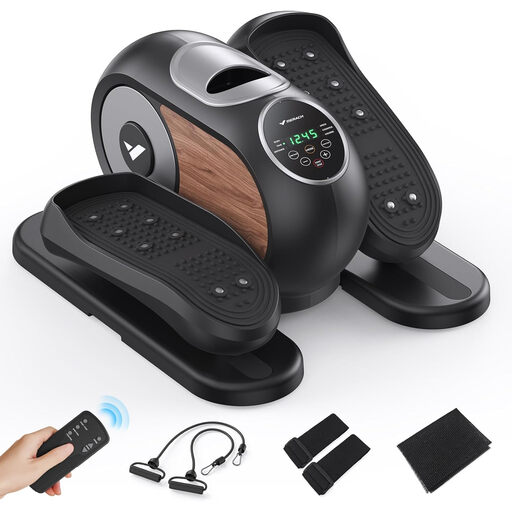
Why This Fits Their Persona: A compact under desk pedal exerciser can suit seated home or office routines where a full-size spinning bike for home is impractical.
It provides 12 manual speed levels, automatic programmes, a remote control and non-slip pads rather than requiring a rider to balance on an upright frame.
Remote-controlled adjustment; LCD workout display; foot straps, PVC pad and resistance bands included.
Place any indoor exercise bike on a level surface and check that all adjustment knobs, pedals and foot pads are secure before use. A rubber mat can protect flooring and reduce transmitted vibration. Keep children away during assembly and operation, and follow the supplied instructions.
Electric under-desk models require mains power, while many conventional bikes use batteries for the display. The electricity cost of a low-power seated pedal exerciser is generally modest, but check the product’s rated power and your tariff rather than assuming all equipment has the same consumption. Mechanical bikes may have fewer powered features but still require occasional bolt checks and cleaning.
For long-term usability, store the equipment in a dry area, wipe the frame with a soft damp cloth and inspect belts, pedals and adjustment points regularly. Do not exceed the listed maximum capacity.
We have compiled a complete, real-time list of products that fully satisfy these strict selection criteria and UK safety regulations.
Yes, but choose a belt-driven model with magnetic resistance, levelling feet and a protective mat. Check the manufacturer’s noise information and avoid placing the bike directly against a shared wall. Even a quiet exercise bike can create floor vibration during fast pedalling.
Lifespan depends on construction, frequency of use, user weight and maintenance. Regularly tighten accessible bolts, keep the frame dry and follow guidance for the belt and resistance system. A bike with a suitable weight capacity and adjustable fit is less likely to be used incorrectly.
A seated pedal exerciser for seniors may suit gentle, low-impact movement while seated, but it is not interchangeable with a full indoor cycling bike. Users undertaking rehabilitation or managing a health condition should follow advice from an appropriate healthcare professional before starting a new programme.