
24/7 Customer Support

Free returns

Same-day & Next-day Delivery

Quality Guaranteed

Unlock Your Welcome Offers: FREE Delivery | Up to 80% OFF | Free 30-day JoyPlus trial
Download the APP
An indoor exercise bike can make regular cardio more convenient, particularly when the weather is poor or travelling to a gym is impractical. However, the product descriptions can make similar bikes appear interchangeable when important differences exist in resistance control, adjustment range, stability and digital features.
Before choosing a bike, look beyond phrases such as “studio-style”, “silent” or “heavy-duty”. These descriptions are only useful when supported by measurable specifications, suitable dimensions and clear safety information.
A flywheel or resistance figure does not tell you how much user weight the frame can safely support. A bike may have a substantial flywheel but a lower maximum load. Always check the stated maximum user weight, and leave a sensible margin rather than selecting a model that is only just suitable.
A silent exercise bike still produces some sound from the belt, pedals, frame movement and digital controls. Magnetic resistance is generally quieter than friction-pad systems because it operates without direct contact with the flywheel. Noise can also increase if the bike is placed on an uneven floor or its bolts are not checked periodically.
An exercise bike with app connectivity can provide workout tracking, guided sessions or progress data. However, check whether the app is free, whether a subscription is required for additional content and whether the bike records useful metrics without a smartphone. Bluetooth compatibility alone does not indicate which third-party applications will connect.
A magnetic resistance exercise bike uses magnets to alter pedalling difficulty without a friction pad pressing directly against the flywheel. This can provide smoother adjustments and reduce contact noise. A belt drive is also generally quieter than a chain drive and usually requires less routine lubrication.
Resistance descriptions vary. Some models list numbered levels, while others use a dial or a broad resistance range. For straightforward training plans, clearly stated levels can be easier to repeat. For interval sessions, a quickly adjustable knob may be more practical.
Look for a steel or alloy-steel frame, levelling feet and a base that does not rock during seated or standing pedalling. A heavy-duty exercise bike should have a clearly stated capacity, not merely a heavier-looking frame.
Place the bike on a flat, stable surface and allow room for safe mounting and dismounting. A protective exercise mat can reduce floor marking and help manage vibration, but it cannot correct an unstable or poorly assembled frame.
For UK homes, also check the available floor area, storage route and whether transport wheels are included. Product dimensions should be compared with the space around the bike, not just the bike’s footprint.
A suitable adjustable indoor cycling bike should allow the saddle and handlebars to be positioned so your knees remain slightly bent at the lowest pedal position and your hands can rest without excessive shoulder reach.
Check whether the saddle adjusts vertically and forwards or backwards. Handlebar adjustment is also important for users with different heights or those who prefer a more upright posture.
An exercise bike with LCD monitor may show time, speed, distance, calories or heart rate. These figures are useful for comparing sessions, but they are estimates unless paired with a compatible external sensor. If heart-rate tracking matters, confirm whether a monitor is included or sold separately.
The following options are matched to different household needs using the specifications provided. Open a product card to view current pricing, availability and delivery details.
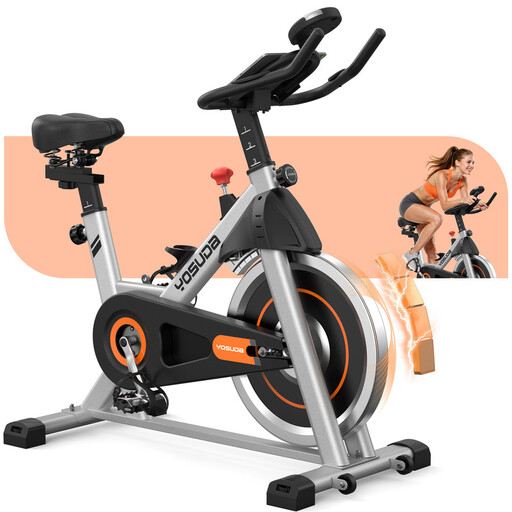
Why This Fits Their Persona: A practical choice for first-time home users who want adjustable training, basic workout data and app connectivity without choosing a higher-capacity frame than they require.
Its stated 120 kg maximum capacity, magnetic system and V-belt drive make the key limits clearer than vague “gym-style” wording.
Bluetooth app connection, HD LCD display, transport wheels and 8-level saddle adjustment.
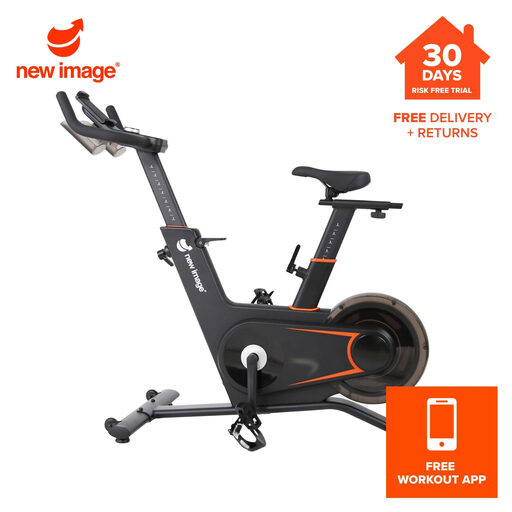
Why This Fits Their Persona: Suitable for households wanting structured resistance control, a compact training setup and a belt-driven ride for use near living spaces.
It specifies 16 electromagnetic resistance levels and a belt-driven flywheel, giving clearer control and drive-system information.
6 kg flywheel, adjustable saddle and handlebars, LCD monitor, phone/tablet holder and levelling feet.
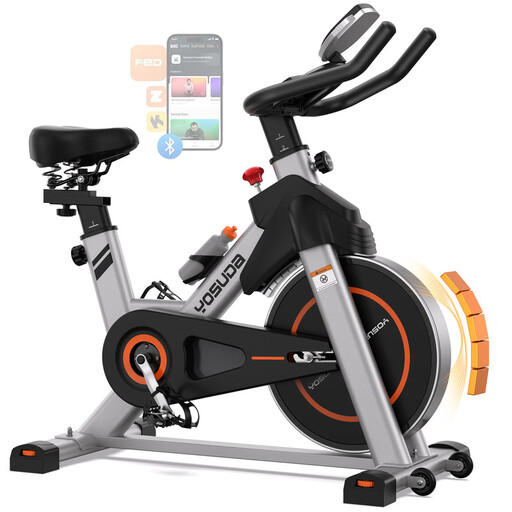
Why This Fits Their Persona: Designed for users who prioritise a higher stated load capacity, stronger resistance potential and frequent cardio sessions at home.
The listing states a 160 kg maximum load, an 8 kg magnetic flywheel and a reinforced steel frame, helping buyers compare capacity separately from resistance.
Bluetooth app connectivity, HD LCD metrics, four-way seat adjustment, cage pedals and 2-year warranty.
Assemble the bike according to the supplied instructions and check that every adjustment lever is locked before riding. The base should sit firmly on a flat surface, with levelling feet adjusted if included.
Set the saddle before increasing resistance. Your leg should remain slightly bent at the bottom of the pedal stroke; excessive knee extension or a cramped position can make sessions uncomfortable. Keep children away during operation, and use the quick-stop brake or resistance control as instructed.
If you are starting a new fitness programme or have a medical concern, seek appropriate medical advice before use. The products listed here are exercise equipment, not medical devices.
We have compiled a complete, real-time list of products that fully satisfy these strict selection criteria and UK safety regulations.
A magnetic, belt-driven bike is often a practical choice where household noise matters, but “silent” operation depends on assembly, flooring and maintenance. Use levelling feet correctly, place the bike on a suitable mat and check bolts periodically. Avoid positioning it directly against a shared wall if vibration may be an issue.
Lifespan depends on user weight, training frequency, assembly quality and maintenance. Wipe away sweat, keep the frame dry and inspect pedals, adjustment points and bolts regularly. A belt-driven magnetic bike generally has fewer friction-contact parts than a friction-resistance model, but replacement components and warranty support should still be checked before purchase.
Power consumption varies by model. Some displays or app systems use batteries, while other connected equipment may require a mains supply. Check the product’s power source and operating instructions. Pedalling resistance itself is created by your movement; the electricity requirement mainly relates to the monitor, sensors or connectivity functions.