
24/7 Customer Support

Free returns

Same-day & Next-day Delivery

Quality Guaranteed

Unlock Your Welcome Offers: FREE Delivery | Up to 80% OFF | Free 30-day JoyPlus trial
Download the APP
Indoor grills and grill pans can make steaks, toasted sandwiches, vegetables, pancakes and quick family meals more convenient. However, the wrong choice may lead to uneven cooking, awkward cleaning or an appliance that takes up valuable worktop space.
For UK households, the main decision is whether you need a plug-in electric grill, a stovetop pan or a versatile option that can handle several cooking styles. Before buying, look beyond cooking-power claims and consider the details that affect everyday use.
A higher wattage can help an electric grill heat quickly, but power alone does not guarantee convenient cooking. A grill with no adjustable temperature control may be less flexible for delicate foods such as sandwiches, vegetables or pancakes.
For a plug-in appliance, check whether it offers a temperature dial or clearly defined settings. For a pan, consider how evenly it is designed to distribute heat across your particular hob.
“Non-stick” does not necessarily mean every component is dishwasher safe. Some grill plates and pans require hand washing, while fixed plates can make it difficult to remove grease from corners and ridges.
Look for removable plates or a grease tray on an electric grill. With a non-stick grill pan, check the care instructions and use wooden, silicone or nylon utensils to reduce the risk of scratching the coating.
A compact product may suit a single person or small kitchen, but it can be frustrating when preparing food for several people. Conversely, a large tabletop grill needs sufficient storage space and a stable, heat-resistant area during use.
Compare the actual cooking dimensions rather than relying on phrases such as “family size”. A 28 × 22 cm plate, for example, offers a different capacity from a 50 × 25 cm tabletop surface.
An electric contact grill uses powered heating elements and generally cooks from one or both sides. It can be useful for burgers, steaks, panini and toasted sandwiches, particularly when you want repeatable temperature control without using the hob.
A tabletop grill is designed for shared cooking at a table or on a worktop. It can suit casual entertaining, although you will need a nearby mains socket and enough clearance around the hot cooking plate.
A stovetop grill pan is more compact to store and can be used on gas, electric, ceramic or induction hobs if the base is compatible. It also avoids adding another electrical appliance to a small kitchen, but cooking results depend more on hob control and heat distribution.
A contact grill with a floating upper plate can accommodate foods of different thicknesses, such as burgers, steaks and filled sandwiches. A model that opens to 180° creates two flat cooking surfaces and may be more practical when grilling several ingredients at once.
For a pan, consider whether a standard non-stick grill pan is enough or whether a divided grill pan would be more useful. Separate sections can help cook eggs, bacon, pancakes or meat at the same time without mixing ingredients.
Check the stated coating and care instructions. Non-stick surfaces are designed to reduce sticking and oil use, but they still require suitable utensils and controlled heat. Avoid overheating an empty pan and allow hot components to cool before cleaning.
For an induction grill pan, look for a magnetic stainless-steel base and confirmation that it is compatible with induction hobs. A pan suitable for gas or electric hobs is not automatically suitable for induction. Also check whether it is oven safe: some pans are not, while others have a specific temperature limit.
If you are considering a crepe pan or pancake pan, a flat surface with a low rim is generally easier to manoeuvre than a ridged steak griddle pan. A multi-purpose grill may be a better fit if you want one item for sandwiches, meat, vegetables and breakfast foods.

Why This Fits Their Persona: A compact option for renters, students and busy professionals who want one appliance for toasties, burgers, steaks and grilled vegetables.
The double-sided heating design and 28 × 22 cm non-stick plates provide a clearly stated cooking area rather than relying only on general capacity claims.
2000W output, multifunction use and food-grade non-stick plates for straightforward everyday cooking.
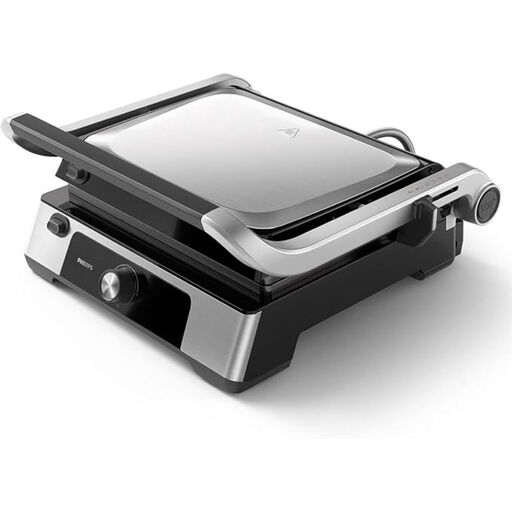
Why This Fits Their Persona: Suitable for households wanting adjustable control, flexible opening and a larger worktop grill for regular meals.
The adjustable temperature dial, removable plates, floating upper plate and removable drip tray address common control, capacity and cleaning concerns.
180° flat-open design, 1800–2200W power range, removable non-stick plates and a 2-year warranty.
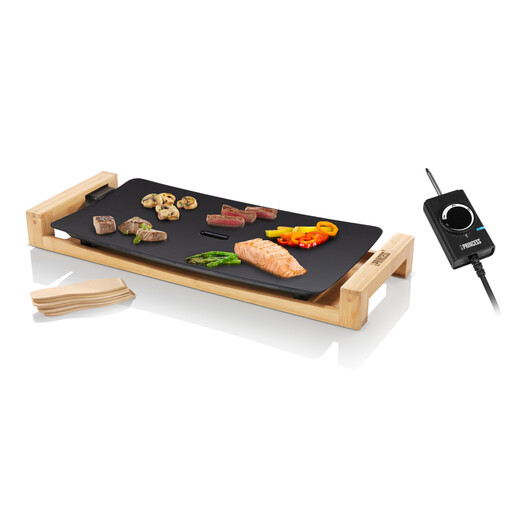
Why This Fits Their Persona: A large freestanding tabletop grill for family meals, shared cooking and casual entertaining where worktop or table space is available.
The 50 × 25 cm cooking surface and integrated grease collection tray make its capacity and cleaning arrangement clear before purchase.
2500W power, 50 × 25 cm cooking surface, curved plate and 2-year manufacturer’s warranty.

Why This Fits Their Persona: A practical stovetop choice for cooking separate breakfast ingredients, burgers, sausages, eggs and pancakes on compatible UK hobs.
Its three sections separate ingredients, while the stated induction, gas, electric, glass and ceramic compatibility helps prevent a mismatch with the hob.
Three cooking sections, a 4.5 mm stainless-steel base and raised ridges; hand wash only and not oven safe.
We have compiled a complete, real-time list of products that fully satisfy these strict selection criteria and UK safety regulations.
Running cost depends on the appliance’s power rating, cooking time and electricity tariff. A 2000W grill uses 2 kilowatt-hours if operated continuously for one hour, although most cooking sessions are shorter. Preheating only for the required time and avoiding unnecessary idle heating can help manage usage.
Only if the pan has a magnetic, induction-compatible base. Look for explicit confirmation in the product specification. Compatibility with gas, electric or ceramic hobs does not by itself confirm induction suitability.
Lifespan depends on heat control, cleaning and storage. Avoid metal utensils, abrasive cleaners and overheating an empty cooking surface. Follow the supplied care instructions, inspect the coating and electrical cable regularly and stop using any product that shows damage.