
24/7 Customer Support

Free returns

Same-day & Next-day Delivery

Quality Guaranteed

Unlock Your Welcome Offers: FREE Delivery | Up to 80% OFF | Free 30-day JoyPlus trial
Download the APP
Keeping an eye on your home, pets or loved ones has never been more straightforward. A modern indoor security camera offers peace of mind, whether you're at work, on holiday or just in another room. However, with so many features like 360-degree views, colour night vision and smart alerts, choosing the right device can feel overwhelming.
This guide is designed to help you navigate the options. We'll break down the essential features to look for and present some of our top recommendations to help you find a camera that suits your specific needs and home.
Making an informed choice starts with understanding the technology. Here are the key factors to consider when selecting an indoor security camera.
The clarity of your camera's footage is paramount. While 1080p HD is a common standard, many newer models offer 2K resolution for even sharper detail. Pay close attention to night-time performance. Traditional infrared (IR) night vision produces black-and-white images, which can be effective. However, a colour night vision indoor camera uses advanced sensors and sometimes small spotlights to capture footage in full colour, making it much easier to identify details in low-light conditions.
Consider the area you need to monitor. A static camera is fine for a small, fixed area, but a 360 home security camera with pan-and-tilt functions allows you to survey an entire room remotely via an app. To avoid constant, unnecessary notifications, look for models with a smart motion tracking camera feature. This uses AI to distinguish between people, pets and irrelevant movements like curtains blowing, and can automatically follow a subject as it moves across the frame. Furthermore, an indoor cctv with audio is essential for communication, allowing you to listen in and speak through the camera.
Most modern cameras connect to your home network via WiFi. Many now support dual-band 2.4GHz and 5GHz WiFi. While 2.4GHz offers better range and wall penetration, 5GHz provides faster speeds and less interference, which is ideal for smooth live streaming. For indoor use, a plug-in security camera uk model is often the most practical choice. It provides a constant, reliable power source, so you never have to worry about recharging or replacing batteries at a critical moment.
Here are a few standout options, each suited to different household needs.
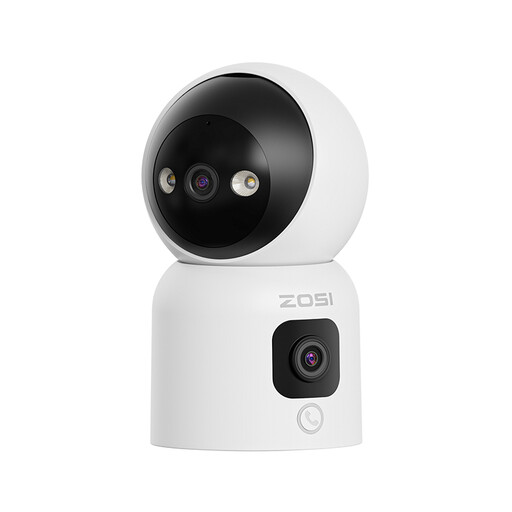
Why It Stands Out This ZOSI model offers a unique dual-lens system. A 360° pan-tilt lens provides comprehensive room coverage, while a second, fixed lens offers a wide panoramic view. Its most distinctive feature is the one-touch and gesture-activated calling. A simple press of a button on the camera or an "OK" hand gesture can initiate a video call to your phone, making it exceptionally easy for children or elderly relatives to get in touch.
Pros
Who is it for? This camera is an excellent choice for families who want a combined security device and communication tool, particularly for keeping an eye on and interacting with children or older family members.
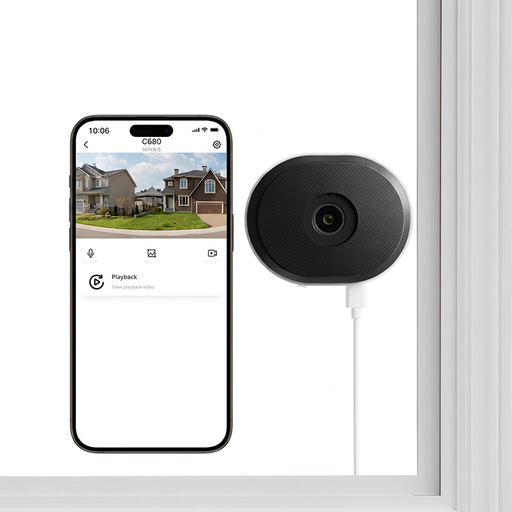
Why It Stands Out Monitoring the outside from the inside is often ruined by glare and reflections. The ZOSI C680 is specifically designed to solve this problem with its anti-glare technology, allowing it to record clear footage through glass, day or night. Installation is incredibly simple, using an included hook-and-loop mount that adheres to the window without any drilling or damage, making it ideal for renters.
Pros
Who is it for? Renters or homeowners who want to monitor their driveway, front garden or entryway without installing an outdoor camera.
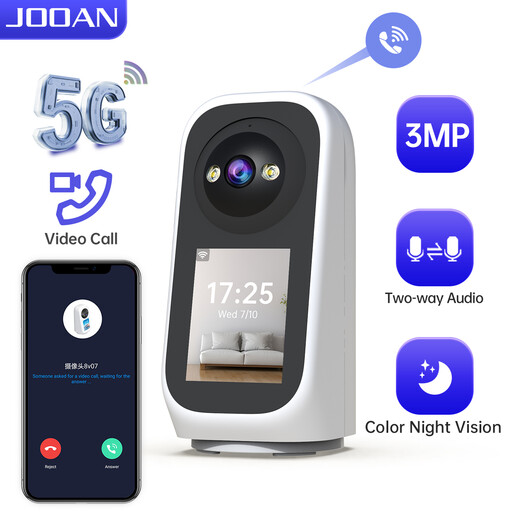
Why It Stands Out This JOOAN camera elevates the concept of a baby monitor camera or elderly monitor by including a built-in 2.8-inch screen. This enables true two-way video calling, not just audio. You can see the person you're talking to on the camera's screen, and they can see you on their end via the app. Combined with 360° pan-tilt-zoom (PTZ) and auto-tracking, it’s a highly interactive monitoring solution.
Pros
Who is it for? Those looking for a more advanced and interactive monitoring system for nurseries, playrooms or for checking in on relatives who may not be comfortable using a smartphone.
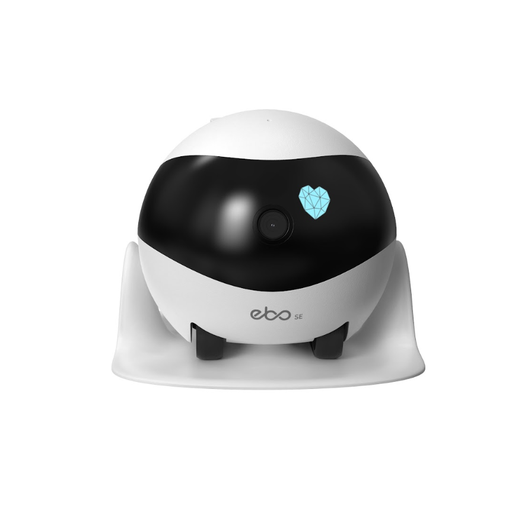
Why It Stands Out For pet owners, a static camera can only show one part of the story. The ENABOT SE is a mobile wifi pet camera on wheels that you can drive remotely around your home using an app. It can navigate under furniture and around corners to find a hiding cat or check on a dog in another room. It also features an auto-patrol mode, where it will automatically tour your home and send you alerts if it detects motion.
Pros
Who is it for? Primarily pet owners who want the freedom to check on and interact with their animals anywhere in the house, not just in a single, fixed location.
The cameras highlighted here represent just a fraction of the available technology. Different homes have different needs, and you may be looking for a specific feature or price point not covered above.
To see a wider variety of models, explore our full range of WiFi security cameras with remote access to find the perfect fit for your home.
1. Can indoor security cameras see in the dark? Yes, virtually all modern indoor security cameras have night vision. Standard models use infrared (IR) LEDs to illuminate the area, producing a clear black-and-white image. More advanced models feature colour night vision, which uses highly sensitive sensors to see in colour in very low light, providing more detail.
2. Do I need a subscription for an indoor security camera? Not necessarily. Most cameras offer flexible storage options. You can typically use a local microSD card (purchased separately) to store recordings directly on the device, with no monthly fees. Many brands also offer optional paid cloud storage subscriptions, which securely back up your footage online so it can't be lost if the camera is stolen or damaged.
3. Are plug-in security cameras reliable for indoor use in the UK? Yes, plug-in models are highly reliable for indoor use. A plug-in security camera uk model connects directly to a mains socket, ensuring it has a continuous and stable power supply for 24/7 recording. This eliminates the need to monitor battery levels or worry about the camera running out of power at an inconvenient time, which can be a concern with battery-operated alternatives.