
24/7 Customer Support

Free returns

Same-day & Next-day Delivery

Quality Guaranteed

Unlock Your Welcome Offers: FREE Delivery | Up to 80% OFF | Free 30-day JoyPlus trial
Download the APP
As a Joybuy Product Recommendation Officer, my role is to help you navigate the crowded cookware market. Choosing a new induction frying pan can feel overwhelming. You're promised perfect sears and effortless cleaning, but the reality is often a warped base, a scratched surface and another pan destined for the recycling bin within a year.
Many UK households have upgraded to efficient induction hobs, but not all cookware is created equal. Before you make a purchase, it's crucial to understand the common pitfalls that lead to buyer's remorse.
To avoid these traps, focus on a few core parameters. Getting these right is the key to finding a pan that performs well and offers genuine value.
For an induction hob to work, the base of the pan must be ferromagnetic (magnetic). However, simple compatibility isn't enough. The construction of that base dictates performance.
The cooking surface directly impacts your daily experience, from cooking to cleaning.
The right size and shape depend on what you cook and for how many people.
We've filtered through the options to match specific pans to different cooking needs, helping you sidestep the common purchasing traps.
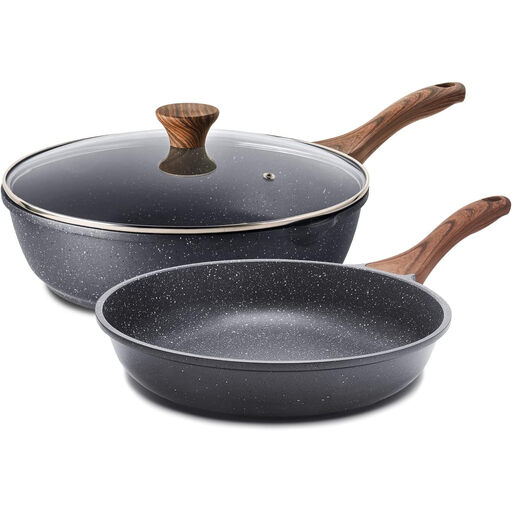
Why This Fits Their Persona: This versatile set provides two essential pan sizes for a busy UK family kitchen. The smaller pan is perfect for quick breakfasts, while the large, deep sauté pan with a lid is ideal for one-pot dinners, curries or pasta sauces. The easy-clean surface saves valuable time after meals.
It sidesteps the "forever non-stick" myth by offering a durable Swiss granite coating that provides reliable performance for everyday use, setting realistic expectations for a hard-wearing, easy-release surface.
The high magnetic conductive base ensures it works efficiently on induction hobs, avoiding the uneven heating trap. The set includes a tempered glass lid for the larger pan.
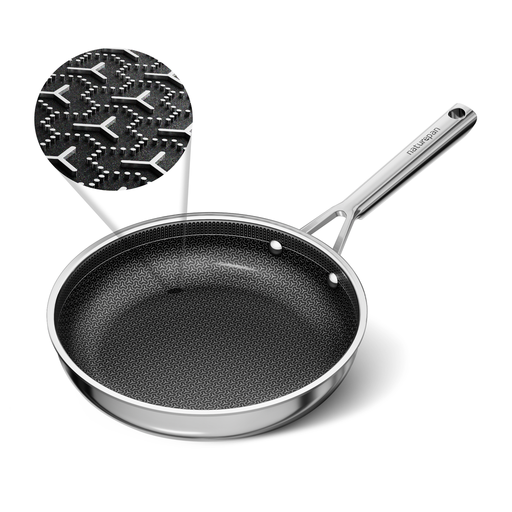
Why This Fits Their Persona: This pan is designed for those who prioritise cooking with minimal oil and want assurance about the materials they use. The coating is explicitly stated to be free from PFAS, PFOA and PTFE, offering peace of mind for health-focused individuals and families.
It cuts through the confusing health claims by being transparent about its composition. The hybrid design also provides a more durable surface than many basic ceramic pans, addressing longevity concerns.
The laser-etched hexagon surface combines raised stainless steel for searing with ceramic valleys for non-stick release. It is also oven safe to a high temperature (260°C).
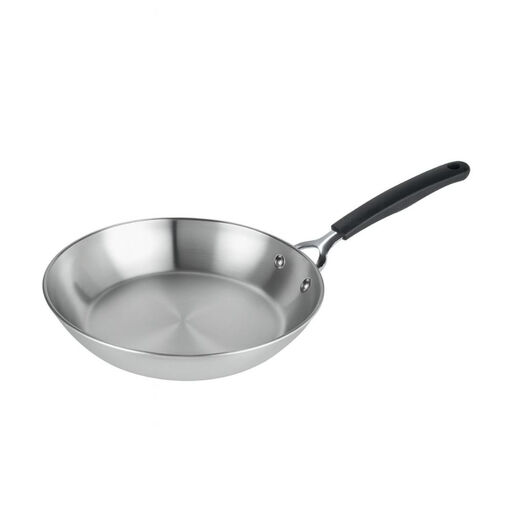
Why This Fits Their Persona: For the home cook who loves a perfect sear on a steak and enjoys making pan sauces, an uncoated stainless steel skillet is the right tool. This pan is built for high-heat performance and precision, rewarding good cooking technique with exceptional results and durability.
This pan completely eliminates the non-stick lifespan issue because it has no coating to degrade. Its encapsulated steel base also ensures fast, even heating, avoiding the "induction-ready" trap of poor performance.
Unmatched durability and high-heat tolerance. It is dishwasher safe, oven safe up to 180°C and can be used with metal utensils without fear of scratching a coating.
We have compiled a complete, real-time list of products that fully satisfy these strict selection criteria and UK safety regulations.
The simplest way is the magnet test. If a standard refrigerator magnet sticks firmly to the bottom of your pan, it is ferromagnetic and will work on an induction hob. If the magnet doesn't stick or the attraction is very weak, it is not compatible.
There are two keys to success with a stainless steel skillet: proper pre-heating and using the right amount of fat. Heat the dry pan over a medium heat for a minute or two. To test if it's ready, drop a tiny amount of water onto the surface. If it sizzles and evaporates immediately, it's not hot enough. If it forms a single, mercury-like ball that glides across the surface, the pan is at the perfect temperature. At this point, you can add your oil or butter, let it heat for a few seconds and then add your food.
Ceramic coatings are a popular alternative as they are made without PTFE or PFAS chemicals like PFOA. This makes them an appealing choice for health-conscious consumers. However, "safety" also includes durability. Some lower-quality ceramic pans can lose their non-stick properties relatively quickly, especially if exposed to very high heat or abrasive cleaning. A high-quality ceramic frying pan that is cared for properly is an excellent and functional choice for a modern kitchen.