
24/7 Customer Support

Free returns

Same-day & Next-day Delivery

Quality Guaranteed

Unlock Your Welcome Offers: FREE Delivery | Up to 80% OFF | Free 30-day JoyPlus trial
Download the APP
Switching to an induction hob is a smart move for any modern kitchen, offering speed, energy efficiency and precise temperature control. However, this advanced technology demands the right cookware. An incompatible or poorly made induction frying pan can lead to frustration, unevenly cooked meals and wasted money.
As a Joybuy Product Recommendation Officer, my role is to help you navigate the market and avoid common purchasing mistakes. Many shoppers fall into a few key traps when selecting a new pan.
This guide will break down the essential features to look for, ensuring your next purchase is a durable and reliable addition to your kitchen.
To get the most out of your induction hob, you need to look beyond the marketing and focus on the pan's fundamental construction. Here are the three non-negotiable factors to check.
The single most important feature of an induction frying pan is its base. For a pan to work, it must be made of a ferromagnetic material (one that a magnet will stick to). However, simple compatibility isn't enough.
For fast, even heating, look for a pan with a thick, bonded base. High-quality pans often feature a tri-ply construction, sandwiching a layer of highly conductive aluminium between two layers of durable stainless steel. This design distributes heat rapidly and evenly across the entire cooking surface, eliminating the hot spots that cause food to burn in one area while remaining undercooked in another. A solid stainless steel frying pan with an encapsulated aluminium core is an excellent choice for this reason.
The choice of cooking surface often comes down to personal preference, but it's crucial to understand the materials.
A truly versatile pan can move seamlessly from the hob to the oven. An oven safe frying pan allows you to sear a steak on the stovetop and then finish it in the oven without changing pans. However, always check the maximum oven-safe temperature. This is often determined by the handle material; stainless steel handles can typically withstand higher heat than Bakelite or silicone-wrapped ones.
For easy clean-up, a dishwasher safe frying pan is a bonus. That said, to prolong the life of any non-stick coating, handwashing with a soft sponge is often recommended by manufacturers.
Based on these practical criteria, we've matched several products to different types of home cooks.
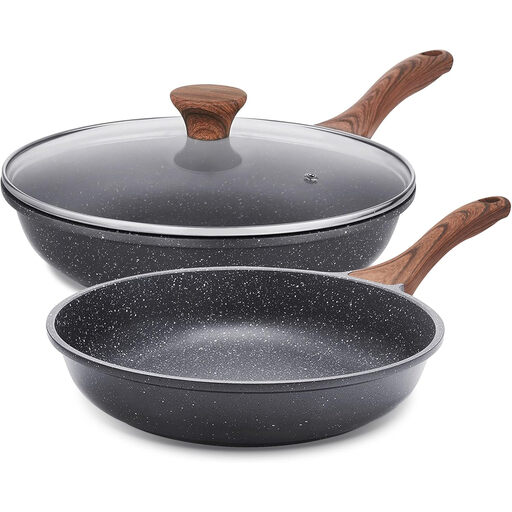
Why This Fits Their Persona: This practical two-pan set is ideal for busy UK households. The 8-inch pan is perfect for a quick breakfast fry-up, while the larger 11-inch covered skillet handles family-sized dinners, making it a versatile workhorse for daily meals.
It directly addresses the "Induction Compatible" myth with a high magnetic conductive stainless steel base designed for even heating, avoiding the poor performance of lesser pans.
A complete frying pan set for induction hob use, it includes a tempered glass lid and offers excellent value by covering multiple cooking needs with one purchase.
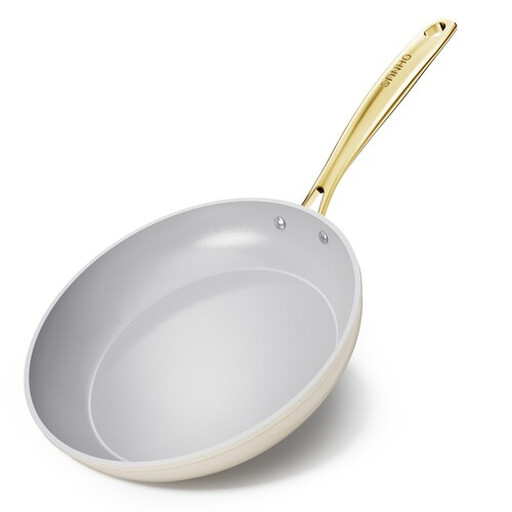
Why This Fits Their Persona: For the home cook who prioritises safety and ingredient purity, this pan's clear commitment to being 100% free of PFAS, PFOA, PTFE, lead and cadmium provides peace of mind for preparing healthy family meals.
It cuts through the vague "healthy cookware" claims by explicitly stating it is free from a comprehensive list of chemicals, offering genuine transparency.
Highly versatile with an oven-safe temperature of up to 260°C. The patented diamond-titanium ceramic coating is also designed for enhanced durability.
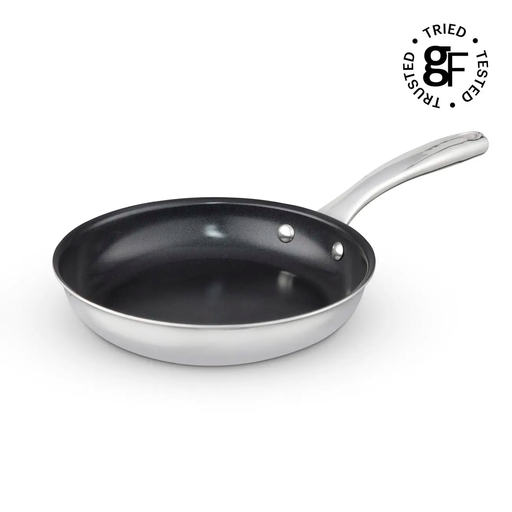
Why This Fits Their Persona: For the cook who demands precision and durability, this pan's tri-ply construction provides the superior heat control needed for perfect sears and consistent results, making it a reliable tool for more ambitious recipes.
The tri-ply stainless steel body is the definitive solution to the uneven heating and warping that plagues lower-quality pans, ensuring long-term performance.
Combines the durability and heat control of stainless steel with a superior ceramic non-stick coating, offering a great balance of performance and convenience.
We have compiled a complete, real-time list of products that fully satisfy these strict selection criteria and UK safety regulations.
The easiest way is the magnet test. If a magnet sticks firmly to the bottom of the pan, it contains ferromagnetic material and will work on an induction hob. If the magnet is weak or doesn't stick at all, the pan is not compatible.
This is almost always due to the construction of the pan's base. A loud buzzing or noticeable hot spots are signs of a thin base or one where the magnetic layer is not properly bonded. A high-quality skillet for induction with a thick, encapsulated base will heat quietly and evenly.
Ceramic coatings are generally manufactured without the use of PTFE and PFOA, which is a key consideration for many health-conscious consumers. However, to ensure you are buying healthy cookware, it is always advisable to check the product description for explicit confirmation that it is also free from other substances like PFAS, lead and cadmium.