Sauce-first dinner hosts
If the leeks need attention while you finish the rest of the meal, look for controls that let you adjust their saucepan without disturbing other zones. A timer or pause function may help when serving interrupts cooking.


For creamy leeks alongside other dinner-party dishes, start with individual-zone controls and enough usable space for your usual pans. A wider bridge or flex-zone hob makes more sense if you regularly use large cookware; whichever layout you choose, check the cut-out, electrical connection and pan compatibility before ordering.
If the leeks need attention while you finish the rest of the meal, look for controls that let you adjust their saucepan without disturbing other zones. A timer or pause function may help when serving interrupts cooking.
If vegetables, potatoes, gravy and a main dish often occupy the hob together, compare the number and arrangement of independently usable zones. Consider bridge or flex zones if your larger cookware calls for them.
If you are replacing a built-in hob, establish the required cut-out, connection type and electrical load before settling on convenience features. Check the pans you intend to keep using, too.
Consider it: Your leeks use one saucepan and your other regular pans fit separate conventional zones.
Trade-off: A standard-zone layout will not give an oversized pan the shared cooking area offered by a bridge or flex model.
Consider it: You regularly use long or large cookware as well as saucepans.
Trade-off: A wider hob needs a suitable opening and electrical installation; AEG specifies a 750 × 490 mm cut-out and hardwired connection for its IKX84443CB.
Consider it: Frequent larger meals call for several pans of different shapes at once.
Trade-off: NEFF lists its five-zone T69YYV4C0 at 934 mm wide, so it is not a like-for-like replacement for a narrower opening.
| Concern | What to check | Who this matters to |
|---|---|---|
| Gentle simmer control | Look for clearly selectable power settings on individual zones; consider a timer or pause function for interruptions. | When the cream goes in, I need to turn down the leeks without changing the heat under another dish. Around 29% of consumers would put that low-heat control first. |
| Space for several pans | Check how many zones your usual pans can occupy simultaneously and whether large cookware needs a bridge or flex area. | If the side dishes and main course cook together, I do not want to keep swapping pans on and off the hob. For around 24% of consumers, usable pan space is the primary concern. |
| Kitchen and electrical fit | Compare the exact cut-out and connection requirements with your kitchen; have the electrical load assessed where needed. | I need to know a replacement will fit the worktop and suit the electrical supply before committing to it. That fit comes first for around 29% of consumers. |
| Cookware compatibility | Check the bases of the saucepan and other pans you use regularly. Which? says induction cookware needs an iron-based base. | I want to keep using my familiar saucepan rather than discover it will not heat on the new hob. Around 18% of consumers would make pan compatibility their first check. |
External width does not establish whether a built-in hob fits the opening. AEG lists the IKX84443CB as 780 mm wide but specifies a 750 × 490 mm cut-out and a hardwired connection.
Give your installer the exact model number and check its cut-out diagram, ventilation clearances, connection and electrical load before ordering.
An unsuitable opening or supply may mean cabinet alterations or professional installation work.
An incompatible pan base will not heat as intended on an induction hob. Which? says the base needs to be iron-based.
Check the saucepan you use for leeks and every other pan you expect to use during the meal.
Frequently used incompatible pans may need replacing.
These functions provide space for larger or differently positioned cookware; an ordinary saucepan may fit one conventional zone.
Measure the cookware you use regularly, then decide whether a shared cooking area would serve it.
Boost is aimed at high-heat tasks. It does not take the place of controllable lower heat once the sauce is added to the leeks.
Compare how you select and adjust an individual zone, treating boost as a separate convenience.
Bosch offers model-specific examples of conventional and flex-zone layouts. Its PUE611BB5E is a four-zone, 592 mm-wide hob; the older PXE675BB1E flex-zone model is marked as no longer available.
AEG lists wider bridge-zone layouts, including the four-zone IKX84443CB and five-zone NIK85M0HFB, both 780 mm wide.
The NEFF N 90 T69YYV4C0 is a 934 mm-wide, five-zone option for kitchens planned around a wide hob.
These built-in hobs include conventional four-zone layouts and models with a bridge or flex feature. Match each one to your pan sizes, available worktop opening and electrical installation rather than treating zone count alone as a fit check.
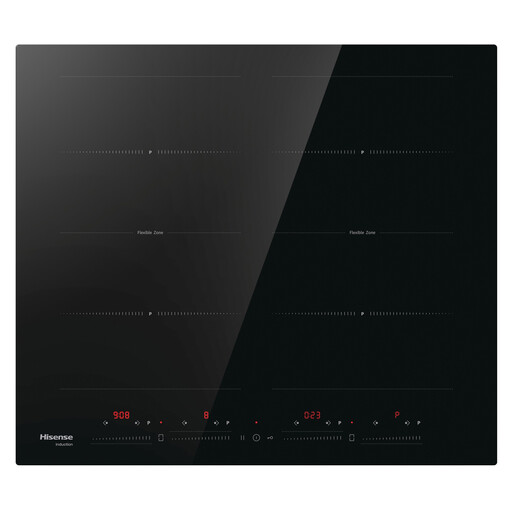 No image available
Consider this layout if you sometimes use larger cookware alongside your saucepan for leeks.
Check the installation instructions for the cut-out, connection and electrical load before choosing it. The listed controls alone do not establish how steadily it holds a gentle simmer.
 No image available
The flexible bridge is relevant if a large or long pan is part of your regular dinner-party cooking.
Allow for the stated 744 × 494 mm cut-out and confirm the connection requirements with the installation instructions. Its listed power settings do not establish gentle-simmer performance.
 No image available
This is a 60 cm option to consider when your usual dinner-party pans do not call for a shared bridge area.
Check the exact cut-out diagram and whether the hardwired installation suits your kitchen. Do not use the number of power settings as proof of a steady simmer.
 No image available
The four-zone layout is worth considering if separate pans for leeks and other dishes are your priority.
Compare the stated 560 × 490 mm cut-out with your worktop and confirm the electrical load for its hardwired installation. Listed power levels do not establish simmer stability.
 No image available
Consider this conventional four-zone layout if your regular pans each fit on an individual zone.
Check the stated 560 × 490 mm cut-out and have the 6000 W load and 32 A fuse requirement assessed against the installation instructions. Confirm the connection type before ordering.
They will work if their bases are induction-compatible. Which? says induction cookware needs an iron-based base, so check your saucepan for leeks and any larger pans you plan to keep using.
A bridge zone helps accommodate larger or longer cookware, rather than improving a sauce cooked in an ordinary saucepan by itself. For leeks, focus on controls that let you adjust that saucepan while other dishes cook.
Check the replacement hob's connection and electrical load before ordering. AEG specifies its IKX84443CB as hardwired with a 7,200 W load; Electrical Safety First advises reviewing power requirements and consulting a qualified electrician if you are unsure.
The applicable requirements depend on where the hob is installed and what work is needed. In England, GOV.UK's Approved Document P provides guidance on electrical safety in dwellings; ask a qualified local electrician to assess your installation and the requirements that apply to it.