
24/7 Customer Support

Free returns

Same-day & Next-day Delivery

Quality Guaranteed

Unlock Your Welcome Offers: FREE Delivery | Up to 80% OFF | Free 30-day JoyPlus trial
Download the APP
Replacing a cooker, adding an extra cooking surface or fitting out a rental kitchen involves more than choosing the lowest-priced induction hob. Product listings often highlight wattage and a sleek glass finish while leaving out details that affect compatibility, installation and everyday convenience.
Three common buying pitfalls are worth avoiding:
For a standard kitchen replacement, a 60cm hob commonly fits a worktop cut-out close to 560mm wide by 490mm deep, but measurements vary between models. Always compare the listed cut-out dimensions with your worktop and cabinet layout rather than relying on the product’s headline width.
The Ciarra four-zone induction model measures 590 × 520 × 62mm and specifies a 560 × 490mm cut-out. Its listed rated fuse is 32A, while the CDA four-zone ceramic model specifies a 30A hard-wired connection. These figures indicate that a qualified electrician should assess the circuit and install the appliance in line with the manufacturer’s instructions and applicable UK electrical requirements.
A compact 29cm model can be more suitable for a small kitchen, studio flat or additional cooking area. The Ciarra two-zone ceramic hob requires a 260 × 490mm cut-out and has a listed 16A fuse.
An induction hob heats a compatible pan through electromagnetic technology. The glass surface itself does not operate like a traditional radiant ring, although it can become hot from contact with the pan. Automatic pan detection is useful because the zone can stop heating when suitable cookware is removed.
A ceramic hob uses radiant heating elements beneath the glass. It works with a wider range of flat-based cookware, including many aluminium and non-magnetic pans, but the surface can remain hot after use. Residual-heat indicators are therefore important.
An electric hob with ceramic glass can be practical when you do not want to replace your cookware. Induction can offer responsive control and reduced heat around the pan, but compatibility should be checked before ordering.
A touch-control hob gives a flat, wipeable surface, while rotary controls can be easier to identify by touch and may be positioned away from the front edge. Look for features that solve a real household problem:
An easy-clean glass hob is simpler to wipe when spills are dealt with after the surface has cooled. Avoid abrasive cleaners and do not use a cracked glass appliance.
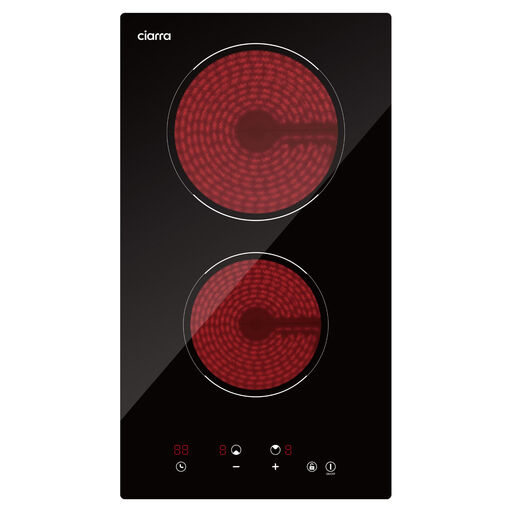
Why This Fits Their Persona: A compact built-in option for a small UK kitchen, flat, annexe or rental upgrade where two cooking zones are sufficient.
Its ceramic heating works with a broad range of cookware, avoiding the need to replace non-magnetic pans for induction compatibility.
Two zones, 2,900W total power, nine power levels, timer, child lock and residual-heat indicator.
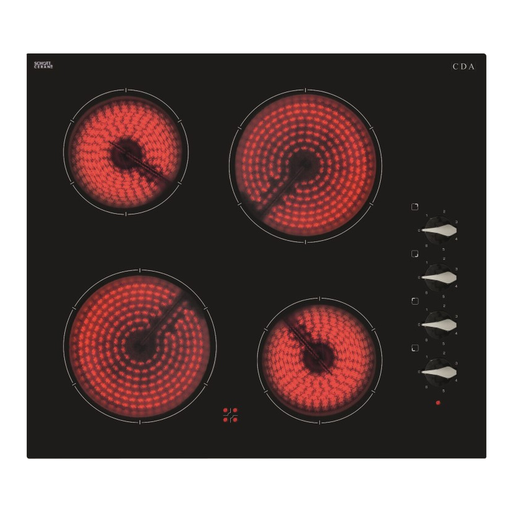
Why This Fits Their Persona: A frameless black glass design for a kitchen renovation where four zones and conventional cookware compatibility matter.
The listed cut-out is approximately 560 × 490mm, and its safety details include residual-heat indicators and a temperature limiter.
Four zones, side-mounted rotary controls, shatter-resistant ceramic glass and a 6.0kW rated electrical load.

Why This Fits Their Persona: Suitable for households needing four induction zones for regular multi-pan cooking and a standard-width built-in layout.
Its specifications clearly state pan diameter ranges, nine power levels and a 32A rated fuse, making cookware and installation checks more straightforward.
Four zones, individual 99-minute timers, automatic pan detection, child lock and automatic safety switch-off.

Why This Fits Their Persona: A portable choice for students, renters, offices, caravan use or households needing occasional extra cooking capacity.
The listing states an 8-level power range, 12–26cm cookware guidance, no-pot detection and a three-hour timer instead of relying only on a wattage headline.
100–2,000W adjustment, 60–270°C temperature range, seven preset functions and a 44.5mm-thick portable body.
We have compiled a complete, real-time list of products that fully satisfy these strict selection criteria and UK safety regulations.
Running cost depends on electricity tariff, cooking time, pan size and how efficiently heat reaches the food. Induction transfers heat directly to compatible cookware, while ceramic heating elements warm beneath the glass first. This can make induction responsive, but a like-for-like household saving cannot be guaranteed.
Built-in installation should not be treated as a simple plug-in task. Check the voltage, rated fuse, cable requirements, worktop cut-out and ventilation instructions. A qualified electrician should assess and connect the appliance safely.
Lifespan varies with build quality, installation, frequency of use and care. Avoid impacts, abrasive cleaning products and blocked ventilation. Using the correct cookware and following the manufacturer’s instructions can help preserve the glass surface and controls.