For stewed pears alongside a family meal, start with an induction hob that has usable low-power controls, a timer and enough zones for your other pans. A conventional 60 cm four-zone layout suits ordinary saucepans if it fits the worktop; consider a flex or bridge zone when wider or unusually shaped cookware makes fixed zones restrictive. Check your pans, the exact cut-out and the electrical and ventilation requirements before ordering.
Who this choice matters to
Low-and-slow dessert cooks
If you regularly simmer pears, compotes or sauces, you need controls that make small heat adjustments straightforward. A timer is worth checking on the exact model; a rapid-heating function does not answer the low-heat question.
One-hob family-meal cooks
When the pears occupy a zone while other dishes cook, the spacing and arrangement of your pans matter as much as the zone count. Check whether your usual cookware fits the layout at the same time.
Kitchen-refit buyers
A replacement has to work with the existing pans, worktop opening, ventilation space and electrical connection. Measure and check the installation instructions for the exact hob rather than relying on its advertised width.
What to check before choosing
Decide how many pans you need to use together, then compare low-heat controls and confirm which layouts your kitchen can accommodate. A wider hob or flexible zone is useful only if your cookware and installation make use of it.
| Concern |
What to check |
Who this matters to |
| Gentle simmering |
Compare the low-power controls and timer on the exact model; do not use boost power as a proxy for simmer control. |
If I regularly cook pears or sauces, I need to adjust the heat without relying on rapid boiling. Around 36% of consumers would put gentle simmering first. |
| Room for other dishes |
Check zone count and spacing against the pans you use together; consider a flex or bridge area for wider cookware. |
With one saucepan occupied by pears, I still need practical space for the rest of dinner. Roughly 36% of consumers would prioritise simultaneous cooking space. |
| Cookware and installation |
Test pan bases with a magnet, then check the model’s cut-out, ventilation and electrical connection requirements. |
If I am replacing a built-in hob, my pans and kitchen opening could determine which model I can use. Around 28% of consumers would make compatibility their primary concern. |
Buying mistakes to avoid
-
Assuming existing pans will work on induction
NEFF advises that induction cookware needs a base attracted by a magnet and sized appropriately for the cooking zone. A familiar saucepan is not necessarily a suitable one.
Test the base of the pan you use for pears and compare its diameter with the hob’s zone guidance before choosing a model.
Unsuitable pans may need replacing before you can use them on the new hob.
-
Treating a wider bridge hob as a direct 60 cm replacement
AEG lists a 750 × 490 mm built-in cut-out, hardwired-only connection and 7,200 W total electrical loading for its 80 cm TO84IB00FB. Those requirements matter even if its joined cooking area suits your pans.
Measure the worktop opening and have the proposed electrical connection assessed before ordering a wider model.
Changing the opening may require worktop alterations as well as electrical installation work.
-
Choosing boost power instead of usable low-heat controls
Boost is a rapid-heating feature, whereas pears need a gentler setting once the liquid is hot. Its presence does not establish how a hob behaves at low power.
Compare the adjustment controls and timer on the exact model, and check whether its lowest settings suit the way you simmer.
-
Overlooking ventilation and glass care
Bosch advises checking model-specific installation instructions. Siemens also cautions that rough-bottomed pans and abrasive cleaners can scratch standard ceramic glass.
Follow the chosen hob’s ventilation instructions, lift rather than drag rough pans, and use non-abrasive cleaning methods.
Relevant brands and model lines
These named models illustrate different layouts and installation considerations; a feature on one model should not be assumed to apply across its brand.
Bosch
A reference point for a conventional 60 cm, four-zone layout with touch controls.
- Bosch lists four zones, 592 × 522 mm dimensions, TouchControl and PowerBoost for the PUE611BB5E.
- The PUE611BB5E has a ring-zone layout rather than a flex or bridge cooking area.
AEG
A reference point for a wider hob with a joined cooking area.
- AEG states that the Bridge function on the 80 cm TO84IB00FB joins two zones for larger cookware.
- That model requires a wider cut-out and a hardwired connection; AEG lists its total electrical loading as 7,200 W.
NEFF
A reference point for a 60 cm hob with a flexible cooking zone.
- NEFF lists four zones, a flex induction cooking zone and an Extended Frying Sensor for the T66FHE4L0.
- Check whether those model-specific functions match your cookware and routine rather than assuming they improve a gentle pear simmer.
Siemens
A reference for comparing induction formats and model-specific flexible-zone or sensor options.
- Siemens describes 60 cm, 80 cm and 90 cm induction formats in its UK range; available functions vary by model.
- Its glass-care guidance cautions against rough-bottomed pans and abrasive cleaners, even for a smooth cooking surface.
Joybuy hobs for this cooking task
These built-in induction hobs cover conventional four-zone layouts, a wider bridge-zone layout and a compact two-zone option. Choose by the pans and dishes you cook together, then confirm that the exact hob fits your kitchen and provides the low-heat control you need.
 No image available
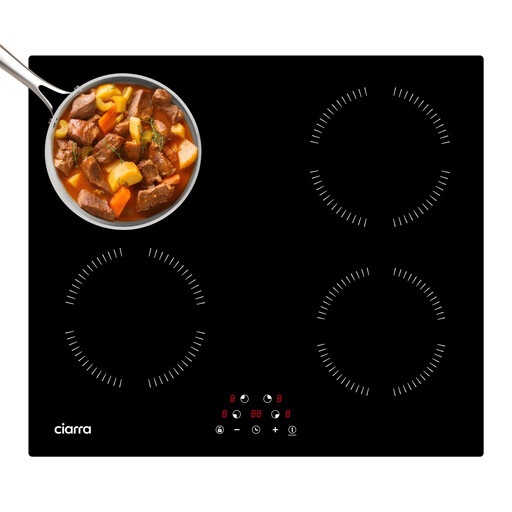
Ciarra built-in 60 cm four-zone induction hob
Consider this conventional four-zone layout if the pears need one pan while you prepare other dishes.
Check its low-heat controls, timer, worktop fit, ventilation and electrical requirements against your cooking routine and kitchen.
View on Joybuy
 No image available
Bosch PIE631BB5E Series 4 60 cm induction hob
This built-in model is an option to assess if a 60 cm layout suits your family-meal pans.
It has a black-glass finish and is described as hardwired. Confirm the cut-out, ventilation and electrical suitability, and check its lowest heat settings for stewed pears.
View on Joybuy
 No image available
Belling IHL773 BLK 77 cm four-zone induction hob
Its flexible bridge is worth considering if wider cookware must share the hob with the saucepan of pears.
The product name specifies four zones, touch controls and boost mode. Check the worktop opening, ventilation and electrical connection, as well as low-heat control for simmering.
View on Joybuy
 No image available
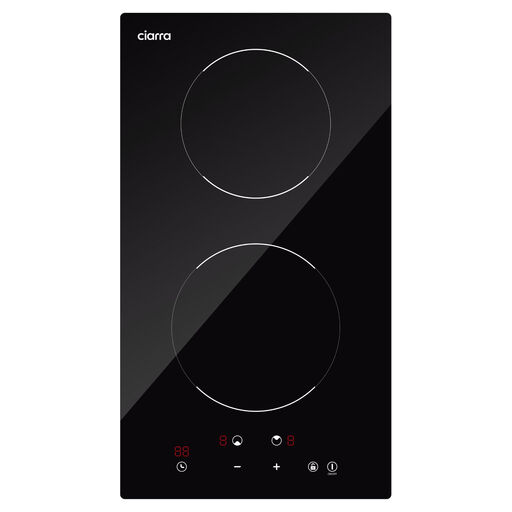
CIARRA CBBIH292T 29 cm two-zone induction hob
Consider this compact layout if you only need to cook the pears alongside one other pan; two zones leave less room for a larger family meal.
The product name specifies 2900 W, nine power levels, a timer, touch controls and a child safety lock. Check the cut-out and electrical requirements, and whether its low settings suit your simmer.
View on Joybuy
Common questions
Will my saucepan work on an induction hob?
It should have a base attracted by a magnet and sized to suit the cooking zone. NEFF recommends checking induction cookware this way, so test the saucepan you actually use for pears before choosing a hob.
Does PowerBoost help with stewed pears?
PowerBoost is for faster initial heating, not a substitute for controllable low heat once the pears are simmering. Compare the exact model’s lower settings and timer rather than choosing on boost alone.
Do I need a bridge or flex zone for a family meal?
Not if your usual saucepans fit comfortably on a conventional four-zone layout. A bridge or flex area becomes relevant when you regularly use wider or unusually shaped cookware; check the function and usable layout on the exact model.
What should I measure before replacing a built-in hob?
Measure the worktop cut-out, not just the visible width of the existing hob. Bosch advises using the exact model’s installation instructions for dimensions and ventilation; also confirm its electrical connection requirements before ordering.
Does the same electrical-installation guidance apply throughout the UK?
Do not apply England-specific guidance to every UK installation. GOV.UK describes Approved Document P as electrical-safety building-regulation guidance for dwellings in England; confirm the applicable local requirements before work begins elsewhere.


