Regular compote makers
If you often reduce berries with sugar and juice, you need to lower the heat promptly, keep the simmer manageable and leave yourself time to stir and watch the texture.


Choose an induction hob with low settings you can adjust easily and a zone that suits your magnetic compote saucepan. A compact hob can suit small batches, while a wider layout may help when several pans are in use; check the installation requirements either way. Do not assume a boiling sensor can manage sugary fruit mixtures without checking the exact model’s instructions.
If you often reduce berries with sugar and juice, you need to lower the heat promptly, keep the simmer manageable and leave yourself time to stir and watch the texture.
If compote is an occasional part of everyday cooking, a straightforward hob may be enough. Worktop fit, electrical connection and whether your existing saucepan works on induction can decide the purchase.
If you make larger quantities or use other pans while the fruit reduces, consider the zone layout, the space for your cookware and whether separate timers would help you keep track.
For berry compote, start with adjustable heat and a compatible saucepan. Then check whether the hob fits your kitchen and the way you use other pans.
| Concern | What to check | Who this matters to |
|---|---|---|
| Gentle simmering | Check how readily you can select and change low power settings. Consider a timer as a reminder to check the pan, not a measure of compote thickness. | When berries release their juice, I want to turn the heat down and stir before the mixture catches. Around 36% of consumers put controllable low heat first. |
| Pan and installation fit | Check the saucepan’s magnetic, flat base against the model’s permitted diameters; also confirm the cut-out and electrical connection. | I want to keep using my saucepan without ordering a hob that will not fit my worktop or electrical setup. Around 29% of consumers make compatibility their primary concern. |
| Zone layout | Compare your pan bases and the number of pans you use at once with the actual zone layout. Consider bridge or flexible zones only if that layout helps. | If I make a larger batch while cooking something else, I need space for both pans. Around 21% of consumers put cooking layout first. |
| Spills and shared use | Look for relevant control locks or residual-heat indicators, and follow the model’s instructions for sugary spills. | In a shared kitchen, I want clear warnings about a hot surface and a way to deal with sticky splashes safely. Around 14% of consumers prioritise safer use and cleanup. |
Boost helps bring a pan up to heat, but you still need control when reducing the fruit. Which? assesses simmering separately in its hob testing.
Check how you select a lower setting and whether the controls are clear enough to adjust while you stir.
Induction needs a magnetic pan base, and the hob’s permitted pan sizes matter for the zone you intend to use.
Test the base with a magnet, check that it is flat and compare its diameter with the exact model’s instructions.
Changing to induction may also mean using a different saucepan if your current one is unsuitable.
Connection requirements vary: AEG lists a UK-moulded-plug connection for the IBX64200CB, while its NII84B10AB is a hardwired model. Neither connection type establishes that a particular kitchen is ready for installation.
Check the appliance specification, worktop cut-out and existing electrical arrangement before ordering; seek competent installation advice for the proposed work.
A different connection or cut-out may require electrical or worktop alterations.
Sugary residue needs particular care on a glass hob. Electrolux advises against abrasive cleaners and gives specific instructions for removing food containing sugar.
Follow your model’s cleaning instructions promptly, taking care to avoid burns around a hot pan or surface.
AEG’s cited models offer different installation and cooking layouts: the 590 mm, four-zone IBX64200CB has a UK moulded plug, while the 800 mm NII84B10AB is hardwired and lists bridge zones and individual timers.
The cited 60 cm PUE611BB5B is a four-zone induction hob for buyers considering a plug-in installation route and touch controls.
The cited T68FHV4L0 is an 80 cm, five-zone model with a flex-induction zone for buyers who need more choice in pan placement.
These choices cover two built-in layouts and a portable single-zone cooker for making compote. Choose by saucepan fit, the space available and how many other pans you need to use—not by assuming that the listed settings have been tested with sugary fruit.
 Image unavailable
Consider this layout if you make compote alongside other dishes and have space for a built-in four-zone hob.
The product title specifies a 60 cm format and four zones. Check the cut-out, electrical requirements and your saucepan’s permitted diameter for this model before ordering; adjust and stir the compote yourself.
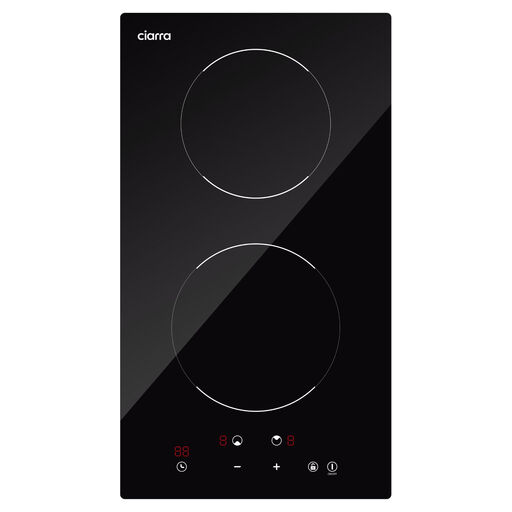 Image unavailable
Consider the narrower built-in layout if two zones meet your cooking needs and worktop space is limited.
The product title lists 2900 W, touch control, nine power levels, a timer and a child lock. Confirm the cut-out, electrical connection and permitted saucepan diameter; the listed controls do not establish how this model simmers compote.
 Image unavailable
Consider a portable single-zone cooker if you need a separate place to make a small batch rather than a built-in replacement.
The product title lists 2000 W, eight power levels, a 60–270°C temperature setting range, a timer of up to three hours and suitable cookware diameters of 12–26 cm. Confirm the operating and power-connection instructions for your intended location, and supervise the fruit as it reduces.
It needs a magnetic, flat base that fits the chosen model’s permitted cookware diameters. Check whether a magnet holds to the base, then compare its size with the instructions for the zone you plan to use.
Do not rely on one to manage a sugary fruit mixture unless the exact model’s instructions expressly support that use. AEG says SenseBoil reduces detected boiling to a simmer, but its support guidance describes operation with water or water with potatoes. Otherwise, watch the pan, stir and adjust the heat manually.
The connection depends on the exact hob and your kitchen installation. AEG lists a UK moulded plug and 3000 W total loading for the IBX64200CB, whereas the NII84B10AB is listed as hardwired with 7350 W total loading. Check the appliance requirements and get competent advice before changing an electrical installation.
For electrical work in dwellings in England, GOV.UK’s Approved Document P provides guidance on electrical safety and when work must be notified. Check how your proposed work is treated with a competent electrician or local building control; requirements elsewhere in the UK may differ.
Follow the cleaning instructions for your exact hob while taking care to avoid burns. Electrolux advises against abrasive cleaners and scouring pads, and its ceramic-glass guidance calls for prompt removal of sugar and food containing sugar.