For lemon curd, choose a portable induction hob with a documented low manual setting and controls you can adjust while whisking, rather than choosing by maximum wattage alone. Waitrose & Partners calls for very gentle heat and continual whisking at the start of its recipe. Check that your saucepan fits the exact hob, that you have room to use and store it, and that the kitchen permits the appliance and has a suitable electrical supply.
Who this is for
Gentle-heat lemon-curd makers
If you whisk egg-based lemon curd over gentle heat, a documented low setting matters more to your starting point than a high maximum output. Waitrose & Partners specifies very gentle heat and continual whisking at the start of its recipe.
Space-limited shared-kitchen users
If the hob must be put away after use, compare its dimensions with both the available worktop and storage space. Tefal lists its Everyday Slim IH210840 as 45mm thick, while Judge gives dimensions of 31cm by 27cm by 5cm for the JEA90.
Shared-socket safety checkers
If other appliances use the same socket or extension lead, check their combined load and the lead’s marked rating before use. Electrical Safety First also advises against connecting one extension lead to another.
What to check before buying
Start with heat control for the curd, then check whether the hob fits the shared space and whether your pan and electrical arrangement are suitable. A listed power setting describes a control option, not the temperature your particular pan will reach.
| Concern |
What to check |
Who this matters to |
| Gentle, adjustable heat |
Look for a stated manual power range and controls you can adjust while whisking; test the lowest setting with your intended compatible pan. |
I need to start gently and adjust the heat without stopping the whisking. Around 42% of consumers put controllable heat first. |
| Shared-space fit |
Compare the hob’s external dimensions with the available worktop and cupboard space, allowing a suitable place to use it. |
When counter and cupboard space are tight, I need a cooking zone I can put away after use. Roughly 33% of consumers prioritise storage and shared-counter space. |
| Cookware and electrical use |
Check that the pan’s flat magnetic base meets the exact model’s requirements, and compare the combined appliance load with any extension lead’s marked rating. |
I need my saucepan to work without overloading the electrical arrangement we share. Around 25% of consumers make cookware and electrical checks their main concern. |
Common buying mistakes
-
Choosing by maximum wattage alone
A high maximum output does not tell you how gently a hob can begin. Waitrose & Partners calls for very gentle heat and continual whisking when the butter is melting; Tefal and VonShef list different minimum manual settings for their portable models.
Compare the documented low settings, then try the lowest setting with water in your intended induction-compatible pan before making a full batch.
-
Measuring the saucepan’s rim instead of its base
A rim measurement does not establish whether the part of the pan that sits on the hob meets its cookware requirements. Tefal specifies a 12cm–25cm base for the Everyday IH201840 and a 12cm–26cm pan range for the Everyday Slim IH210840.
Check that the pan base is magnetic, measure its flat base and compare it with the requirements for the exact hob model.
If the pan is unsuitable, you may need a different induction-compatible saucepan.
-
Treating a shared extension lead as an extra unrestricted socket
Other connected appliances add to the load. Electrical Safety First advises against exceeding an extension lead’s marked current rating, using a cable reel wound when its full rating is needed, or connecting extension leads together.
Use a suitable wall socket where possible. If an extension is necessary, check its rating against the combined load and follow the reel’s instructions.
-
Skipping the plug and cable check
An Office for Product Safety and Standards report identified a serious fire risk involving a non-conforming fuse link in the plug of a specific induction cooker. That finding does not describe every portable hob.
Inspect the plug, lead and appliance before use, and stop using the unit if any part is damaged or behaves abnormally.
Portable induction brands to consider
Tefal
Tefal’s Everyday models provide documented manual power ranges and pan-size guidance. The Everyday Slim IH210840 is listed as 45mm thick.
- Tefal lists a 300W–2100W manual range, timer and pause function for the Everyday Slim IH210840.
- Tefal’s portable-induction user guide describes domestic household use and excludes staff kitchen areas in workplaces from its stated use and guarantee coverage. Check the instructions for the exact model before using one in a workplace kitchen.
VonShef
VonShef lists a single portable hob with 10 manual power settings from 200W to 2000W.
- Its listed controls include a timer and temperature settings from 60°C to 240°C.
- Check the manual’s pan-base requirements against your saucepan before buying; a low listed power setting alone does not establish how the pan will heat.
Judge
Judge’s JEA90 offers temperature selection in a portable unit measuring 31cm by 27cm by 5cm.
- Judge lists 10 selectable temperatures from 60°C to 240°C.
- If a low manual wattage setting is important for your curd, check the JEA90 manual and try its lowest setting with your intended pan; a selected temperature is not a measured pan temperature.
Portable hob on Joybuy
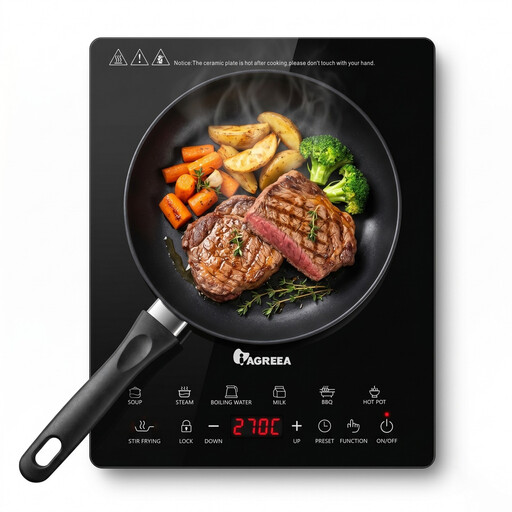
This portable single-zone induction hob has adjustable controls relevant to starting lemon curd gently. Check its exact cookware requirements, plug and cable, and your shared kitchen’s appliance rules before deciding whether it suits your setup.
 No image available
IAGREEA DF200-14V10 2000W black glass induction hob
Consider this portable hob if you want adjustable controls while whisking lemon curd; its listed settings do not establish how evenly your saucepan will heat, so stay with the pan and test a gentle start before making a full batch.
The product title lists eight power levels, temperature control from 60°C to 270°C, a three-hour timer, seven preset functions and a child safety lock. It lists suitability for 12–26cm cookware; confirm how that measurement applies to your pan base. Check the plug details and appliance instructions, as well as the shared kitchen’s socket arrangement and rules, before use.
View on Joybuy
Frequently asked questions
What matters most when making lemon curd on an induction hob?
Choose controls that let you begin gently and adjust the heat while whisking. Waitrose & Partners instructs cooks to heat very gently and whisk continuously until the butter has melted; a hob’s maximum wattage does not tell you how its lowest setting will behave with your pan.
Will my existing saucepan work on a portable induction hob?
It needs an induction-compatible magnetic base that meets the exact hob’s size requirements. Tefal specifies a 12cm–25cm base for the Everyday IH201840 and a 12cm–26cm pan range for the Everyday Slim IH210840, so measure the flat base rather than relying on the rim diameter.
Can I use a 2000W or 2200W hob with a shared extension lead?
Check the extension lead or reel’s marked rating and the combined load of everything connected before using it. Electrical Safety First puts a single socket’s maximum at about 3000W or 13A, advises against daisy-chaining extension leads, and says a cable reel must be fully unwound to carry its full rated load.
Do I need to register if I make lemon curd to sell?
If you are starting or taking over a food business, the Food Standards Agency says to register with your local authority at least 28 days before trading or food operations begin. Making curd privately for yourself or housemates is a different situation from making it as a food business.


