One-pot holiday-cottage cooks
If pumpkin soup is the only dish needing a hob, a portable single zone can be put away between uses. Tefal UK and Judge both describe single-zone models relevant to this setup.


For one pot of pumpkin soup, a portable single-zone induction hob is a practical choice if the cottage has a suitable socket, space to use it safely and a compatible pot. Choose more than one zone when another pan regularly needs heat at the same time; a built-in hob also requires a suitable worktop and electrical installation. Whatever the format, check the model’s pan requirements and supervise cooking.
If pumpkin soup is the only dish needing a hob, a portable single zone can be put away between uses. Tefal UK and Judge both describe single-zone models relevant to this setup.
Hosts supplying a hob for guests need to consider the electrical setup, appliance instructions and supervised use. Electrical Safety First gives guidance on socket loading and kitchen appliance safety; Home Office fire-safety guidance addresses small paying-guest accommodation.
If soup and another dish need heat simultaneously, compare two-zone and built-in multi-zone options rather than assuming a single portable zone will cover the meal.
Choose when: One compatible stockpot is all you need to heat, and the hob must be stored after use.
Trade-off: It cannot heat a second pan while the soup cooks.
Choose when: A second pan regularly needs heat but you are considering a worktop-based setup.
Trade-off: It needs more space; check the particular model’s connection and fitting instructions. Judge describes its double induction hob as worktop-insertable.
Choose when: A cottage owner is equipping a kitchen for meals that routinely use several pans.
Trade-off: Worktop fit and electrical installation become part of the decision; it is not a portable solution for a visitor.
| Concern | What to check | Who this matters to |
|---|---|---|
| One-pot control and portability | Look for adjustable heat or a suitable soup setting, and check that the permitted pan diameter fits your stockpot. | If I am cooking just one pot and putting the hob away afterwards, I need manageable heat without giving up permanent worktop space; around 50% of consumers put one-pot control and portability first. |
| Electrical and guest safety | Check the hob’s rating, socket and lead condition, and any extension lead’s marked rating; confirm the owner’s arrangements for its use. | When I supply a hob for guests, I want a setup that supports clear instructions and supervised cooking; roughly 33% of consumers prioritise electrical and guest safety. |
| Multi-pan capacity | Decide whether another pan needs heat at the same time, then check the space and fitting requirements of the format you choose. | If soup shares the meal with food cooking in another pan, I need to heat both at once; about 17% of consumers put multi-pan capacity first. |
An induction hob needs suitable magnetic cookware. Judge’s JEA90 instructions also rule out pans with a base under 12 cm.
Check the pot’s base with a magnet where appropriate, then compare its diameter with the instructions for the exact hob.
A different soup pot may be needed if the existing one is unsuitable.
A single zone can cook the soup, but cannot simultaneously heat another pan for onions, an accompaniment or a second dish.
Plan the whole meal before deciding whether the smaller setup is enough.
Electrical Safety First warns that overloaded leads and cable reels can overheat, and that their current ratings vary.
Prefer a suitable wall socket. If a lead is unavoidable, check its marked rating and the total connected load, do not daisy-chain leads, and follow the cable reel’s instructions.
A preset or timer does not remove the risk of a pot boiling dry. Electrical Safety First advises against leaving electrical appliances on and unattended.
Stay nearby, lower the heat for simmering and check the pot periodically; use a timer as a reminder, not a substitute for supervision.
Tefal UK lists single-zone tabletop options for compact or supplementary cooking, including the IH201840 and IH210840.
Judge lists the single-zone JEA90 as well as a double induction-hob option for kitchens needing another zone.
Daewoo Electricals identifies the SDA1805 as a 2000 W single induction hob in its instruction-manual listing.
These choices cover a portable hob for one-pot cooking and a built-in two-zone hob for a cottage kitchen where another pan needs heat. The built-in model is an installation decision, not a portable substitute.
 No image available
A portable choice when one pot of soup is the main cooking task.
Rated 2000 W, with ten power settings, six functions and a safety lock.
Check that your pot has a magnetic base and fits the permitted diameter in the model instructions. Confirm a suitable cottage socket and stay nearby while cooking.
 No image available
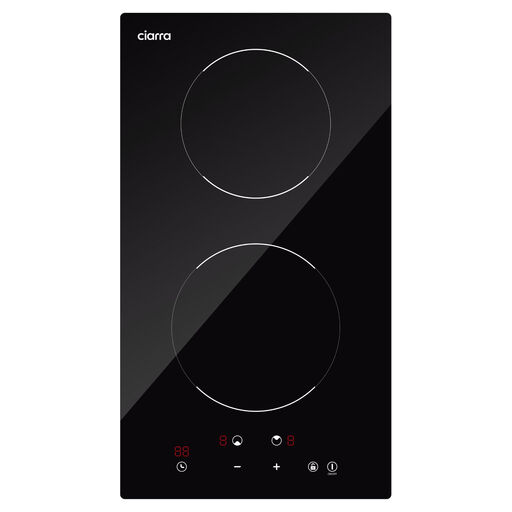
A built-in option for a cottage kitchen where soup and another pan need heat at the same time.
Rated 2900 W, with nine power levels, a timer and a child safety lock.
Before installation, confirm the worktop cut-out, ventilation and electrical connection requirements, as well as magnetic-pan fit for each zone.
It will work only if its base is suitable for induction and its size falls within the hob’s permitted range. Judge’s JEA90 instructions exclude bases under 12 cm; check the instructions for the exact model you intend to use, because pan-size requirements differ.
Only use a lead whose marked rating accommodates the hob and everything else connected to it; a suitable wall socket is preferable. Electrical Safety First warns that extension-lead ratings vary and advises against daisy-chaining them. Check the cottage’s electrical setup before using a high-power hob.
No. Automatic shut-off does not replace supervision: Electrical Safety First advises against leaving electrical appliances on and unattended. Stay nearby and check the pot as the soup simmers.
Check that the appliance, electrical setup and instructions suit the property and its guests. For small paying-guest accommodation within its scope, Home Office fire-safety guidance, updated 20 January 2025, addresses the responsible person’s duties; the arrangements needed depend on the premises.