Frequent batch blanchers
If you repeatedly heat a large saucepan of water, check how its base fits the intended zone before comparing rapid-boil functions.


For repeated batches of green vegetables, start with your largest saucepan: its magnetic base must suit the cooking zone you plan to use. If getting water back to the boil quickly matters, compare rapid-boil functions on that zone. A plug-in hob may suit a simpler replacement, while hardwired or flexible-zone models offer different layouts but call for model-specific checks of the worktop, ventilation and electrical connection.
If you repeatedly heat a large saucepan of water, check how its base fits the intended zone before comparing rapid-boil functions.
If you want to limit changes to an existing kitchen, compare the exact cut-out, connection type and ventilation instructions rather than relying on the hob’s nominal width.
If an oval pan or a wider cookware layout matters to you, consider bridge or flex zones alongside the worktop space and electrical installation they require.
For batch blanching, establish that your saucepan will work on the intended zone, then weigh faster boiling against the installation changes your kitchen can accommodate.
| Concern | What to check | Who this matters to |
|---|---|---|
| Saucepan and zone fit | Test the pan base with a magnet and compare its base diameter, not its rim, with the intended cooking zone. | If my largest blanching pan cannot be detected or does not suit the zone, the hob will not meet my main cooking need. Around 42% of consumers would put pan and zone fit first. |
| Boil turnaround | Check whether the exact model has a boost function on the zone you will use and read its operating limits. | When I cook several batches, I want the water to return to the boil promptly after adding vegetables. Roughly 33% of consumers would make heating turnaround their primary concern. |
| Kitchen and electrical fit | Compare the required cut-out and ventilation instructions with your kitchen, and confirm whether the model is plug-in or hardwired. | If I am replacing an existing hob, fitting the worktop and electrical setup may determine which model I can choose. For about 25% of consumers, installation fit would take priority. |
Two hobs of similar overall width can have different cooking zones. NEFF advises that induction cookware needs a ferromagnetic base suited to the zone size.
Measure the base of your largest blanching pan, check that a magnet sticks to it and compare it with the zone you intend to use.
Bosch lists the PUG61RAA5B as Plug & Play, whereas AEG lists the SO64IA0SCB and IKX84443CB as hardwired only. The connection affects installation planning.
Confirm the exact model’s connection type before ordering. Electrical Safety First recommends a registered electrician for installation or repair work.
A bridge or flex zone can help with certain pan shapes and placements, but it does not remove the need for a magnetic base that suits the cooking area.
Compare a round stockpot with a suitably sized circular zone first; consider bridge or flex functions if your cookware layout calls for them.
Cut-out and ventilation requirements vary by model and by the cabinet arrangement beneath it, according to Bosch’s installation guidance.
Read the exact installation drawing before purchase, particularly if a drawer or oven sits below the hob.
The 60 cm PUG61RAA5B illustrates a plug-in route for a conventional saucepan.
Its cited models illustrate a choice between a conventional four-zone layout and a wider bridge-zone layout.
The T56TT60N0 is relevant when flexible cookware placement matters during batch cooking.
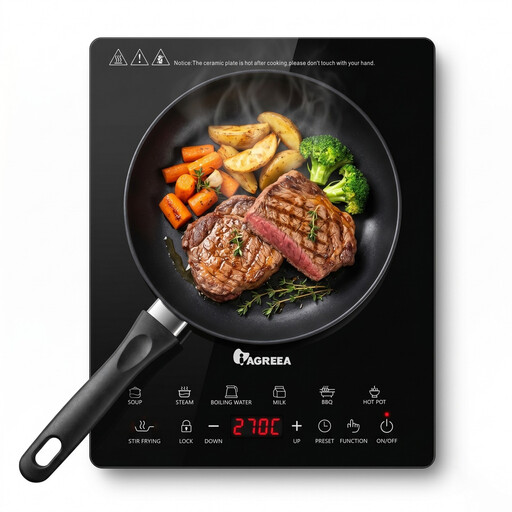
This portable induction cooker is an option for blanching with a compatible saucepan rather than a built-in hob replacement. Check its pan fit and electrical connection for your kitchen.
 No image available
Consider this portable cooker if your blanching saucepan has a magnetic base within its stated 12–26 cm suitable-cookware range; confirm that the base also suits the cooking zone.
The product name lists eight power levels, seven preset functions and a three-hour timer. Check the electrical connection before buying, and do not rely on a particular boil-recovery time without checking how it performs for your pan and batch size.
It needs a ferromagnetic base that suits the intended cooking zone. NEFF recommends checking whether a magnet sticks to the base and comparing the base diameter, rather than the rim diameter, with the zone.
A boost function is worth comparing if prompt reheating between batches is important to you. Check that the exact model offers it on the zone suited to your saucepan, and read any operating limits; the function cannot compensate for an incompatible pan.
Not necessarily: a round pot may suit one appropriately sized circular zone. AEG’s IKX84443CB combines zones through its Bridge function, while NEFF lists flex zones on the T56TT60N0; consider those layouts if your cookware shape or placement calls for them.
Only if the exact model and your kitchen’s electrical setup permit that installation route. Bosch lists the PUG61RAA5B as Plug & Play, but the cited AEG models are hardwired only. Electrical Safety First recommends a registered electrician for installation work. In England, GOV.UK’s Approved Document P covers electrical safety in dwellings; check the applicable requirements for your location and installation.
Measure the existing worktop cut-out and check the cabinet space beneath it against the exact model’s installation drawing. Bosch notes that hob dimensions, installation methods and ventilation requirements vary by model.