
24/7 Customer Support

Free returns

Same-day & Next-day Delivery

Quality Guaranteed

Unlock Your Welcome Offers: FREE Delivery | Up to 80% OFF | Free 30-day JoyPlus trial
Download the APP
Replacing a hob can improve everyday cooking, but the wrong choice may create expensive installation problems, limited cooking space or cookware compatibility issues. Marketing descriptions often focus on power boosts and stylish glass surfaces while leaving out details that matter more in a real UK kitchen.
Before choosing among induction hobs, check the installation requirements, electrical load, cooking-zone layout and control system. A suitable model should match both your kitchen worktop and the way you prepare meals.
A 60cm induction hob may measure around 590–600mm wide, but the required worktop opening can vary. Some models need a cut-out close to 560mm × 490mm, while compact hobs have different dimensions. Always compare the appliance dimensions and cut-out size with your existing worktop before ordering.
Built-in installation also involves ventilation, clearances and electrical connection requirements. Hard-wired appliances should be installed by a suitably qualified electrician in line with the manufacturer’s instructions and applicable UK requirements.
A four-zone hob is not automatically practical for four large pans. Standard circular zones may leave oversized cookware unsupported or heat unevenly. If you regularly use griddles, roasting pans or large stockpots, look for a flexible cooking zone hob that can combine areas.
Conversely, a two-zone induction hob may be more suitable for a flat, studio, garden room or smaller kitchen where worktop space is limited.
Power figures and boost functions can indicate available heating capacity, but they do not describe how the hob manages multiple zones at once. Check whether the boost function has a time limit, how many zones can use it together and whether the controls allow accurate simmering.
Convenience features also need careful comparison. A touch control hob may be easy to wipe clean, while rotary dials can be more familiar and usable for shoppers who prefer physical controls.
Choose between a built-in induction hob, a portable induction hob or another type of electric hob according to your property and intended use.
Check the rated power, fuse or connection information before purchase. A qualified installer can advise whether your existing circuit is suitable.
Induction heats compatible magnetic cookware directly, so aluminium, copper and some stainless-steel pans may not work unless they have a ferromagnetic base. A simple magnet test can provide an initial indication, but always follow the appliance manual.
Match pan diameter to the marked zone. For family cooking, four-zone induction hobs provide space for several pans, while a flexible area can make batch cooking more convenient. Portable models often specify a cookware range; one example supports magnetic pans measuring 12–26cm in diameter.
Useful features include:
A black glass hob is straightforward to wipe after it has cooled, but avoid abrasive cleaners, harsh scouring pads and placing heavy items on the surface. Do not use a hob with cracked glass.
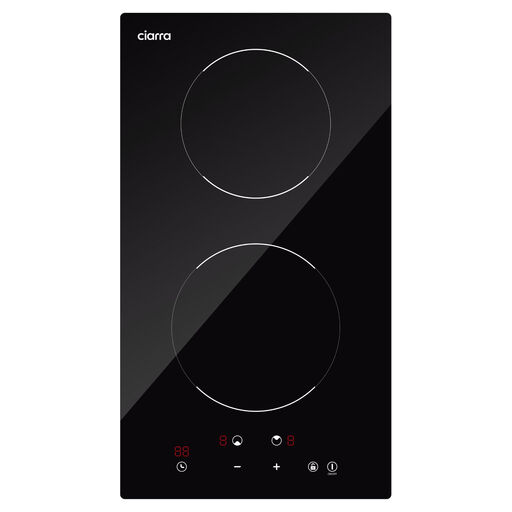
Why This Fits Their Persona: Its compact 29cm format suits smaller UK kitchens, flats or worktops where a full-width hob would take up unnecessary space.
The two-zone layout avoids paying for unused cooking capacity, while its stated 260mm × 490mm cut-out dimensions make planning more precise.
Offers 2,900W total power, nine power levels, a timer, touch controls and a child lock.

Why This Fits Their Persona: A 60cm built-in format with four zones suits kitchen renovations and households wanting detailed control for regular multi-pan cooking.
The specification lists 17 power levels, individual zone timers and a 7.4kW connected load, giving clearer information than a vague “fast heating” statement.
Includes PowerBoost, QuickStart, ReStart, child lock and two-stage residual heat indicators.
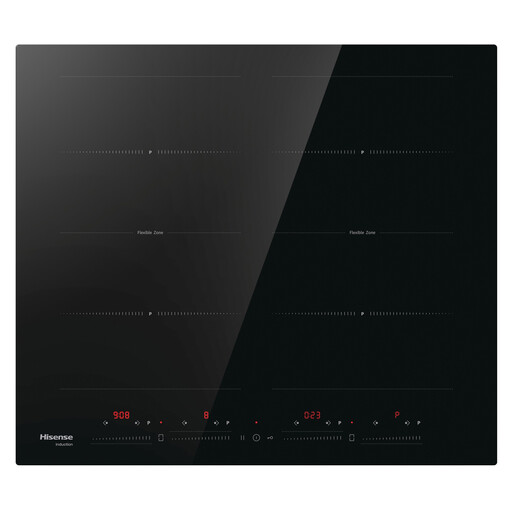
Why This Fits Their Persona: Four zones and Area Flex are practical for family meals, large cookware, griddles and batch cooking.
Area Flex combines two zones for larger cookware, while Rapid Boil is specified to reduce to a low simmer after five minutes rather than running indefinitely at boost power.
Provides four individual slider controls, Heat Shift, an integrated timer, child lock and residual heat indicators.
A portable induction hob can be useful in rented accommodation, a home with limited cooking capacity or when an additional zone is needed for entertaining. The IAGREEA DF200-14V10 offers 2,000W, eight power levels, a 60–270°C temperature range, a three-hour timer and cookware compatibility from 12–26cm. Its 44.5mm thickness is also relevant where storage space is limited.
The ochama 2,000W portable induction cooker provides 10 heat settings, six preset functions, touch controls and a child lock. Portable units should sit on a stable, heat-resistant surface with ventilation openings unobstructed. They should not be moved while operating, and the surface may remain hot after use.
We have compiled a complete, real-time list of products that fully satisfy these strict selection criteria and UK safety regulations.
Induction transfers heat directly to compatible cookware, which can reduce wasted heat during cooking. Actual running cost depends on the appliance’s power, cooking time, electricity tariff, pan size and selected setting. Compare the rated power and your typical usage rather than relying only on general efficiency statements.
Possibly. Test existing pans with a magnet on the base. If it sticks firmly and the base is flat, the pan may be suitable, but the hob’s instructions remain the reference point. Aluminium, glass and non-magnetic stainless steel cookware generally will not operate correctly without a magnetic base.
Lifespan varies with construction, installation, frequency of use and maintenance. Follow the cleaning and ventilation instructions, avoid impacts to the glass and arrange professional installation for hard-wired models. Check the warranty period and the availability of manufacturer support before buying.