Family multi-pan cooks
If soup shares the hob with rice, vegetables or another pan, compare usable zone count and spacing. Four zones are useful only if your pans can sit on them together.


For a family red lentil soup meal, choose a four-zone built-in induction hob if your soup pot and side-dish pans fit its layout; consider bridge or flex zones when a wide pot needs a different cooking area. An 80 cm hob can provide more room for several pans, but check its cut-out, electrical requirements and your cookware before buying.
If soup shares the hob with rice, vegetables or another pan, compare usable zone count and spacing. Four zones are useful only if your pans can sit on them together.
If you use a wide stockpot or casserole, measure its base against the cooking-zone diagram. A bridge, combi or flex area may help where one standard zone is a poor match.
Check your existing pans for magnetic bases, then compare the proposed built-in hob with your worktop opening and electrical installation.
Choose when: A round soup pot and the other pans you normally use fit the zone layout.
Trade-off: Several large pans may crowd a conventional layout.
Choose when: Your wide or long cookware suits the model’s combined cooking area.
Trade-off: Joined zones do not add physical space around neighbouring pans.
Choose when: You regularly need a soup pot and several side-dish pans on the hob together.
Trade-off: The wider appliance needs a suitable worktop opening and electrical installation.
| Concern | What to check | Who this matters to |
|---|---|---|
| Room for several pans | Compare the bases of the pans used together with the exact zone diagram and spacing. | If soup is simmering while I cook rice and vegetables, I need those pans to fit at the same time. Roughly 33% of consumers put simultaneous cooking space first. |
| Fit for a wide soup pot | Measure the pot base and check the model’s bridge, combi or flex-zone layout. | With a broad stockpot, I want a cooking area that suits its base without assuming any joined zones will fit. Wide-pot flexibility is the primary need for around 25% of consumers. |
| Control from boil to simmer | Check how lower power levels and timers work; treat boost as an initial-heating feature. | Once my lentils reach the boil, I need to turn the heat down and keep track of the cooking time. About 25% of consumers place simmer control first. |
| Cookware and installation fit | Test pan bases with a magnet; check the cut-out, clearances and electrical instructions. | Before replacing my hob, I need to know whether my pans, worktop and electrical supply suit it. For roughly 17% of consumers, compatibility is the deciding concern. |
A hob described as 80 cm wide is not necessarily a straightforward replacement for a 60 cm model. Built-in openings vary: AEG specifies a 750 × 490 mm cut-out for its NIK85M00AZ.
Compare the exact installation drawing with your worktop opening, cabinet and ventilation space before ordering.
A different opening may mean altering the worktop.
Non-magnetic aluminium or copper cookware needs a suitable magnetic base to work on an induction hob.
Check the underside of each regularly used pan with a magnet and compare its base with the hob’s zone guidance.
Unsuitable pans would need replacing if you switch to induction.
Bridge and combi functions depend on the exact positions of the joined zones and the shape of the cookware base.
Measure your pot base and review the model’s zone diagram before choosing this feature.
Connection requirements differ by model. Bosch describes its PUG61RAA5B as Plug & Play, while AEG lists the five-zone NIK85M00AZ as hardwired only, with a 7,200 W total electrical loading.
Read the exact hob’s electrical and installation instructions and discuss your property’s supply with a competent installer.
Bosch has model-specific options worth comparing when choosing between conventional zones and a combined cooking area.
AEG lists 60 cm Bridge and wider 80 cm MultiBridge or FlexiBridge models relevant to large cookware and multi-pan meals.
Selected NEFF models offer flexible zone arrangements for cooks comparing different pan sizes and positions.
The HIA64UK is a conventional four-zone model to compare when a round soup pot and side-dish pans fit a standard layout.
These built-in four-zone induction hobs are choices to compare for cooking soup alongside other dishes. Check each model’s pan layout and fitting requirements against your kitchen; the 77 cm Belling model also names a flexible bridge area.
 No image available
Consider this wider hob if you use several pans and want to assess a flexible bridge area for larger cookware.
The title lists four zones, touch controls and boost mode. Compare the bridge layout with your pot base and the installation drawing with your worktop.
 No image available
This conventional four-zone layout is worth checking if your soup pot and side-dish pans have room on separate zones.
Confirm the pan layout, connection method and installation requirements for your kitchen.
 No image available
Compare this model if a 60 cm built-in hob suits the space you have for family-meal cooking.
The product title specifies a hardwired connection. Have a competent installer check the electrical requirements, and compare the installation drawing and zone layout with your kitchen and pans.
 No image available
This four-zone model is a comparison point when soup and side dishes need separate cooking positions.
Check that your pan bases fit the zones, then confirm the required electrical supply and fitting instructions before ordering.
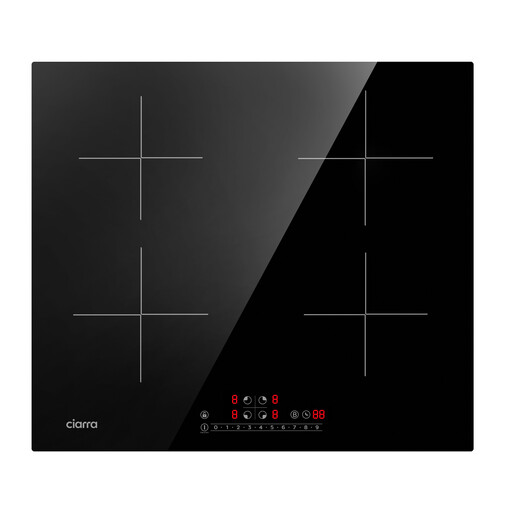 No image available
Compare this model if you want four cooking positions and selectable heat levels for moving soup from the boil to a simmer.
The title also lists touch controls and a booster function. Check the zone layout against your pans and confirm the connection requirements before purchase.
It will need a suitable magnetic base. General guidance suggests checking whether a magnet sticks firmly to the underside; non-magnetic aluminium or copper pans need a suitable magnetic induction base. Check the hob’s guidance for your pot’s base size too.
Not if your round soup pot fits a standard zone and the other pans still have room. Consider a bridge, combi or flex area when your cookware base suits the joined-zone layout better than a single zone; check the dimensions on the exact model.
No: use a boost function, where available, for initial heating rather than as a substitute for a lower simmer setting. Reduce the power when the soup reaches the boil, and follow your recipe and the hob’s controls for the cooking stage.
Do not assume the existing connection suits a new hob. Check its installation instructions and ask a competent installer to assess the supply and the work involved. In England, GOV.UK’s Approved Document P provides guidance on electrical safety in dwellings; requirements elsewhere in the UK must be checked for the relevant nation.